
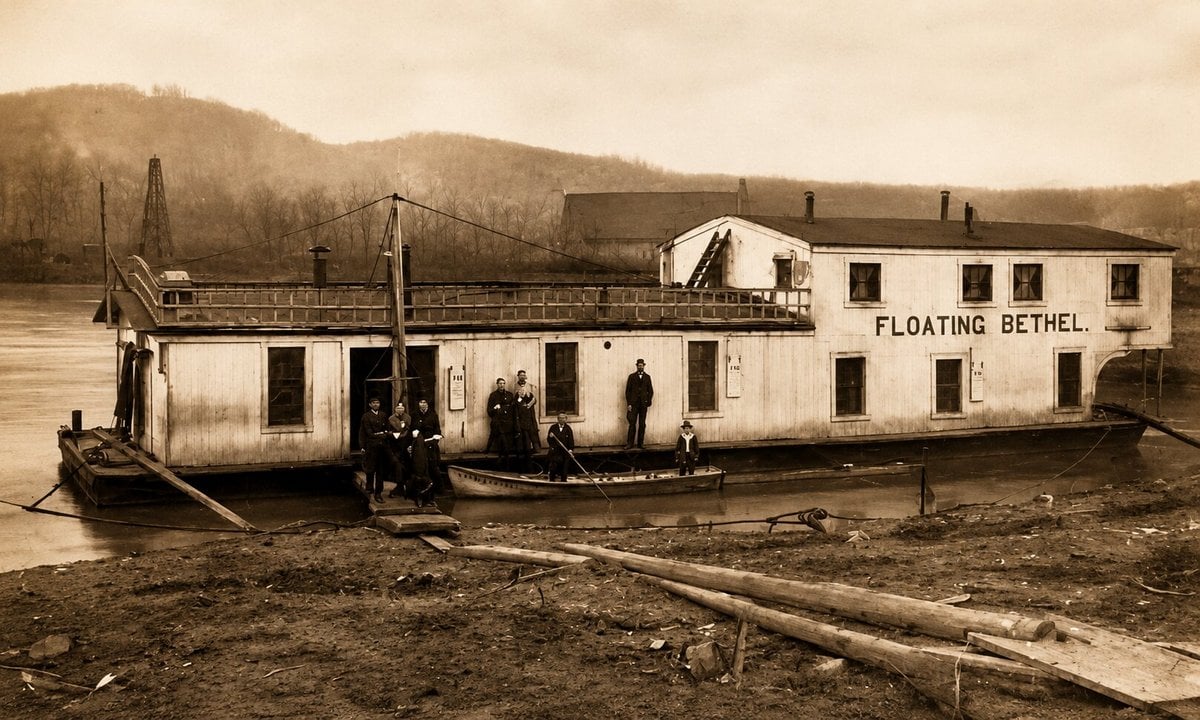
MOUNDSVILLE, W.Va. — In the 1890s, an unusual vessel began traveling the Ohio River, stopping at towns in Ohio, Pennsylvania, and West Virginia.

It had no engine or rudder and was steered by enormous oars. When it reached a community, evangelists climbed onto the roof and sang to draw residents to religious services inside.
Known as The Floating Bethel, the converted barge served as a traveling church for members of a young Christian movement that rejected denominational divisions and sought to restore the unity they believed characterized the New Testament church.
The Floating Bethel would become an unusual part of the early history of the Church of God, now commonly identified as the Church of God (Anderson, Indiana). Its journey also preceded an important chapter in West Virginia religious history, when Moundsville became a publishing and missionary center for the growing movement.
A church built on a barge
The Floating Bethel was primarily associated with evangelist George T. Clayton, who planned to use the Ohio River to hold religious meetings in communities along both banks.
An early history of the movement says Clayton acquired a boat measuring about 26 by 80 feet and fitted it with living quarters and a meeting hall. He planned to tie up at towns along the river, hold meetings for a time, and then continue downstream.
Jim Comstock’s West Virginia Heritage Encyclopedia, published in 1976, offers a particularly vivid account of the vessel and the missionaries who lived aboard it. Comstock described the Bethel as a chapel built on a salvaged barge, with living quarters and enough room to accommodate hundreds of worshippers.
Because the vessel lacked a rudder, large oars at either end were used to steer it. When the evangelists arrived in a community, singers gathered on the roof to attract attention before inviting people aboard for services.

Travel aboard the Bethel could be difficult. Comstock recounted episodes in which high water forced crew members to stay awake and use poles to keep the vessel from being driven against the riverbank.
The missionaries relied partly on donations for food, which could produce a peculiar diet. A.T. Rowe, who traveled aboard the Bethel, later recalled that applesauce and onions seemed particularly abundant because people along the river frequently donated them.
The Floating Bethel was more than a curiosity. A history of the movement records that Clayton intended to stop at towns on each side of the Ohio and hold meetings, while contemporary editions of the Gospel Trumpet, the movement’s newspaper, documented the activities of its traveling evangelists.
A movement against denominational divisions
The people aboard the Floating Bethel belonged to a religious movement associated with Daniel Sidney Warner, an Ohio-born evangelist who had broken with the Church of God movement led by John Winebrenner.
Warner and his followers rejected denominational divisions among Christians and opposed using creeds to test church membership. They emphasized holiness, Christian unity, and a return to what they understood as the church described in the New Testament.
Their opposition to sectarianism would remain central to the movement’s identity. Years later, when its newspaper was printed in West Virginia, the Gospel Trumpet prominently described itself as both “RADICAL” and “ANTI-SECTARIAN.”
The Ohio River provided evangelists with a ready-made missionary route. In the late 19th century, communities along the river were connected commercially and socially despite lying in three different states. The Bethel could simply move from one community to another, carrying its meeting place and missionaries with it.
According to Comstock, congregations were established on both sides of the river between Pittsburgh and Moundsville during the evangelistic campaign.
Moundsville becomes a center of the movement
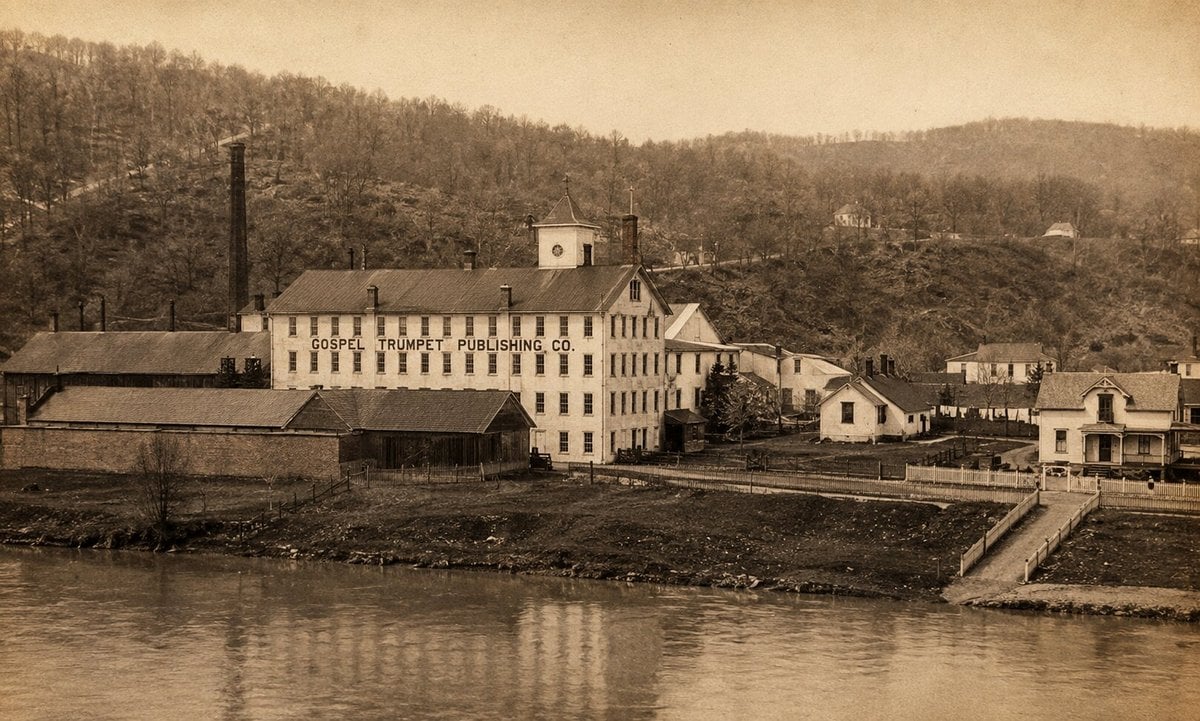
The Church of God’s connection with West Virginia became much more substantial in 1898, when the Gospel Trumpet publishing operation moved from Grand Junction, Michigan, to Moundsville.
Warner founded the newspaper in 1881, and it moved several times in its early years. It was published in Indiana, Ohio, and Michigan before relocating to Moundsville in July 1898.
The relocation was a major undertaking. According to a 1925 Church of God yearbook, a special train left Grand Junction on June 28, 1898, carrying the entire publishing operation and its workers. Nine freight cars carried equipment, while two passenger coaches and a baggage car completed the train.
It reached Moundsville the following evening. The yearbook says the city would remain home to the publishing work for eight years.
Church of God historical records indicate that the publishing work had already grown considerably before the move. By 1898, more than 90 workers and their families were associated with the operation when Moundsville was being considered as its new home.
The move placed a national religious publishing operation in a West Virginia town on the Ohio River. From Moundsville, the Gospel Trumpet carried sermons, theological arguments, missionary reports, testimonies, reports of divine healing, marriages, obituaries, and news from religious workers in the United States and abroad.
A religious publishing center in West Virginia
Surviving copies of the Gospel Trumpet provide direct evidence of the scale and character of the Moundsville operation.
A July 6, 1899, issue identifies the newspaper as published by the Gospel Trumpet Publishing Company in Moundsville. By 1902, the publishing house was installing a Linotype machine to greatly increase its ability to set type.
The Jan. 2, 1902, edition reported that the machine had just arrived and would soon be operating in the type room. Supporters had donated $318.05 toward its purchase, including a $100 contribution.
The Moundsville community included more than printers and editors. Comstock described a massive three-story workers’ home measuring 148 by 168 feet, with 104 rooms and a chapel. Workers could live there while participating in the publishing operation or preparing to enter missionary work.
The community operated under an unusual economic system. According to local historical research, workers received no wages, regarding their labor as service to the religious mission.
The Gospel Trumpet continued to advertise assemblies in Moundsville and report on missionaries traveling throughout the country. A 1904 issue, for example, invited readers to a Moundsville assembly scheduled for November while reporting missionary activity in Japan.
Another issue that year described a Moundsville assembly attended by religious workers who had traveled from Oregon, Florida, and Pennsylvania.
By then, Moundsville was connected through the publication to a religious network extending far beyond West Virginia.
The Floating Bethel burns
The vessel that had carried Church of God evangelists through the Ohio Valley did not survive the decade.
Comstock records that the Floating Bethel burned in Moundsville on Dec. 16, 1898, only months after the publishing operation had moved to the city. Local historical accounts say timbers salvaged from the wreck were later incorporated into two houses in Moundsville’s Park View area, though those accounts date the fire to 1899.
The date discrepancy does not obscure what followed. By the time the floating chapel disappeared, the movement had established a much more permanent presence in Moundsville through its publishing operation and community of religious workers.
The Gospel Trumpet remained there until 1906, when the operation relocated to Anderson, Indiana.
Its growth during the West Virginia years can be measured in railroad cars.
The publishing company had needed nine freight cars to move its equipment into Moundsville in 1898. When it left eight years later, 28 cars were required to transport the operation to Anderson, according to the Church of God’s 1925 yearbook.

Another reform movement along the upper Ohio
The Church of God was not the first Christian reform movement to establish a significant presence along this stretch of the Ohio River.
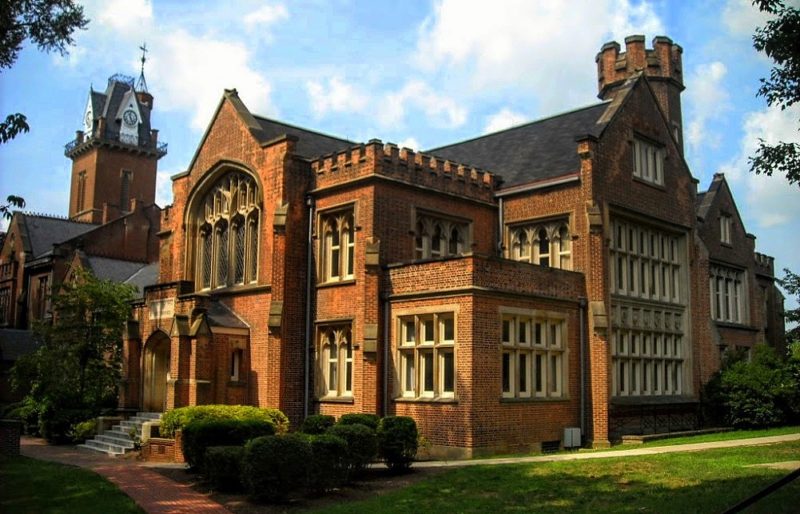
Several decades earlier, Alexander Campbell had become a principal figure in the Restoration Movement from his home at Bethany, a short distance north of Moundsville in what is now West Virginia.
Campbell’s movement differed from Warner’s Church of God in important theological and organizational respects. It also emerged generations earlier. Yet both questioned the divisions created by established denominations and called for Christian unity based on their understanding of New Testament Christianity.
Comstock, writing about the Churches of Christ, considered the state’s role significant. Although he traced the Restoration Movement’s beginning to southwestern Pennsylvania, he wrote that much of its early development occurred in what became West Virginia.
The geographic proximity is striking. Bethany, Wellsburg, and Moundsville all lie along a relatively short section of the upper Ohio Valley, where the river and later expanding road and railroad networks allowed people, publications, and ideas to move readily among communities in West Virginia, Pennsylvania, and Ohio.
The reasons this corridor proved important to two separate Christian reform movements, generations apart, deserve further study. For the Church of God, however, the movement’s surviving publications and institutional histories document Moundsville’s importance.
The West Virginia years
The Church of God ultimately established its principal institutional center at Anderson, where Anderson University and the Church of God archives preserve extensive records of the movement.
Its years in Moundsville and the northern panhandle of West Virginia remain visible in those archives. Copies of the Gospel Trumpet printed more than a century ago still carry the name of the West Virginia city at the top of their pages.
The Moundsville complex itself has largely disappeared. Local historical researchers report that the principal Gospel Trumpet buildings no longer survive, though concrete stairs associated with the former workers’ home remain on the hillside near Greenwood Cemetery.
Comstock reported in 1976 that 112 Church of God congregations were operating in West Virginia, ranging from a congregation of five members to one with 453 members in South Charleston.
By then, the floating chapel that had traveled the Ohio was a distant memory. The publishing operation had been gone from Moundsville for 70 years, and Anderson had long since become the movement’s best-known institutional home.
But the scale of what happened during the West Virginia years still shows up in the record of that final move.
The religious publishing operation that arrived in Moundsville in 1898, with equipment filling nine freight cars, left eight years later, requiring 28.