
UNION, W.Va. — Fossil bones discovered in a West Virginia cave in 1796 and sent to Thomas Jefferson helped scientists identify an extinct giant, although researchers now believe the fossils came from a different cave than the one traditionally associated with the discovery.
Local tradition attributed the fossils to Organ Cave in Greenbrier County, but research more recently published by paleontologist Frederick Grady concluded they probably came from Haynes Cave in Monroe County instead.
The animal became known as Megalonyx, and its best-known species, Megalonyx jeffersonii, was named for Jefferson, who studied the fossilized bones at length at his home, Monticello, in Charlottesville, Va.
The revelation began when workers in 1796 digging nitrate-bearing soil for saltpeter encountered large bones in a limestone cave in what was then Greenbrier County, Virginia.
Col. John Stuart, known as the “Father of Greenbrier County,” obtained some of the bones and sent specimens to Jefferson, who was deeply interested in fossils and natural history. In an April 1796 letter, Stuart described remains from a “Tremendous animal of the Clawed kind” and suggested the bones might belong to an animal related to a lion.
Jefferson adopted that interpretation, describing the fossils in a 1779 letter to Benjamin Rush as those of “an animal of the lion kind, but of most exaggerated size.”
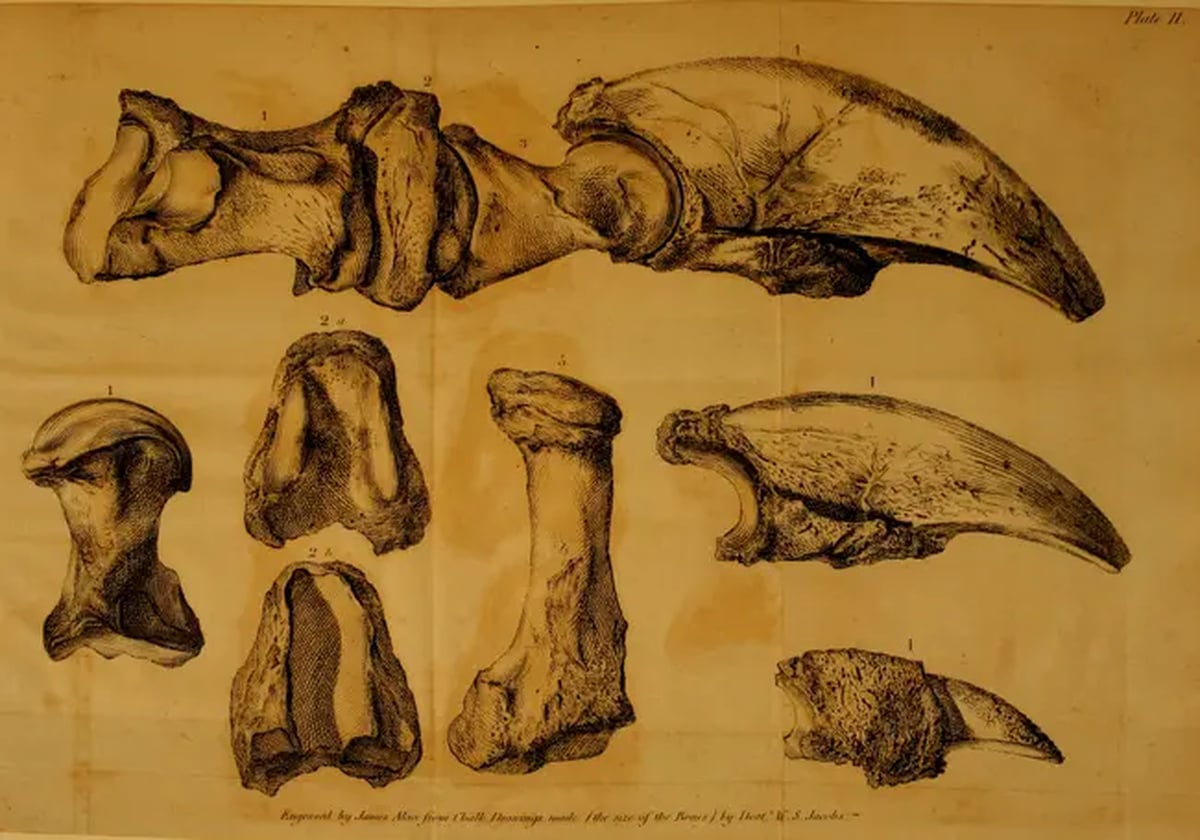
The specimens included bones from a forelimb and unusually large claws, Jefferson said, and he named the animal Megalonyx, from Greek words meaning “great claw.”
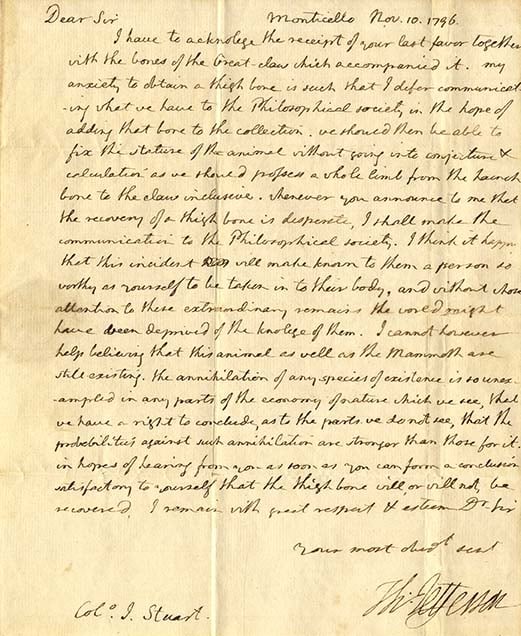
Jefferson continued corresponding with Stuart about the discovery and in November 1796 asked whether a thigh bone could be obtained, saying a complete limb would allow the animal’s size to be determined “without going into conjecture & calculation.”

But before Jefferson presented his findings to the American Philosophical Society in Philadelphia in March 1797, he encountered information about Megatherium, a large fossil sloth discovered in South America. The comparison caused him to reconsider the proposed relationship between the Virginia animal and large cats.
Jefferson’s paper was published in the Transactions of the American Philosophical Society in 1799. A paper by Philadelphia physician and anatomist Caspar Wistar accompanied it and provided a detailed anatomical description and illustrations of the fossils.
Wistar compared the bones with those of sloths, and subsequent study confirmed that Megalonyx was a ground sloth.
The American Philosophical Society describes Jefferson’s presentation as an early event in the development of vertebrate paleontology in the United States: “His lecture is widely considered the beginning of vertebrate paleontology in the United States.”
Researchers reconsidered the location
The identification of Organ Cave as the discovery site dates to at least 1928. In A History of Organ Cave Community, published that year, Blanche Humphreys wrote that Andrew Price of Marlinton had concluded during his historical research that Jefferson was referring to Organ Cave.
Humphreys said Price based his conclusion in part on Lewisburg property records he believed showed Frederic Cromer owned the farm containing the cave, but he acknowledged a problem with the identification. Jefferson placed the cave west of the Greenbrier River, while Organ Cave is east of it. She suggested Jefferson had been mistaken about the direction.
Humphreys also asserted that Jefferson had visited Organ Cave. Jefferson’s published account of the fossils, however, describes workers discovering the bones, and his correspondence shows Col. John Stuart sending him specimens. The 1928 account provides no evidence that Jefferson personally visited the cave.
Paleontologist Frederick Grady later reexamined the location using land records and historical correspondence and reached a different conclusion. His research found that Gromer had not owned Organ Cave and identified Haynes Cave in present-day Monroe County as the probable discovery site.
Grady later investigated the location using land records, correspondence involving Jefferson and Stuart, and documents concerning later ownership of the cave, and his research found that Gromer had not owned Organ Cave.
“Organ Cave … can be eliminated as it was never owned by Gromer,” Grady wrote in an account of the investigation.
The records instead led Grady to Haynes Cave near Second Creek. Correspondence involving Tristram Patton, who later owned the property, referred to the cave and additional bones discovered there, so Grady concluded that Haynes Cave was probably the source of Jefferson’s specimens.
Additional evidence came from Haynes Cave in the early 1990s, when researchers recovered two fragments of a Megalonyx shoulder blade there. The discovery established the presence of Megalonyx remains in the cave but does not independently prove that Jefferson’s specimens came from the same location.
A 2024 review of the scientific history and classification of Megalonyx said Grady had presented “cogent evidence” for the identification. The researchers listed Jefferson’s original fossils as likely coming from Haynes Cave, and the West Virginia Geological and Economic Survey also identifies Haynes Cave as a locality for Megalonyx jeffersonii remains.
The West Virginia Legislature used Monroe County rather than Organ Cave when it designated Megalonyx jeffersonii the state fossil in 2008. Its resolution states that the bones Jefferson studied were found “in a limestone cave in what is now Monroe County.”
However, the resolution contains a separate historical error. It credits Wistar with naming the animal Megalonyx jeffersonii. A 2024 review of the animal’s nomenclature found that Jefferson established the genus Megalonyx in 1799 and French naturalist Anselme-Gaëtan Desmarest introduced the species name jeffersonii in 1822.
Organ Cave remains historically significant
Organ Cave’s association with Jefferson’s fossils is separate from its documented history and includes about 40 miles of surveyed passages. Saltpeter was produced there, and the cave preserves equipment associated with that industry.
Read also: Geologic anomaly in southern West Virginia visible only from the air
Commercial tours of Organ Cave began during the 19th century, though it is now closed to tourists. Haynes Cave is also associated with historic saltpeter production.
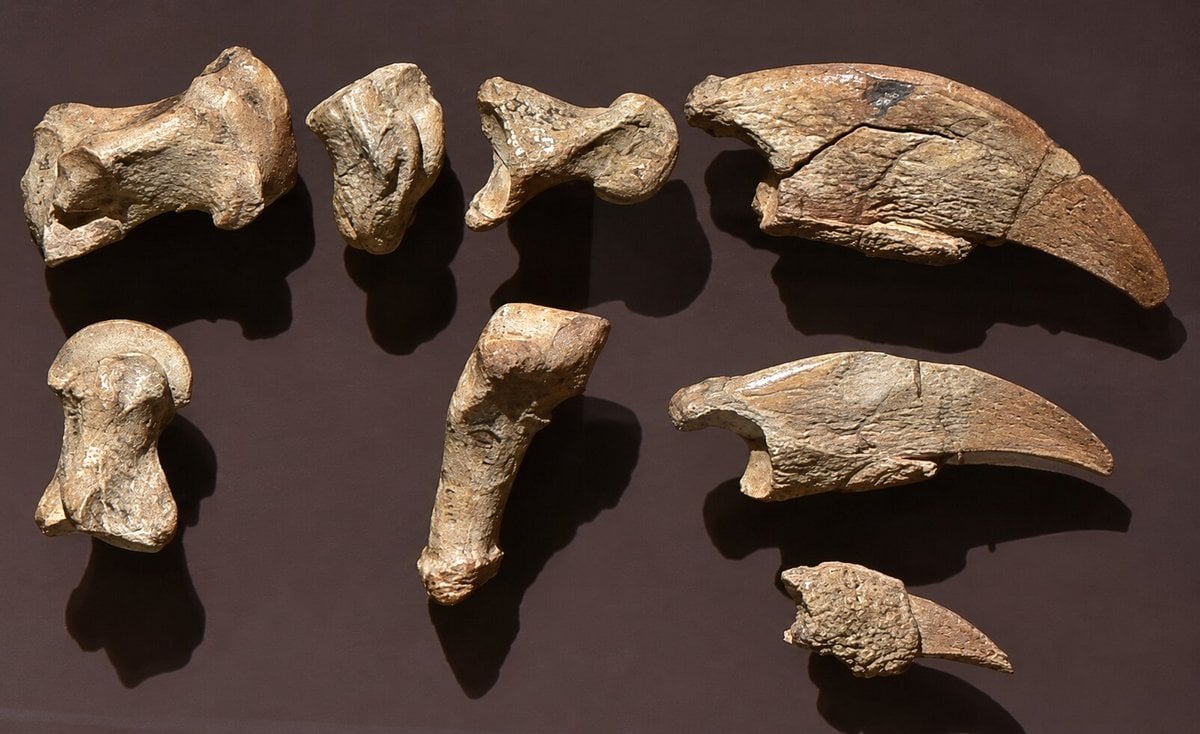
Jefferson’s original Megalonyx hand bones are preserved in the Academy of Natural Sciences of Drexel University in Philadelphia.
The West Virginia Cave Conservancy now owns and manages Haynes Cave, protecting the property and its archaeological and natural resources.