
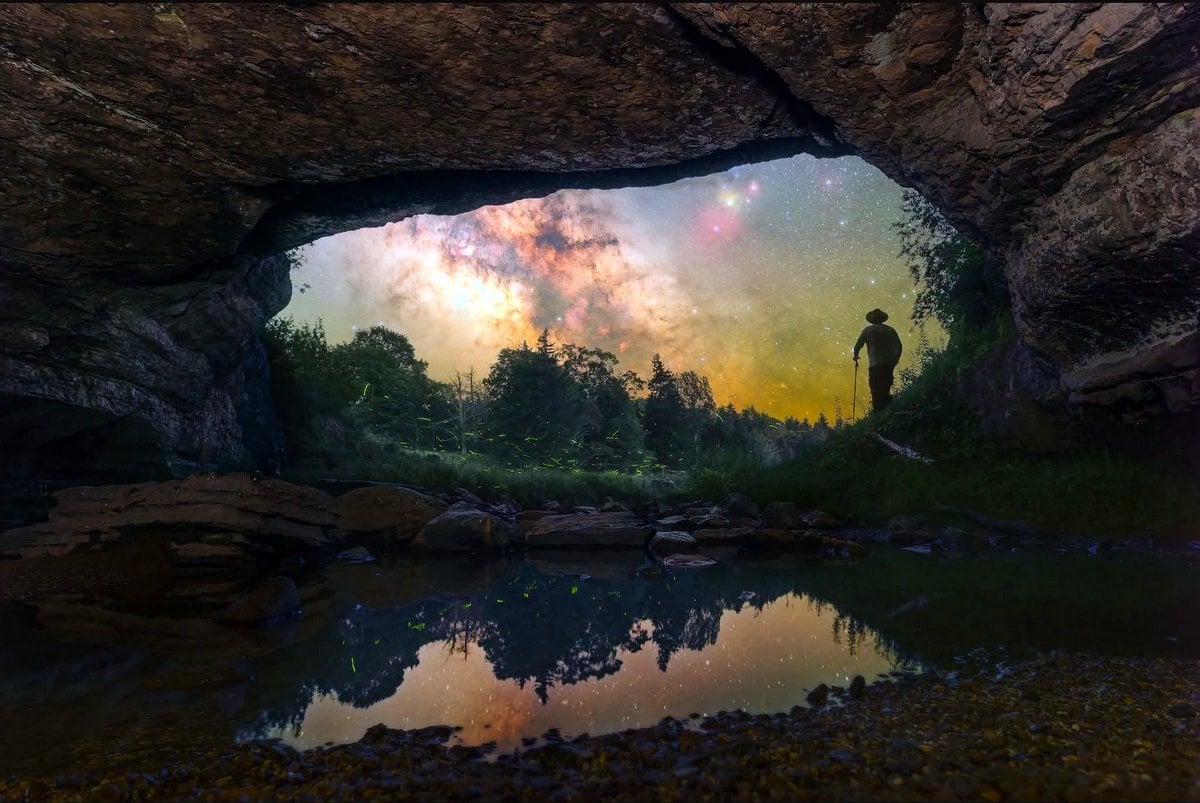
The Sinks of Gandy is one of West Virginia’s best-known cavern features, where Gandy Creek disappears beneath a limestone ridge in eastern Randolph County before emerging again downstream.

Located near the community of Osceola in the Allegheny Mountains, the sinks have long been one of West Virginia’s best-known wild caves. The West Virginia Encyclopedia says it may be the most visited wild cave in the state, although both entrances are on private property and the cave is currently off limits to the public.
Geography
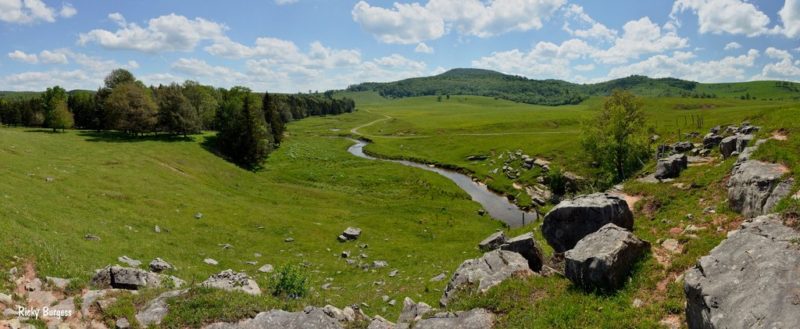
The Sinks of Gandy is located on the western flank of the Allegheny Mountains in eastern Randolph County, about 15 miles northeast of Spruce Knob. The feature lies within the upper watershed of Gandy Creek, a tributary of the Cheat River.
At the upstream “sink,” nearly the entire creek disappears into openings in the Greenbrier Limestone. Water then travels through an underground passage beneath a limestone ridge before reappearing at a broad cave mouth known as the “rise.”
The cave passage extends roughly 2,000-2,500 feet (600–760 m), depending on the route measured. Most visitors enter through one opening and exit through the other, effectively walking through the mountain along the underground stream.
Geology
The Sinks of Gandy formed within the Mississippian-age Greenbrier Limestone, which was deposited about 330 million years ago, when much of present-day West Virginia lay beneath a shallow tropical sea.
Over millions of years, slightly acidic groundwater dissolved fractures in the limestone, enlarging them into passages. As surface drainage developed, Gandy Creek captured one of these underground conduits, creating today’s disappearing stream.
The cave exhibits several classic karst features, including:
- Sinkholes
- Underground streams
- Solution passages
- Breakdown rooms
- Speleothems in isolated sections
- Seasonal flooding
Because the active stream still occupies much of the cave, the interior continues to evolve through erosion and dissolution.
Cave characteristics
Unlike decorative commercial caves, the Sinks of Gandy is primarily a stream passage. Visitors encounter:
- Flowing water throughout much of the route
- Gravel bars
- Limestone ledges
- Boulder breakdown
- High-ceilinged chambers
- Narrow passages requiring brief stooping
- Complete darkness beyond the entrances
Water depths vary from ankle-deep to waist-deep, depending on rainfall.
Historically, visitors sometimes traversed the cave from one entrance to the other, following the underground course of Gandy Creek. Both entrances are on private property, and the cave is currently off-limits to the public.
Hydrology
The underground section is one of the most dramatic examples of stream piracy in West Virginia.
During periods of normal flow, nearly all of Gandy Creek disappears underground. During heavy rain or spring snowmelt, however, the cave’s capacity may be exceeded, causing portions of the creek to continue flowing across the surface while the cave passage fills rapidly.
Water levels can rise with little warning, making flooding the cave’s greatest natural hazard.

Biology
The Sinks of Gandy supports several specialized cave-dwelling organisms adapted to permanent darkness.
Species documented in the cave include:
- Cave crickets
- Salamanders
- Various aquatic invertebrates
- Bats that periodically roost in parts of the cave
Because caves provide sensitive habitat, visitors are encouraged to avoid disturbing wildlife, especially hibernating bats.
Human history
Indigenous peoples almost certainly knew of the sinks long before European settlement, though little archaeological evidence has been documented in the active stream passage because of periodic flooding.
European-American settlers recorded the feature in the nineteenth century, and it gradually became known among hunters, loggers, and local residents. By the twentieth century, it had become one of West Virginia’s most famous wild caves, attracting generations of explorers.
Unlike many caves that require technical climbing, the Sinks offered adventurous visitors a chance to explore underground with relatively modest equipment.
Access
The Sinks of Gandy has a long history as a destination for cavers, photographers, naturalists, and other visitors, but the cave is located on private property. According to the West Virginia Encyclopedia, both entrances are on private land, and the sinks is currently off limits to the public.
Historically, visitors sometimes traversed the cave by following Gandy Creek underground. The cave can flood suddenly after rainfall because it carries the creek’s entire flow, creating a potentially serious hazard for anyone underground.
Visitors to the area should respect private-property boundaries and should not enter the cave without authorization from the property owners.
Visitors should prepare for:
- Cold water year-round (typically 50–55°F)
- Complete darkness, requiring multiple reliable light sources
- Wet, slippery footing
- Variable water depths
- Remote conditions with no cell service
Never enter the cave during or immediately after heavy rainfall, as rapidly rising water can trap visitors inside.
Although ropes are typically not required, helmets, sturdy footwear, waterproof lighting, and warm clothing are strongly recommended.
Conservation
Although surrounded by the Monongahela National Forest, the entrances to the Sinks of Gandy are located on private property. This distinction matters because surrounding national forest land does not make the cave itself public recreation land.
Like other caves in the Appalachian region, the Sinks contains a sensitive underground environment. Conservation concerns associated with caves include wildlife disturbance, damage to cave formations, litter and graffiti, and the potential spread of white-nose syndrome among bats.

Significance
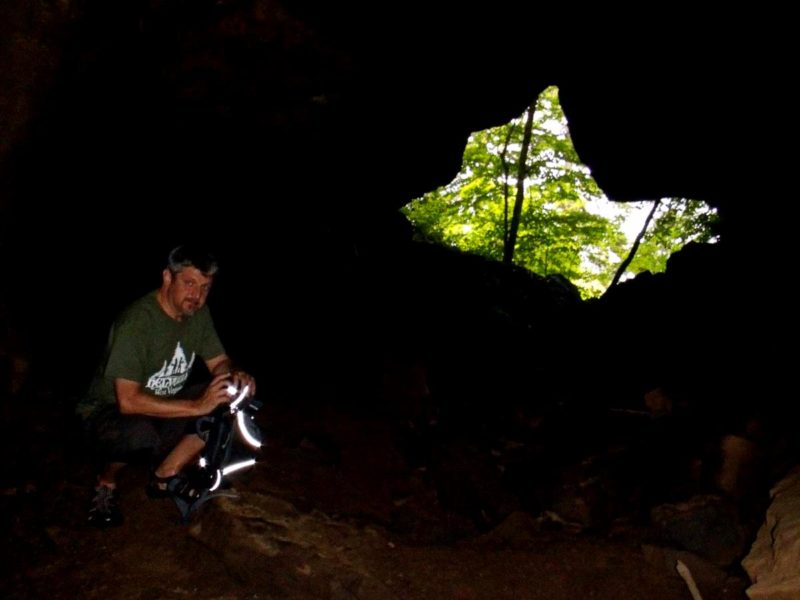
The Sinks of Gandy is one of West Virginia’s best-known examples of karst drainage. Gandy Creek disappears beneath the earth at a blind valley south of Yokum Knob and flows northeast through a large cave before emerging on the opposite side of the ridge.
The cave also occupies an unusual place in West Virginia cultural history. Writer and illustrator David Hunter Strother, using the pen name Porte Crayon, described an 1854 visit to the cave in an account published in Harper’s Magazine in 1872. His description and illustration helped introduce the Sinks of Gandy to a national audience.
Although generations of visitors have explored the cave and the West Virginia Encyclopedia describes it as possibly the state’s most visited wild cave, its entrances are on private property, and it is currently off limits to the public.