
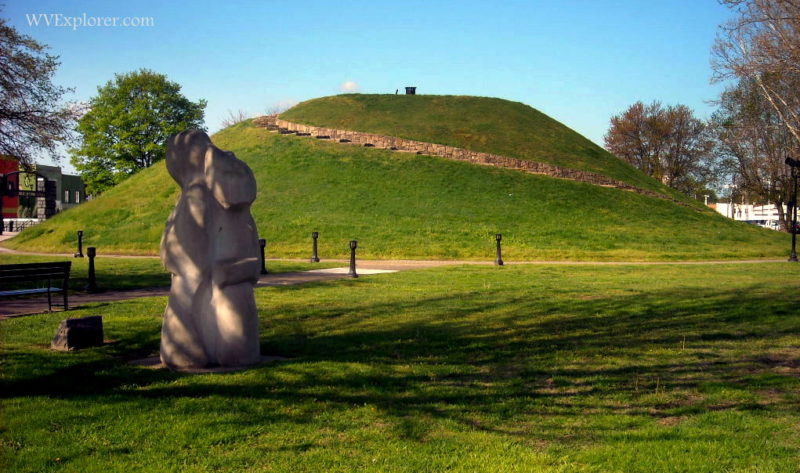
Prehistoric sites in West Virginia have long suffered neglect and destruction, chiefly due to prejudice and misunderstanding, though in recent years they have come to the forefront of heritage tourism and are now taking their rightful place as monuments that memorialize people whose existence has otherwise been lost.

Before the era of significant European influence, many native peoples lived in what is now West Virginia in large numbers, establishing settlements throughout the valley regions where agricultural endeavors were most easily carried out.
The most obvious indication of their habitation is burial mounds, many of which still dominate the landscape in the valleys of the Ohio, Kanawha, and Monongahela rivers. The Grave Creek Mound in Moundsville, Criel Mound in South Charleston, and Camden Park Mound in Huntington are among the largest and best-known examples, though hundreds of mounds may yet exist.
Though not as obvious, native residents also left a record of their habitation in the form of petroglyphs — carvings rendered in stone, many of which feature stylized images of beasts and even human figures.
Here follows a list of protected landmarks of prehistoric and protohistoric age. Others exist, but to help provide protection, we have not included them here.
- Beards Fork Petroglyphs
- Boaz Mounds
- Camden Park Mound
- Catawba Mound
- Dingess Petroglyph
- Dunbar Mound
- Grave Creek Mound
- Lynco Petroglyphs
- May Moore Mound
- McCullough Mound
- Mount Carbon Stone Walls
- Oak Mounds
- Romney Cemetery Mound
- Salt Rock Petroglyphs
- Saint Marys Mound
- South Charleston Mound
- Sunset Mound
- Panther Petroglyph
- Wildcat Branch Petroglyphs
NOTE: If you choose to visit this or any other petroglyph in West Virginia, officials at the W.Va. Division of Culture & History request that you please refrain from touching the rock. Oils in human skin can cause the rock to more quickly erode.