
RICHWOOD.. W.Va. — For generations, one of West Virginia’s most remarkable frontier stories held that a white boy born in western Virginia was captured by the Shawnee Indians, adopted their way of life, and eventually became Blue Jacket, one of the most important Native American leaders to resist U.S. expansion into the Ohio Valley.

The boy was said to be Marmaduke Van Swearingen, a member of a prominent Virginia family. According to versions of the story repeated for more than a century, he was captured while hunting with a younger brother, negotiated his brother’s release, and willingly remained with the Shawnees.
He supposedly arrived among them wearing a blue hunting shirt, from which he took his new name. In time, the story continued, the young Virginian became so thoroughly identified with his adopted people that he rose to become a Shawnee chief and ultimately commanded Native forces against the United States.
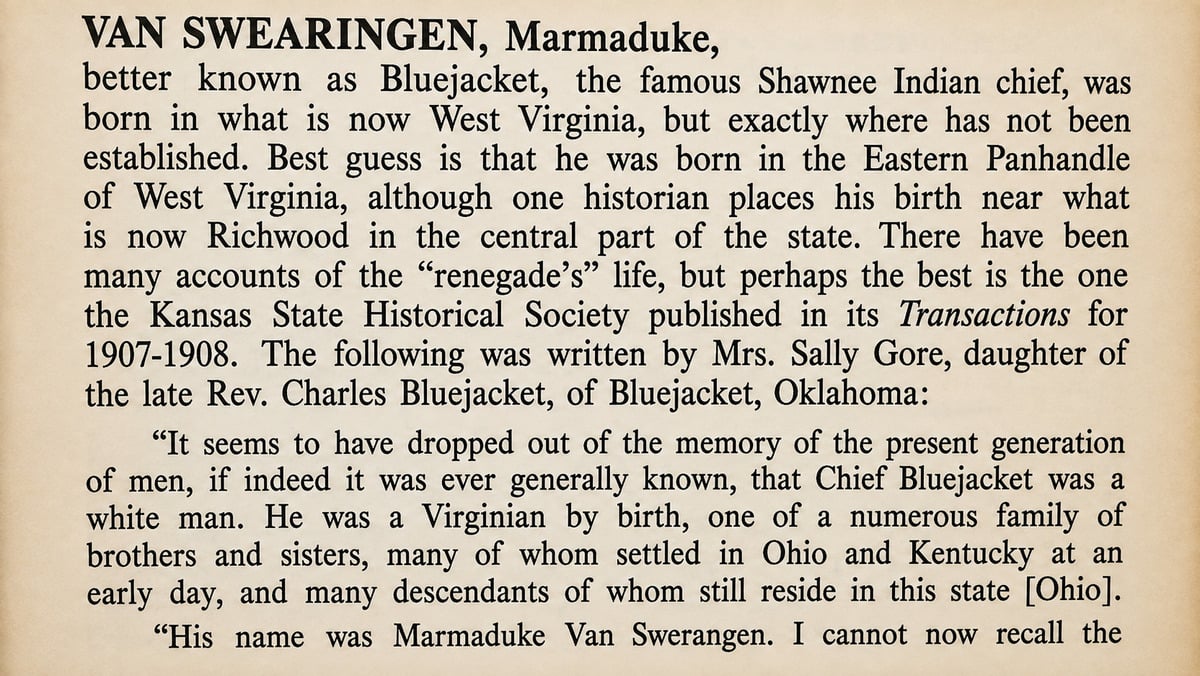
It was a compelling story, and West Virginia historian and newspaperman Jim Comstock gave it a prominent place in his West Virginia Heritage Encyclopedia in 1974. Comstock identified Van Swearingen as “better known as Bluejacket, the famous Shawnee Indian chief,” and said his birthplace was somewhere in what is now West Virginia.
But historians eventually discovered a fundamental problem with the story: Blue Jacket appears to have been Blue Jacket long before Marmaduke Van Swearingen could possibly have become him. More than two centuries after the two men’s lives supposedly became one, DNA testing provided powerful additional evidence that they had never been the same person at all.
A West Virginia boy disappears into the frontier
The version preserved by Comstock primarily derives from an account published in 1877 by Thomas Jefferson Larsh, a great-nephew of Van Swearingen. Later researchers identified Larsh’s newspaper article, “Very Interesting Facts About a Noted Indian Chief,” as the first detailed published account linking Van Swearingen with Blue Jacket.
In the account Comstock reproduced, Van Swearingen was one of several siblings in a Virginia family. While still a teenager, he and a younger brother were said to have been captured by the Shawnees during the Revolutionary War while on a hunting expedition.
Rather than attempt to escape, Marmaduke supposedly made an extraordinary bargain. He agreed to remain with the Shawnees and become one of them if his younger brother was allowed to return home safely. According to the story, the Shawnees accepted.

The teenager thereafter became known as Blue Jacket because he wore a blue linsey blouse, or hunting shirt, when captured. The account said he developed a strong preference for Shawnee life and declared his intention to marry within the tribe.
The tale grew even more extraordinary. Van Swearingen supposedly excelled in Shawnee life so completely that he became a chief before he was 25 and participated in the councils and military campaigns of his adopted nation.
However, a substantial difference existed between family tradition and historical documentation.
Blue Jacket was already there
Marmaduke Van Swearingen’s birth was recorded in a family Bible as Jan. 2, 1763, near Hagerstown, Maryland, according to researchers who investigated the legend. Blue Jacket was apparently much older.
Historians have generally placed the Shawnee leader’s birth between 1738 and 1740. More damaging to the Van Swearingen story, researchers found references to Blue Jacket in Ohio Valley trading records in the 1750s—before Marmaduke was born.
John Sugden, whose Blue Jacket: Warrior of the Shawnees became an important modern biography of the leader, concluded that Blue Jacket was Shawnee by birth. His research is among the sources now cited by the West Virginia Encyclopedia, which treats Blue Jacket and Van Swearingen as separate individuals rather than accepting the older identification.
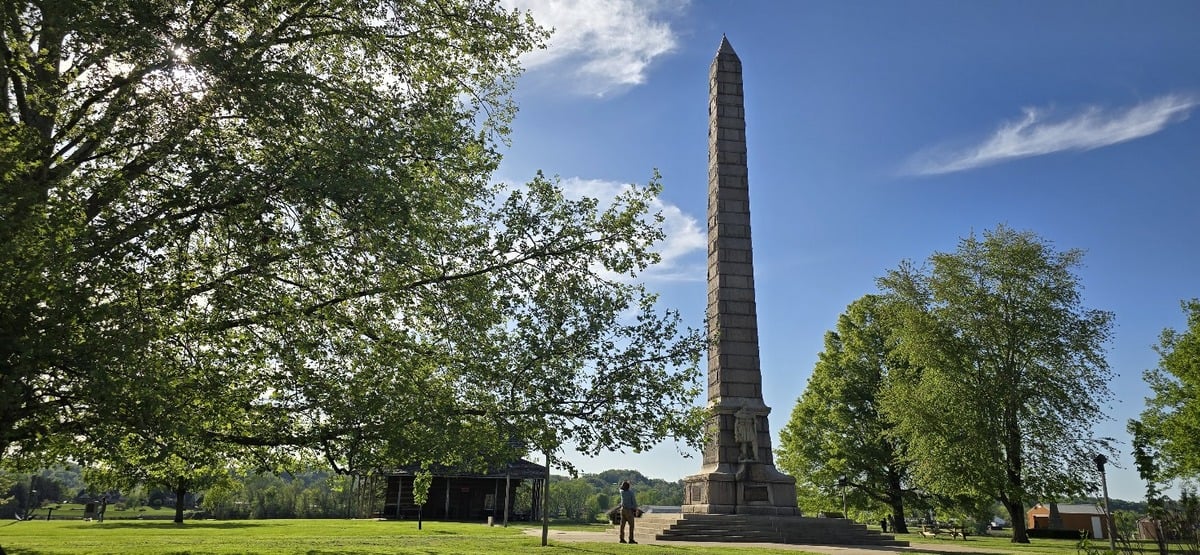
The distinction matters because the real Blue Jacket was a significant figure in the Native resistance that sought to halt American settlement north of the Ohio River. He participated in the long struggle between the United States and a confederation of Native nations in the Ohio country and was among the Shawnee leaders associated with the Native forces defeated by Gen. Anthony Wayne at the Battle of Fallen Timbers in 1794. His name appears on the Treaty of Greenville, signed the following year.

That struggle followed decades of conflict between the Shawnee and Virginia settlers, including the Battle of Point Pleasant in 1774.
American officials recognized Blue Jacket’s standing among the Shawnees. In a September 1795 letter to President George Washington, Secretary of War Timothy Pickering noted that Blue Jacket was among the chiefs who had signed the treaty and described him as “the great Warrior of the Shawanees.”
The treaty opened much of present-day Ohio to American settlement and marked a turning point in the contest for the region. Yet the story that this Shawnee leader had actually begun life as a white Virginian proved remarkably difficult to dislodge.
The Bluejacket family helped preserve the story
One of the most intriguing elements of Comstock’s account is that the tradition did not survive exclusively among Van Swearingen descendants.
Comstock reproduced an account attributed to Sally Gore, daughter of the Rev. Charles Bluejacket and granddaughter of Jim Bluejacket. She described Marmaduke Van Swearingen as the founder of the Bluejacket family and recounted his capture and adoption by the Shawnees.
The account also provided considerable information about later generations of the Bluejacket family, including Charles Bluejacket, born in 1816 and later educated at a Quaker mission school. He became a Methodist and eventually moved from Kansas to Indian Territory, where he died in 1897.
That family testimony lent the Van Swearingen story an authority it might otherwise have lacked. It was no longer merely a tale told by a Virginia family claiming kinship with a famous Shawnee chief; versions of the tradition had become entangled with the Bluejacket family’s history.
The story subsequently appeared in newspapers and historical publications and was repeated by later writers. By the time Comstock published it in his encyclopedia in 1974, he could describe Van Swearingen’s identity as Blue Jacket as established fact. Modern researchers, however, traced the earliest detailed published version to Larsh’s 1877 account and noted that Larsh was Van Swearingen’s great-nephew writing about his own family’s history.
West Virginia became part of the legend
The story also blurred where Van Swearingen belonged in West Virginia history.
Comstock wrote that the future chief was born somewhere in what became West Virginia, suggesting the Eastern Panhandle as the most likely location while noting that another historian placed his birth near present-day Richwood in Nicholas County.
The modern West Virginia Encyclopedia preserves the Richwood connection more cautiously, saying the controversy arose from the belief that the Van Swearingen family lived near present-day Richwood. Its entry no longer identifies Van Swearingen as Blue Jacket and notes the historical and genetic evidence that the two were separate men.
Research published in 2006 offers yet another geographic account. Citing earlier genealogical and county histories, the researchers placed the Van Swearingen family home northeast of the junction of the Monongahela and Cheat rivers, near present-day Point Marion in southwestern Pennsylvania, and placed Marmaduke’s birth near Hagerstown rather than Richwood.
The shifting locations illustrate one of the difficulties of frontier tradition. As the story passed through families and histories, details that seemed precise could still rest on claims made generations after the events they described. The central claim, however, eventually became something scientists could test.
DNA puts the legend to a test
In 2006, researchers Carolyn D. Rowland, R.V. Van Trees, Marc S. Taylor, Michael L. Raymer, and Dan E. Krane published a study in The Ohio Journal of Science asking a remarkably straightforward question: “Was the Shawnee War Chief Blue Jacket a Caucasian?”
They didn’t need Blue Jacket’s remains to answer it. Because the Y chromosome passes through the paternal line, researchers could compare living male-line descendants of the two families. They obtained DNA samples from six direct male descendants of George I Blue Jacket, a son of Chief Blue Jacket, and compared them with four men representing the Van Swearingen paternal line.
If Blue Jacket had really been Marmaduke Van Swearingen, the paternal genetic evidence should have reflected that relationship. It did not. The researchers found that the Blue Jacket and Van Swearingen descendants represented different paternal lines and concluded that, while acknowledging the possibility of an undocumented break in biological paternity somewhere in the generations tested, the genetic evidence did not support the Van Swearingen claim.
The DNA findings reinforced a historical case that had already become difficult to escape. The documentary chronology placed Blue Jacket on the frontier before Marmaduke Van Swearingen was old enough to be his father, while the genetic evidence indicated their paternal families were unrelated.
The legend obscured a different story
Removing Marmaduke Van Swearingen from Blue Jacket’s biography does not diminish the Shawnee leader’s historical importance. Instead, it separates his documented life from a white-captive story that attached itself generations later.
Blue Jacket resisted American expansion, participated in the Native confederacy’s struggle for the Ohio country, and remained a Shawnee spokesman after the defeat at Fallen Timbers. The West Virginia Encyclopedia says he later urged Native people to reject European-American influences and restore traditional customs. His death is generally placed between 1808 and 1810.
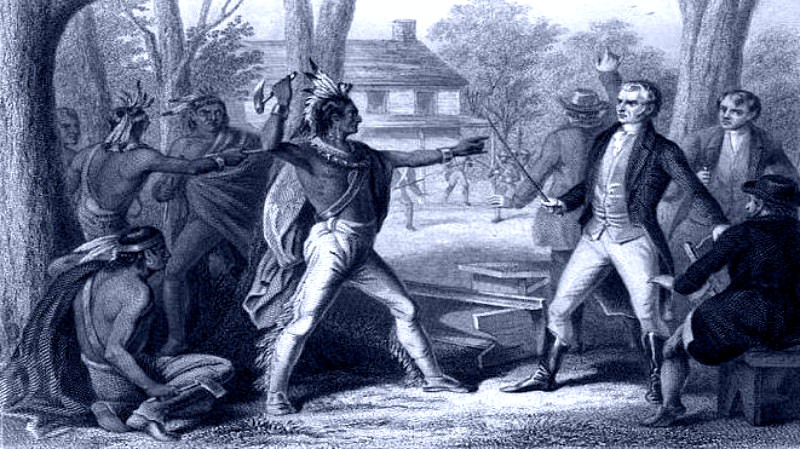
West Virginia is associated with another disputed tradition involving a prominent Shawnee leader—the claim that Tecumseh was born in present-day Lewis County rather than Ohio.
Marmaduke Van Swearingen remains interesting for a different reason. Sometime in the 19th century, his family’s history became so convincingly linked to Blue Jacket’s that the resulting story survived in family accounts, newspapers, historical publications, and, eventually, a West Virginia encyclopedia.
For West Virginia readers, the old pages Comstock preserved therefore document something more elusive than the birthplace of a famous Shawnee chief. They preserve the evolution of a frontier legend—one compelling enough to survive for generations before historical research and, finally, DNA separated the two men.
Excellent article! Thank you for making the facts known about Blue Jacket. Hopefully, your factual article will dispel the myths and legends about the real Blue Jacket.
Another great historical story i love reading these my grammie grew up in point pleasant west Virginia n i visited point pleasant 1 time n i simply love it really want to come back 😀 my dads biological father was also from west Virginia
So what happened to Marmaduke Van Swearingen. Any evidence there?
I sure recommend Alan W. Eckert’s books to anyone interested in that period of history. What a time to have lived on the frontier.