
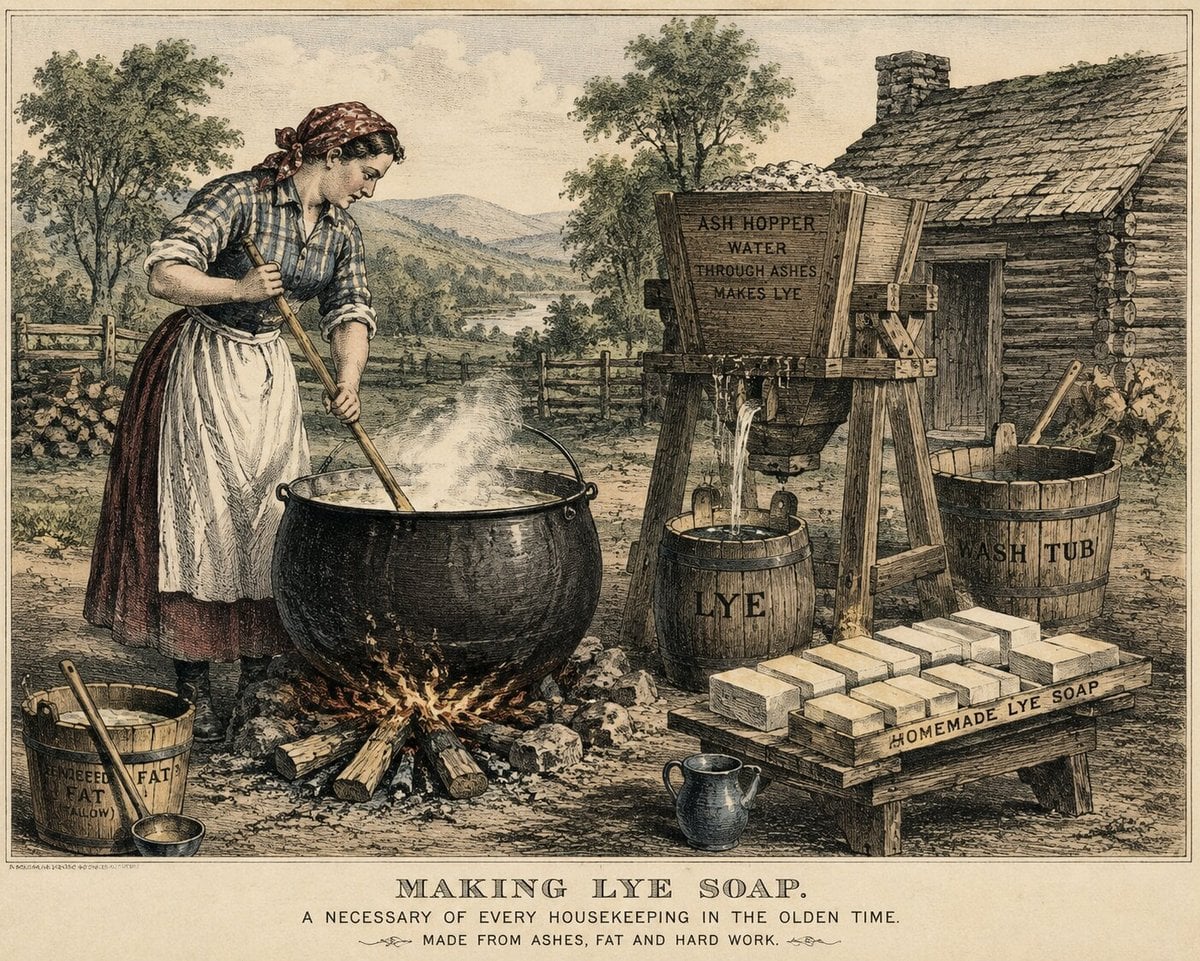
PARKERSBURG, W.Va. — Long before bottles of detergent and wrapped bars of soap became fixtures in West Virginia homes, some families made a cleaning agent from two things they already had—wood ashes and leftover animal fat.

According to an account by late Parkersburg journalist Cordelia Moellendick, preserved in volume 11 of the W.Va. Heritage Encyclopedia, the process could begin with a small log, a pile of hickory ashes, and a bucket positioned to catch the caustic liquid that drained from them.
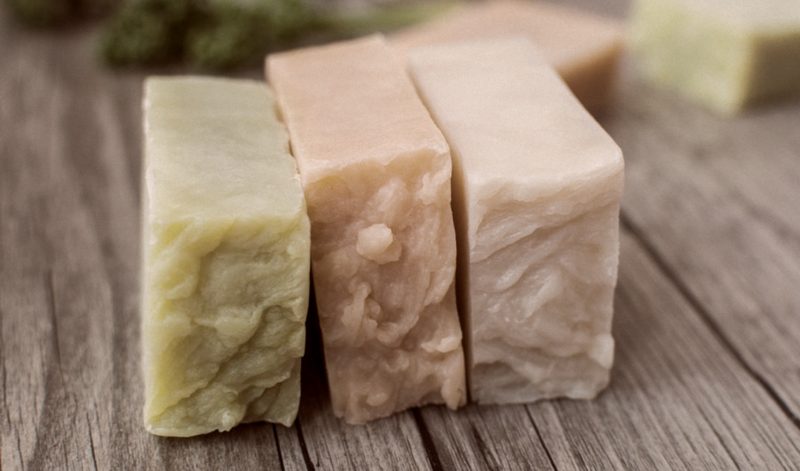
What emerged was lye, which could then be boiled with grease, tallow, or even meat scraps to produce hard or soft soap. The homemade product apparently did its job remarkably well, though Moellendick left little doubt about its gentleness.
“The homemade soap took the dirt off and most of the outer skin,” she wrote.
West Virginia soapmaking started with ashes
Moellendick described a homemade apparatus West Virginians used to extract lye from wood ashes.
“A groove was made in a small log,” her account begins. Two rows of clapboards were fitted into the groove and slanted outward until they stood about 2½ feet apart at the top. Boards fitted into the ends completed a hopper that could hold wood ashes.
They then filled the hopper with ashes from hickory or other green wood and poured water over them. As the water worked downward through the ashes, it became the alkaline solution used to make soap.
The liquid eventually reached the bottom of the hopper, followed the groove cut into the log, and drained into a waiting bucket, according to Moellenick.

“This lye was boiled with grease, tallow, or meat scraps and made into either hard or soft soap,” she wrote.
The basic process she describes aligns with historical soapmaking documented by the National Park Service at Fort Scott National Historic Site. The agency describes an ash hopper as a wooden container through which water passed through wood ashes before the resulting lye was collected and mixed with animal fat.
It separately describes water, fat, and lye as the three basic ingredients in traditional soap recipes. Its account says grease, beef fat, or mutton tallow could be boiled with lye-infused water until the mixture thickened, after which the soap could be poured into a wooden mold and allowed to harden.
The practice survived in West Virginia farm country
The use of ashes and animal fat to make soap was remembered in other parts of West Virginia well into the 20th century.
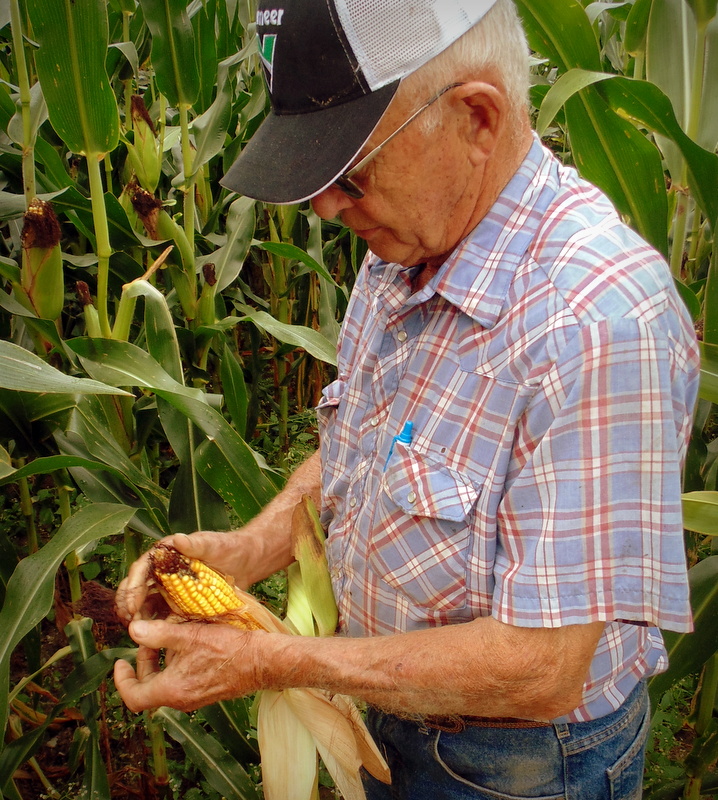
Sam Tuckwiller, whose family has farmed in the Greenbrier Valley for generations, told West Virginia Explorer in 2020 that families produced much of what they needed at home before World War II. Materials included wood-fire ash and hog butchering.
“Ashes and fat from the hogs could be used to make lye soap,” Tuckwiller said.
His recollection offers a second West Virginia account of the same basic practice that Moellendick described in the Parkersburg region: wood ashes provided the alkaline component, while animal fat supplied the other principal ingredient.

The tradition also survived as a West Virginia folk craft. Margaret Byrnside “Dr. Maggie” Ballard, a Monroe County physician and historian, participated for many years in the Mountain State Art & Craft Fair at Cedar Lakes, where she made and sold lye soap.
The park service also confirms that people commonly combined animal fat with lye collected from an ash hopper to make homemade soap and characterizes the resulting lye soap as effective for cleaning but hard on the skin.
Wash day could mean a trip to the creek
Moellendick’s account goes beyond soap-making to describe what happened when West Virginians put it to work.
Rather than loading clothing into an electric washing machine, she wrote, families could take their laundry to a creek. Half-sawn barrels served as wash tubs, and people could spread clothing on flat stones.
Especially dirty areas underwent a process she called “battling,” beating soiled areas with sticks to help clean them.
The technique was not unique to the account she preserved. Historical descriptions of laundry practices elsewhere also document the use of wooden implements to agitate clothing before the widespread adoption of mechanical washing machines. At Fort Scott, for example, the park service describes a wooden washing stick that served much the same function as an agitator in a modern machine.
Moellendick nevertheless offers a particularly vivid picture of the practice in West Virginia—creek water, half-barrels, flat stones, sticks, and homemade soap made from ashes and scraps of animal fat.
The wash tub could become the bathtub
The same equipment used for laundry could serve another purpose, Moellendick said.
People didn’t necessarily bathe with scented soap in a heated bathroom. Instead, half of a barrel used on wash day could serve as a bathtub.
“The smokehouse was the bathroom or a corner of the kitchen in winter,” she wrote.
In describing bathing, she delivered her memorable assessment of the homemade soap, saying it removed dirt along with “most of the outer skin.”
Her remark appears to have been a humorous exaggeration rather than a literal claim about skin removal. However, the park service independently supports the underlying observation that traditional lye soap can be harsh, describing homemade lye soap as good for cleaning but hard on the skin.
Why wood ashes could be turned into soap
The seemingly unlikely transformation of fireplace ashes and animal grease into a cleaning agent relied on chemistry, even though soapmakers did not need modern chemical terminology.
Traditional lye production involved pouring water through wood ashes in an ash hopper and collecting the lye-infused runoff beneath it. Because lye is caustic, the hopper itself could be constructed of wood.
The collected alkaline solution was then combined with fat and heated. The park service describes a historical rule of thumb of “about two pounds of grease, beef, or mutton tallow for every gallon of lye-infused water, although recipes and methods could differ.”
That process also explains why accounts of soapmaking so often mention both wood fires and livestock. In the Greenbrier Valley, Tuckwiller specifically remembered using ashes and hog fat together to make lye soap.
A Parkersburg writer preserved the old method
Moellendick was writing about West Virginia history for the Parkersburg News by at least the 1930s, and the Parkersburg News and Sentinel has continued to reproduce some of her historical writing.
Her account of homemade soap records not only the ingredients but also the physical details of the process: the grooved log, angled clapboards, hickory ashes, dripping lye, and a bucket waiting at the end.
Together with later recollections such as Tuckwiller’s in the Greenbrier Valley, the account documents a household practice remembered in widely separated parts of West Virginia.
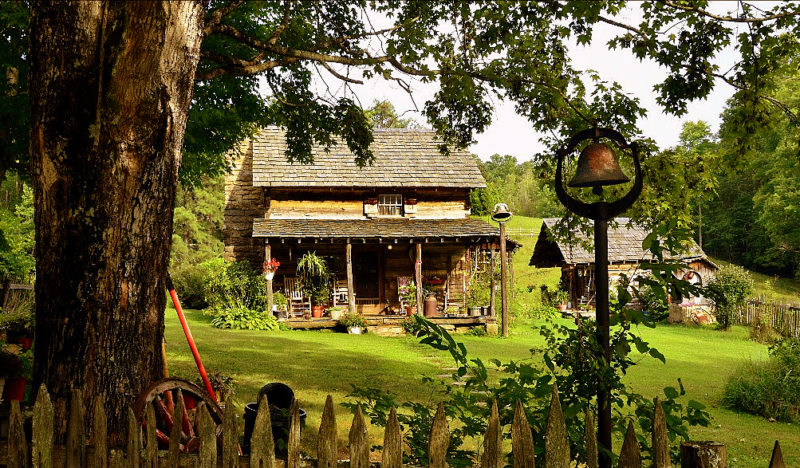
For families who made it, soap could begin not on a store shelf but with ashes from a wood fire, animal fat boiled down, and water poured slowly through a homemade wooden hopper. Today, places such as the Pioneer Farm at Twin Falls Resort State Park interpret that largely self-sufficient world where historic buildings recreate an Appalachian farmstead.