
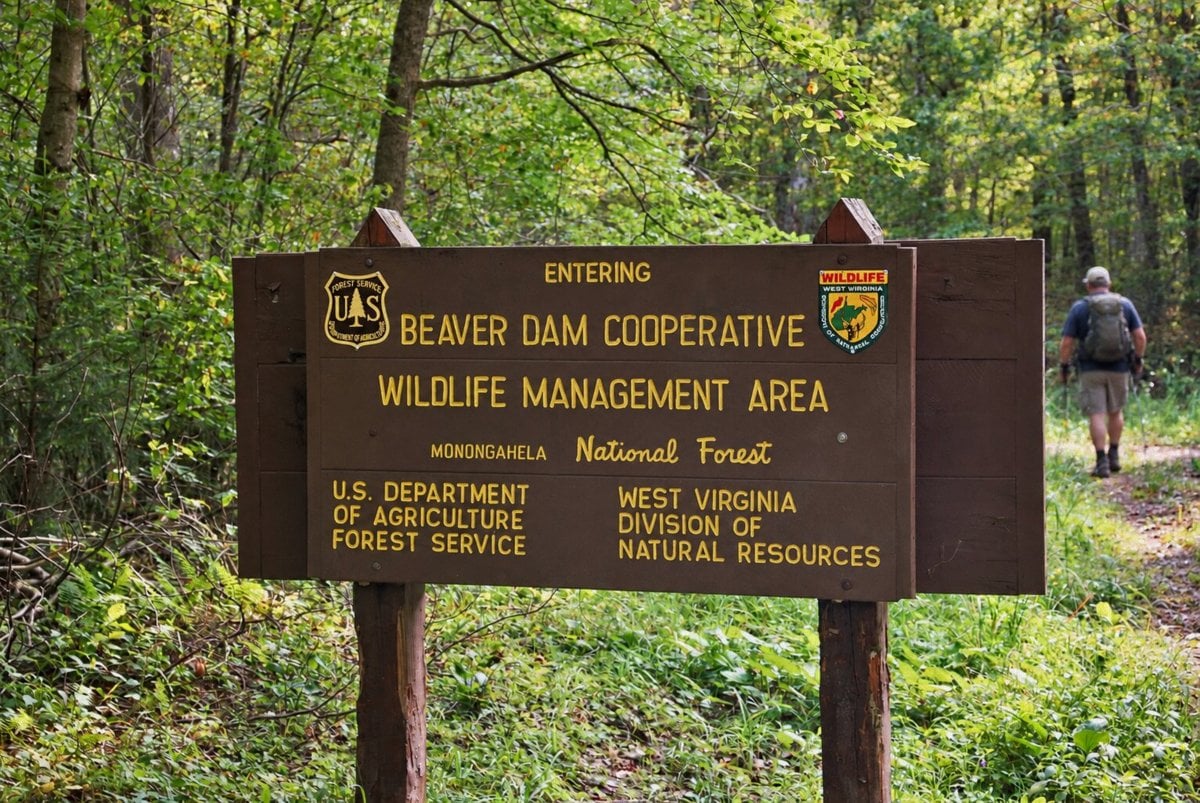
ELKINS, W.Va. — Much of the wildlife habitat inside West Virginia’s largest national forest isn’t managed by the federal government alone.

For generations, biologists with the W.Va. Division of Natural Resources have worked alongside the U.S. Forest Service to manage trout streams, wildlife habitat, and sensitive species across the Monongahela National Forest. The two agencies have now renewed the agreement governing that cooperation, substantially updating a document that had not undergone a major revision since the 1980s.

The bureaucratic-sounding agreement has practical consequences across some of West Virginia’s best-known public lands. Ten state wildlife management areas lie within the Monongahela, and state fisheries officials estimate that approximately 90 percent of West Virginia’s trout streams are within the forest.
According to Cindy Sandeno, supervisor for the national forest, the updated memorandum of understanding establishes a framework for continued cooperation on fish and wildlife habitat, threatened, endangered, and sensitive species, and annual planning between the agencies.
“For more than six decades, the forest service and W.Va. Division of Natural Resources have worked side by side to conserve the natural resources that make West Virginia so special,” Sandeno said.
The renewed agreement provides a framework for confronting conservation issues that often extend beyond either agency’s jurisdiction, she said.
“Our forests, streams, and wildlife don’t recognize administrative boundaries, and neither can we,” Sandeno said. “By working collaboratively, we can accomplish more for West Virginia’s natural resources and the communities that depend on them.”
Partnership reaches back generations
The roots of that cooperation go back farther than the current agreement, according to historian Jack I. Cromer, writing in the West Virginia Encyclopedia.

In 1936, West Virginia and the forest service entered a cooperative agreement that established “game breeding ground areas” within the forest, Cromer pointed out. Those areas preceded today’s wildlife management areas.
Later wildlife management in the forest dates to sustained cooperation between the service and the state wildlife agency at least to 1946. In 1983, for example, the agencies established a 1,739-acre ruffed grouse management area in the forest’s Potomac Ranger District under a 30-year memorandum of understanding and cooperative agreement.
Today, Beaver Dam, Blackwater, Cheat, Cranberry, Little River, Neola, Otter Creek, Potomac, Rimel, and Tea Creek wildlife management areas are located within the Monongahela. The land remains federally managed, but the state coordinates wildlife management there.
That arrangement helps explain why visitors hunting, fishing, or watching wildlife on national forest land may encounter management work carried out by state wildlife personnel, Sandeno said.
“Neither agency can accomplish this work alone,” she said.
From trout streams to young forests
The agencies already work together on habitat restoration projects across the national forest. At the Beulah Wildlife Enhancement Project in Randolph County, the state and the forest service have worked to restore 2,287 acres of national forest land in the West Fork Glady Fork watershed.
The project includes managing wildlife openings, improving forest stands and creating vernal pools to increase habitat diversity, according to state officials. The agency says native brook trout, ruffed grouse and American woodcock are among the species expected to benefit.
The relationship is particularly important to trout management. The service reports more than 900 kilometers of cold-water trout streams within the Monongahela and says estimates indicate that about 90 percent of West Virginia’s native brook-trout streams occur there.
Cooperative management of those waters has deep historical roots. After widespread logging altered mountain watersheds during the early 20th century, Civilian Conservation Corps crews began restoring trout habitat with logs and rocks during the 1930s. Of the 67 CCC camps operating in West Virginia, 31 were in or near the newly established forest, according to the state’s trout-management plan. Some of the stream structures built during that period survive today.
Wildlife management on national forest lands can include planting trees and shrubs for food and cover, maintaining wildlife openings, developing wetlands and improving public access through roads, trails, parking areas and shooting ranges.
Paul Johansen, chief of wildlife for the state, said the renewed agreement lets the agencies keep sharing expertise while building on that history.
“Our partnership with the Monongahela National Forest has been an important part of wildlife and fisheries conservation in West Virginia for generations,” Johansen said. “This updated agreement allows us to build on that successful history, share expertise, and work together to support the fish and wildlife resources that are so important to West Virginians.”
The agencies have not detailed major operational changes resulting from the new memorandum. Rather, their announcement describes the update as a renewed framework for work that has evolved over decades.
For hikers, hunters, anglers, and other visitors to the Monongahela, however, that cooperation is already visible across the landscape—from wildlife openings and young forests to cold mountain streams where native brook trout survive.
