
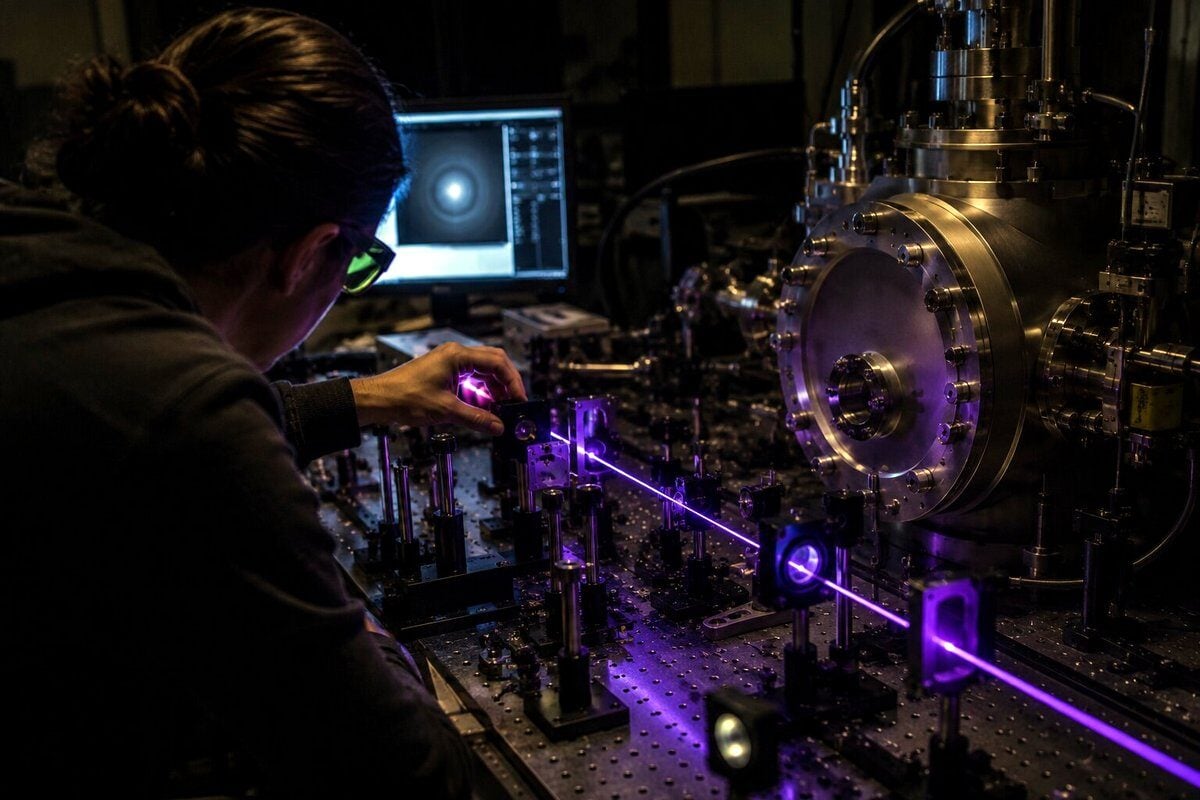
MORGANTOWN, W.Va. — West Virginia University researchers have secured a $633,833 National Science Foundation grant to develop technology that could improve computer chip manufacturing, spacecraft propulsion systems and future fusion-energy devices.
The project places WVU scientists among a relatively small group of researchers working to solve one of plasma physics’ most challenging problems—understanding what happens when electrically charged gases interact with solid materials.
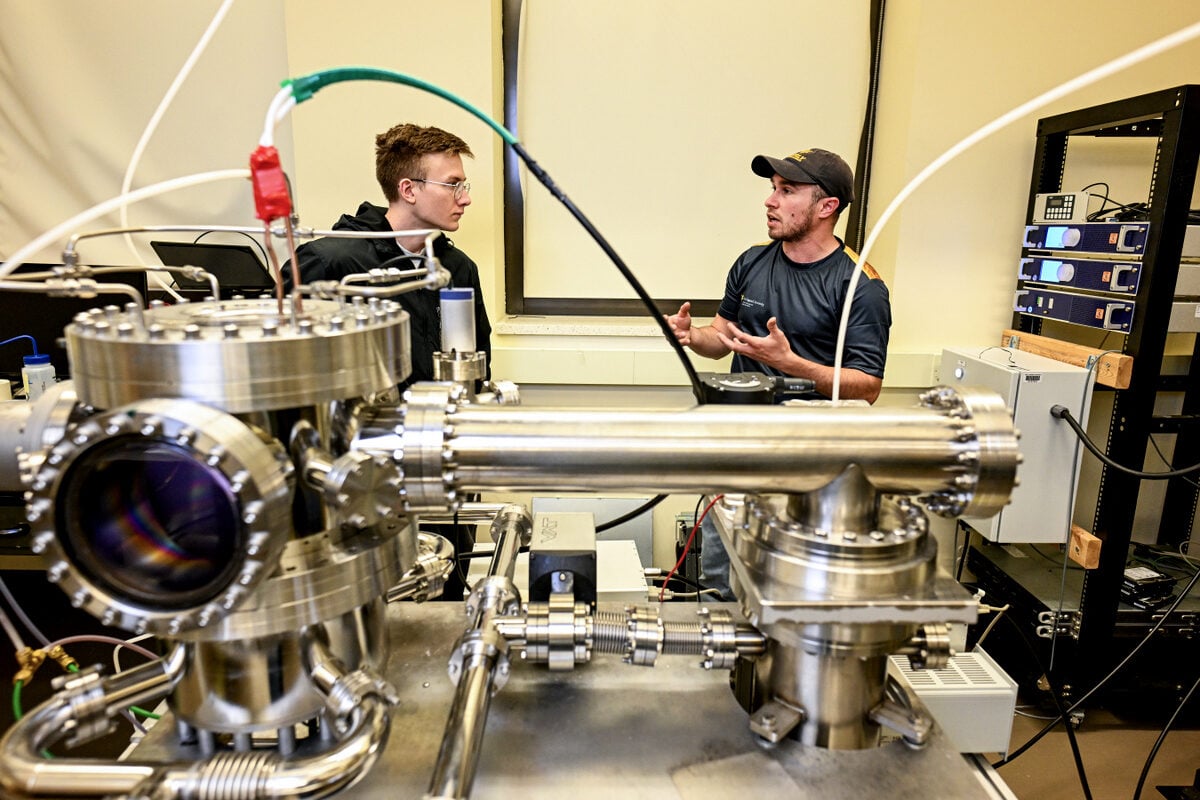
Although most people never encounter plasma directly, it plays a critical role in modern technology. Plasma is used to manufacture semiconductors that power smartphones and computers, to propel certain spacecraft, and it remains central to efforts to develop practical fusion energy.
Researchers Thomas Steinberger, assistant professor, and Jacob McLaughlin, research assistant professor, both in WVU’s Department of Physics and Astronomy in Morgantown, are developing new laser-based techniques to observe plasma behavior in unprecedented detail.
The work could help engineers better control how plasma interacts with materials, potentially improving efficiency, reducing wear, and extending the lifespan of components used in advanced technologies.
The NSF award is another example of scientific research taking place in West Virginia, with implications that extend far beyond the Mountain State.
“These are questions that scientists have been trying to answer for decades,” Steinberger said. “What we’re building allows us to observe these boundary regions in a way that hasn’t really been possible before.”
Why plasma matters
Often called the fourth state of matter, plasma is an electrically charged gas composed of ions and free electrons. Naturally occurring plasmas include lightning and the sun, and scientists also create plasmas for use in manufacturing, energy production, and advanced propulsion systems.

One of the most important—and least understood—regions of a plasma forms where the charged gas meets a solid surface.
At that boundary, a thin electrical layer known as a plasma sheath develops. Within the sheath, charged particles transfer energy to a material’s surface, affecting how quickly it wears down and how efficiently plasma-based devices operate.
Understanding that interaction is important because plasma-facing materials are used in technologies ranging from semiconductor fabrication equipment to spacecraft engines and experimental fusion reactors.
Read more: Ancient river once flowed across West Virginia before vanishing during the Ice Age.
“This is one of those regions in plasma physics that we know is incredibly important, but it’s also extremely difficult to measure without affecting the system you’re trying to study,” Steinberger said.
WVU has become a recognized center for plasma research through its Center for KINETIC Plasma Physics, which brings together researchers studying laboratory plasmas, fusion science, space physics and advanced diagnostics
Using lasers to study an invisible world
To better understand these plasma boundaries, the WVU team is developing diagnostic tools that can observe charged particles and electric fields without disturbing the plasma.
Traditional instruments often interfere with the environments they are meant to measure, making it difficult to verify theories about how plasma behaves near surfaces.
The researchers will instead use advanced optical techniques, laser-induced fluorescence and quantum beat spectroscopy.
The first technique uses lasers to track ion motion within a plasma. The second measures subtle changes in electron energy levels to determine electric field strength.
By combining the two methods, Steinberger and McLaughlin hope to create detailed two-dimensional maps showing both ion motion and electric field behavior from the center of a plasma to its outer boundary.
“We can look at how ions are moving while also measuring the electric fields at the same time,” McLaughlin said. “That gives us a much higher level of confidence in what’s actually happening near the surface.”
Testing a longstanding theory
One goal of the project is to investigate whether a little-understood phenomenon known as an inverted plasma sheath can occur under ordinary laboratory conditions.
Scientists have theorized for years that under certain circumstances plasma sheaths can behave very differently from traditional models.
In a conventional plasma sheath, positively charged ions accelerate toward a material surface. In an inverted sheath, that flow may be greatly reduced or even reversed, fundamentally changing how the plasma interacts with the material.
Although the concept has been explored extensively in theory, researchers have rarely observed it directly because of the limitations of existing measurement techniques.
The WVU team hopes its new diagnostic tools will provide some of the clearest evidence yet about whether those conditions occur and how they affect plasma behavior.
Potential applications in manufacturing and spaceflight
Beyond testing scientific theories, the researchers hope their work will eventually help engineers gain greater control over plasma-material interactions.
“If we can control how many ions actually hit a surface, if we can reduce or manipulate that ion flux, there are many applications where that becomes extremely valuable,” Steinberger said.
In semiconductor manufacturing, improved control of ion bombardment could increase the precision of plasma-processing tools used to etch microscopic circuits onto computer chips.
Similar benefits could apply to electric propulsion systems on spacecraft, where plasma generates thrust.

The findings may also prove valuable to fusion-energy research, where intense plasma interactions can damage reactor components and shorten their lifespan.
Reducing those effects could improve performance and extend the life of critical equipment.
Opportunities for West Virginia students
The NSF grant will also support training opportunities for undergraduate and graduate students at WVU.
The project includes developing a new advanced plasma physics laboratory module and outreach efforts for students in rural and underserved communities across West Virginia.
Researchers say that hands-on experience with sophisticated laser systems and plasma diagnostics can help prepare students for careers in science, engineering, and advanced technology fields.
“We’ve been very fortunate with the students we’ve had involved,” Steinberger said. “They come in motivated, asking the right questions and bringing the kind of intuition that makes this work exciting.”
Over the next three years, the WVU team will build and test its new diagnostic systems before applying them to a series of controlled plasma experiments.
If successful, the work could help answer questions that have challenged plasma physicists for decades and contribute to technologies that power everything from computer chips to spacecraft.