
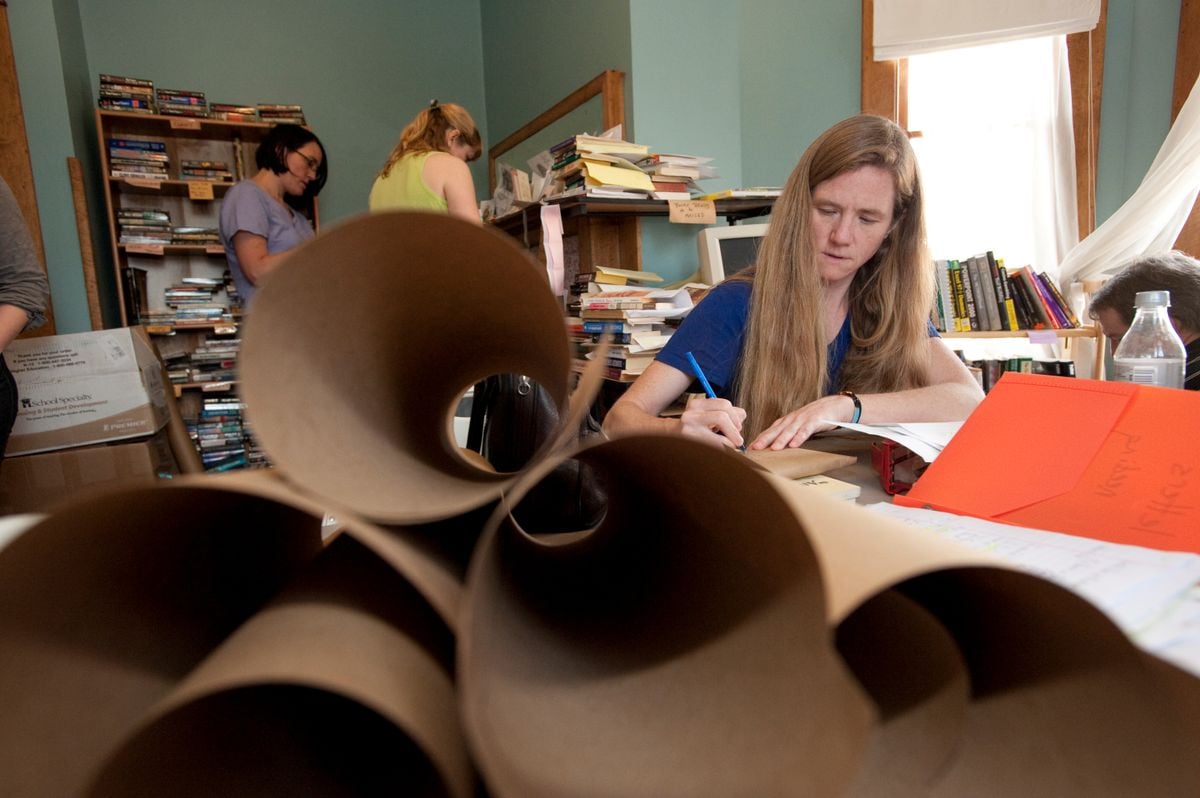
MORGANTOWN, W.Va. — For thousands of incarcerated people across Appalachia, a book is more than a way to pass the time. It can be a source of education, personal growth, family reconciliation, and hope.

According to Katy Ryan, a West Virginia University professor, founder of the Appalachian Prison Book Project, and founding director of the WVU Center for Prison Education and Research, access to literature can be transformative for people serving time in correctional facilities.
Appalachian Prison Book Project has distributed more than 70,000 books
Since 2004, the Appalachian Prison Book Project has distributed more than 70,000 free books to incarcerated individuals in West Virginia, Virginia, Tennessee, Kentucky, Ohio, and Maryland. The effort, run by volunteers and supported by donations, has become one of the largest prison book initiatives serving the Appalachian region.
Ryan, who serves as the Eberly Family Professor of Outstanding Teaching in the WVU Eberly College of Arts and Sciences in Morgantown, said the organization receives an extraordinary range of requests from incarcerated readers, spanning fiction and poetry to educational resources and practical guides.
“Books can be a lifeline, a refuge, an inspiration,” Ryan said. “Reading can transport us to another world and help us understand the one we are in.”
Readers request everything from Science Fiction to GED materials
Requests to the Appalachian Prison Book Project reflect the diverse interests and ambitions of those behind prison walls. Readers ask for
- science fiction
- westerns
- romance novels
- poetry
- manga
- mathematics textbooks
- astronomy books
- Indigenous studies
- LGBTQ+ literature
- works by Black authors,
- language-learning materials
- music instruction guides
- business books
- puzzle collections
The demand demonstrates a desire not only for entertainment but also for education and self-improvement, Ryan said.
“We know a book cannot provide everything a person needs, but people who write to APBP have taught us never to underestimate the power of reading,” she explained. “People have told us that a book we sent encouraged them to earn a GED, start writing daily, reconnect with family, study science, learn another language, and so much more.”
The impact of those books is documented in an extensive archive maintained by the project. Ryan said nearly 100,000 letters from incarcerated readers have been collected over the years, offering firsthand accounts of how access to literature can influence lives in correctional institutions.
The correspondence reveals stories of educational achievement, personal reflection, and renewed relationships.
Prison book club helped reunite an incarcerated mother with her son
One of the most memorable examples came from an early prison book club organized through the program. Participants read Natalie Goldberg’s acclaimed writing guide “Writing Down the Bones,” which inspired one incarcerated reader to reconnect with her adult son.
“The book inspired one member to write to her adult son and have a difficult conversation,” Ryan recalled. “Her son wrote back, they spoke on the phone, and within a few months he visited her for the first time since she had been incarcerated.”
Stories like this illustrate how reading can extend beyond literacy and education, strengthening personal relationships and fostering emotional healing.
The project’s influence is also reflected in a recently published collection of writings and artwork by incarcerated individuals across the region.
New collection shares voices of incarcerated Appalachians
In 2024, volunteers with the Appalachian Prison Book Project co-edited “This Book Is Free and Yours to Keep: Notes from the Appalachian Prison Book Project,” a volume featuring letters, artwork, and creative writing contributed by incarcerated people served by the organization.
Among the most powerful reflections in the collection is a preface by Hugh Williams Jr., who described how a single book altered the course of his life.
“I was the one all my teachers gave up on, but ten years later I became a teacher,” Williams wrote. “I taught GED classes, career management, and history. It all began with a shivering boy, alone and crying in a cell, wanting to die, when he was handed a book of fiction by John Sanford about a detective named Lucas Davenport. I still can’t believe the difference a book can make.”
The statement underscores a theme often expressed by participants in prison literacy programs: books often serve as gateways to education, self-discovery, and opportunity.
Former prisoners credit books with transforming their lives
Another former recipient described how reading became a daily escape and ultimately changed his future.
“I would not be here today if people like yourself had not donated books to prison,” he wrote. “I read at a third-grade level when I went in, and because of books that were provided by APBP, I read over a thousand books prior to my release.”
He said books allowed him to travel beyond prison walls through literature, accompanying characters and historical figures in works ranging from “The Adventures of Tom Sawyer” to “The Canterbury Tales.”
“Little by little I became immersed in literature and began to transform myself into something more than a number,” he wrote.
For advocates of prison education, such testimonials highlight the broader societal value of literacy and educational access within correctional settings. Research has consistently linked educational opportunities in prisons to improved outcomes, including higher literacy rates, increased employability, and lower recidivism rates following release.
Ryan believes the letters the Appalachian Prison Book Project receives offer compelling evidence of those benefits.
The most recent message she shared came from someone who had recently completed a prison sentence and returned to life outside incarceration.
Reflecting on the books he received while incarcerated, he thanked the volunteers who packed and shipped them.
“You might say, ‘It’s not like we’re changing the world,’” he wrote. “But you did change my world.”
For Ryan and the volunteers who continue to send books throughout Appalachia, that sentiment captures the mission of the Appalachian Prison Book Project.
While a single book cannot solve every challenge incarcerated individuals face, supporters say access to literature provides something essential: the opportunity to learn, imagine, grow, and prepare for a future beyond prison walls.
More than two decades after its founding, the Appalachian Prison Book Project continues to connect readers with books across West Virginia and the broader Appalachian region, one package and one life-changing story at a time.
Rachel Brosky, media manager for WVU Strategic Communications and Marketing, contributed to this story.