
Blair Mountain, in Logan County, West Virginia, is a mountain in the southern West Virginia coalfields best known for the 1921 Battle of Blair Mountain, the largest armed labor uprising in U.S. history.
The mountain rises to approximately 1,952 feet above sea level amid the steep, heavily dissected terrain characteristic of the region. Its wooded ridges and slopes became a natural defensive barrier in 1921, when thousands of armed coal miners marching toward the nonunion coalfields of southern West Virginia encountered forces assembled along the heights to stop their advance.
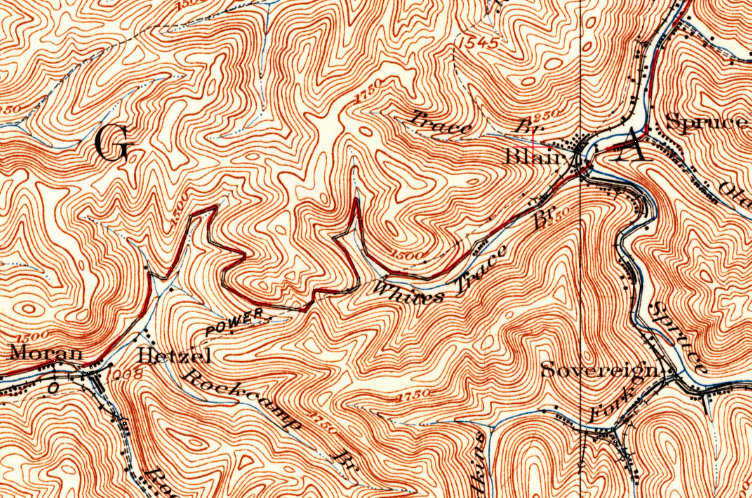
More than a century later, Blair Mountain remains predominantly forested. The historic battlefield, which encompasses portions of the mountain and surrounding landscape, is listed on the National Register of Historic Places and is nationally significant for its association with the West Virginia Mine Wars and the American labor movement.
Blair Mountain at a glance
Location: Logan County, West Virginia
Elevation: Approximately 1,952 feet (595 meters)
Coordinates: 37.86288° N, 81.85623° W
USGS topographic map: Amherstdale, West Virginia
Feature type: Summit
Region: Southern West Virginia coalfields
Historic significance: Site of the 1921 Battle of Blair Mountain
Historic designation: Blair Mountain Battlefield, National Register of Historic Places
National Register reference: No. 08000496
Original National Register listing: March 30, 2009
National Register status restored: June 27, 2018
Geography and topography
Blair Mountain rises amid the narrow valleys and elongated ridges of the southern West Virginia coalfields. Communities and transportation routes in the region historically developed largely along streams and valley bottoms, while steep mountainsides separated neighboring watersheds and settlements.
At approximately 1,952 feet, Blair Mountain is not remarkable in West Virginia for its elevation. Its historical importance instead derives partly from its location and topography.
The long ridge formed a natural barrier along the route armed miners followed as they moved south from the Kanawha Valley during the summer of 1921. Defenders occupying higher ground could control approaches across steep, wooded slopes, placing miners advancing from below at a substantial disadvantage.
That geography helped determine where one of the most significant confrontations in American labor history would occur.

Battle of Blair Mountain
The Battle of Blair Mountain culminated years of conflict over attempts to unionize West Virginia’s coalfields.
Coal companies exercised considerable economic and political influence in many mining communities and strongly resisted organization by the United Mine Workers of America. Labor disputes during the preceding decade included the Paint Creek-Cabin Creek Strike of 1912-13 and increasingly violent confrontations in the southern coalfields.
Tensions intensified after the Matewan Massacre on May 19, 1920. Baldwin-Felts detectives had traveled to Matewan to evict miners and their families from company housing after workers joined the union. A confrontation involving the detectives, miners and local officials erupted into gunfire, killing Matewan Mayor Cable Testerman and seven Baldwin-Felts detectives.
Matewan Police Chief Sid Hatfield survived the shootout and became a prominent figure among union miners. On Aug. 1, 1921, Baldwin-Felts agents shot and killed Hatfield and his friend Ed Chambers on the steps of the McDowell County courthouse in Welch.
The killings intensified anger across the coalfields. Later that month, thousands of armed miners assembled near Marmet, southeast of Charleston, and began moving south through Boone County. They intended ultimately to reach Mingo County, where miners attempting to organize had faced arrests and violence.
Their route brought them toward Blair Mountain and Logan County.
Fighting on Blair Mountain
Logan County Sheriff Don Chafin assembled a force to prevent the miners from continuing south. His forces included deputies, mine guards, state police, civilian volunteers, and others who occupied defensive positions along Blair Mountain and neighboring ridges.
Fighting intensified in late August 1921 as miners attempted to advance through the mountainous terrain. Over several days, rifles and machine guns were used across ridges, slopes, and hollows.
Aircraft employed by forces opposing the miners also flew over the battlefield and dropped explosive and gas bombs, though historical accounts differ on their effectiveness.
Estimates of the number of miners involved vary considerably, generally placing the force in the thousands. Casualty estimates also differ, and historians have not established a definitive number of people killed during the fighting.
The battle ended after President Warren G. Harding sent federal troops into West Virginia. Many of the miners were World War I veterans and were unwilling to fight soldiers of the United States Army. They began laying down or concealing their weapons and returning home.
Hundreds of participants subsequently faced criminal charges, including murder, conspiracy, and treason. Union leader Bill Blizzard was among the most prominent defendants and was acquitted of treason.
Union strength in the southern West Virginia coalfields declined substantially after Blair Mountain and would not recover to comparable levels until labor reforms and organizing campaigns of the 1930s.
Blair Mountain Battlefield
The historic Blair Mountain Battlefield encompasses a much larger landscape than the mountain’s named summit. Its significance lies in the network of ridges, gaps, slopes, and hollows across which the confrontation unfolded, rather than at a single point on the mountain.

Archaeological investigation associated with the historic designation identified 15 contributing battle-related features within the battlefield. Together with the surviving terrain, these features help document how the confrontation unfolded across the landscape.
The relationship between the battlefield and its topography is particularly important. Defenders could occupy higher elevations and control approaches, while miners advancing from the north encountered steep, heavily wooded ground.
For that reason, preservation efforts have focused not only on individual archaeological resources but also on maintaining the integrity of the larger historic landscape.
Preservation
The Blair Mountain Battlefield was added to the National Register of Historic Places on March 30, 2009. The designated historic area encompasses approximately 1,669 acres associated with the events of 1921.
The battlefield was removed from the National Register later in 2009 following a dispute over property owners’ objections. Preservation organizations challenged the decision amid broader concerns that surface mining and other disturbances could damage portions of the historic landscape.
After years of litigation and administrative review, the keeper of the National Register determined that the earlier removal had been erroneous. Blair Mountain Battlefield was restored to the National Register on June 27, 2018.
The preservation controversy brought renewed national attention to Blair Mountain and raised a larger question unusual among historic sites: how to preserve a battlefield whose most important surviving feature is the mountain landscape itself.
Blair Mountain today
Blair Mountain remains a predominantly wooded Appalachian ridge. Unlike battlefields defined by surviving forts, buildings, or extensive monuments, much of its historical character is expressed in the terrain.
The mountain’s slopes, ridgelines, gaps, and hollows remain essential to understanding the events of 1921. In the context of the miners’ route south, the landscape explains why Blair Mountain became an obstacle and why defenders chose its heights.
Much of the battlefield and surrounding mountain is privately owned. Visitors should respect private property and stay on public roads and authorized access points when exploring the area.
The West Virginia Mine Wars Museum in Matewan interprets the broader labor struggle that culminated at Blair Mountain and provides additional historical context for the battle and the southern West Virginia coalfields.
Historical significance
Blair Mountain holds an unusual place in West Virginia history because its natural geography and human history are inseparable.
The mountain was not chosen as a battle site in advance. Its location and terrain put it between thousands of advancing miners and the southern coalfields they sought to reach, while its height gave defenders a natural position to stop them.
The resulting confrontation transformed a wooded Logan County ridge into a nationally significant historic landscape associated with the struggle to organize America’s coal miners.
More than a century after the gunfire ended, the mountain remains the battlefield’s principal surviving feature.