
CEDAR GROVE, W.Va. — Forrest Hull remembered autumn before foliage forecasts, scenic-drive maps, and photos of mountainsides ablaze with color became common ways to mark the season in West Virginia.
“Where are the autumns of yesterday?” Hull asked in a 1970s essay appropriately titled “Yesterday’s Autumns.”
He remembered little boys who “played so hard all day and slept so hard all night” and a childhood in which the future seemed to “hang like a wide sky over every present moment.”
There were persimmons and nuts in the hills, squirrels in the trees, fires of burning leaves, and games played by moonlight. There were smells from the kitchen, radio programs and girls whose smiles could leave a boy brooding on a back porch.
Hull, a Kanawha Valley historian, writer, and artist born in Cedar Grove in 1891, looked back on the autumns of his youth. His recollections, later collected in A Forrest Hull Sampler, preserve something more elusive than a record of changing leaves. They document how an earlier generation of West Virginians experienced the season.
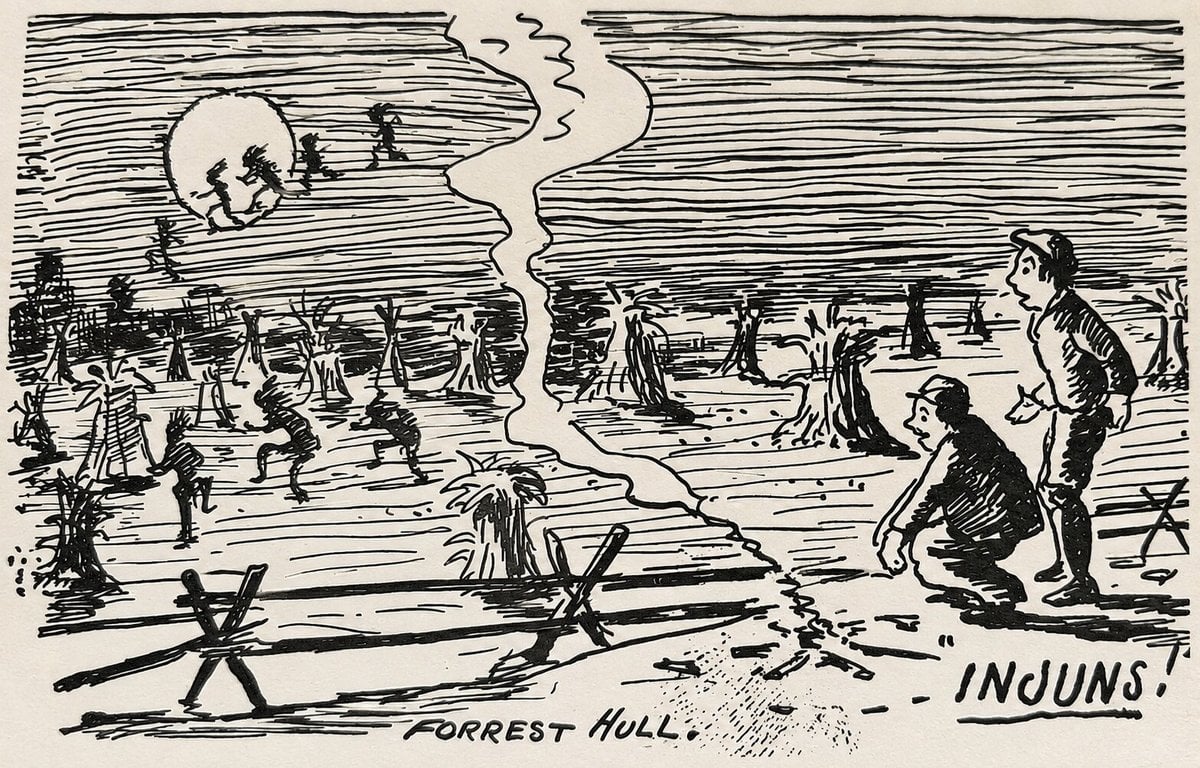
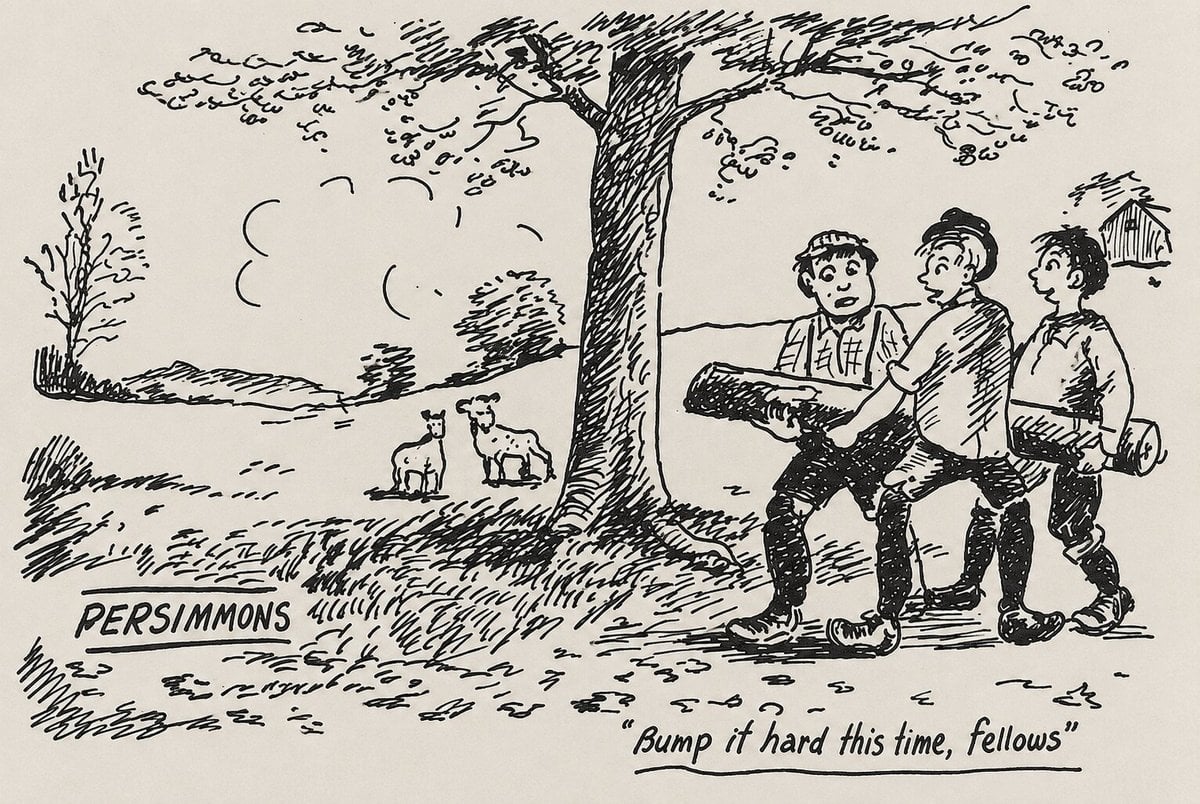
His own illustrations reinforce the memory. One depicts boys beneath a persimmon tree. Another shows a moon hanging over an autumn landscape as figures gather outside.
The trees still change color. Frost still settles into West Virginia valleys. But much of the autumn Hull knew has disappeared, and some aspects of the season itself have measurably changed.
Autumn before the foliage forecast
Hull’s recollections are striking partly because foliage occupies so little of them.
He remembered the hills where boys searched for nuts, ate “the puckering persimmons,” and threw stones at squirrels that “chattered and threw bark back at us” from the high branches. He remembered playing hide-and-seek in moonlight and sitting beside fires of burning leaves.
Indoors, autumn had its own character. He remembered “the warming sun” coming through a window and an appetite that “required no stimulus from a bottle.” He recalled a world in which no machine had to tell people when to get up and “perfumes sweeter than the odors of Araby” came from the kitchen.
Even entertainment belonged to those memories. Hull recalled the voices and programs that once filled the house, including “Sweet Beulah Land,” Treasure Island, Tom Sawyer, and The Nickel Novels.
His autumn was not simply a visual season. It was something heard, smelled, tasted, and participated in.
That distinction is noticeable today because West Virginia autumn is so often presented visually. Foliage reports, scenic drives, and social media photographs encourage travelers to follow the progression of color southward and downhill through the mountains.
West Virginians once had a vocabulary for autumn
Hull was hardly alone in assigning special significance to the stages of fall.
In 1925, Marshall County historian Scott Powell recorded seasonal expressions that he already considered to be disappearing. In History of Marshall County, West Virginia: From Forest to Field, Powell included a section headed “Antiquated Terms” that discussed “Indian Summer” and other expressions once familiar to early settlers of the Ohio Valley.

Powell described Indian summer as mild weather arriving several weeks after an autumn cold spell and lasting anywhere from one or two weeks to more than a month. Most distinctive was the atmosphere. He wrote that the season was marked by “haze or smoke” so pronounced that it “obscured the sun or made it appear as a ball of fire in the sky.”
Powell’s historical explanation for the origin of the expression “Indian Summer” should not be accepted as established fact. Researchers have proposed numerous explanations for the term, and its actual origin remains uncertain.
But his account establishes something more useful for understanding Hull’s world—a century ago, a West Virginia historian considered such expressions part of a seasonal vocabulary inherited from earlier generations in the Ohio Valley.
What people called Indian summer
The expression “Indian summer” can be traced in written American sources to the 18th century.
A historical account published by the National Weather Service notes a recorded use in 1778 by French-American writer J. Hector St. John de Crèvecœur, who described an interval of calm and warmth characterized by a tranquil atmosphere and general smokiness. Because Crèvecœur wrote that the phenomenon “is called” Indian summer, the account notes that the expression was apparently already in circulation.
Later descriptions generally settled on a recognizable weather pattern—an unusually warm, quiet, and often hazy period during October or early November, typically following colder weather. Some traditional definitions require a killing frost before the warm spell can properly be called an Indian summer.
The National Weather Service still defines the term as a period of warm fall weather following cool weather, usually after the season’s first frost.
That sequence remains familiar in West Virginia—cold nights followed unexpectedly by several mild, sunny days that seem to briefly return the landscape to an earlier season.
The name, however, has become less common. The American Meteorological Society now discourages the expression and recommends “Second Summer” for the weather phenomenon.
In an account of historical West Virginia autumn, the older term remains significant because it belonged to the period’s vocabulary.
Smoke was once part of the season
The haze in older descriptions of Indian summer also offers an interesting connection to Hull’s memories. He remembered fires of burning autumn leaves.
Burning leaves and other vegetation remains legal under some circumstances in West Virginia, but outdoor burning is now regulated during the state’s fall fire season. State forestry officials warn that declining humidity can leave fallen leaves and forest litter increasingly dry and flammable, and debris burning has historically been a leading cause of wildfires in the state.
Hull’s recollection therefore preserves another sensory element of an earlier autumn—children gathered around the smoke and warmth of burning leaves — even though the practice itself has not entirely disappeared.
Persimmons marked the changing season
Hull thought enough of persimmons to illustrate them. In one of his drawings, three boys stand beneath a large tree, with “PERSIMMONS” written prominently beside them.
The American persimmon is native to much of the eastern United States, and its orange fruit ripens in autumn. For generations, wild persimmons provided something more immediate than a date on a calendar: a seasonal event that could be seen, gathered, and eaten.
Persimmons also accumulated folklore. One enduring Appalachian and eastern American tradition involves splitting the seed and interpreting the shape within — popularly described as a spoon, fork, or knife—as a supposed forecast of the coming winter. No scientific basis supports using a persimmon seed to predict winter weather.
For Hull and the boys he remembered, their significance was much simpler. They did not go somewhere to see autumn. They went into the hills to eat it.
West Virginia’s autumn really has changed
Hull understood that he was writing about memory and loss. But measurements show that West Virginia’s seasonal calendar has changed as well.
Researchers examining observations from 18 locations across West Virginia found evidence of a substantial lengthening of the state’s growing season during the 20th and early 21st centuries.
Observations averaged across the 18 locations from 1927 through 2016 suggested a growing season of about 168 days. During the more recent period from 1987 through 2016, however, changes in the timing of spring and fall conditions suggested that West Virginia’s growing season had lengthened by about 20 days.
The researchers cautioned that a statewide figure can conceal enormous local differences. Elevation and West Virginia’s rugged terrain produce complex variations in growing-season length, temperature, cloud cover, and other conditions from one place to another.
The finding does not mean Hull’s childhood autumn was simply 20 days shorter than autumn today, nor can statewide climate observations explain the personal memories of a boy born in Cedar Grove in 1891. They do show that the seasonal rhythms West Virginians experienced have not remained fixed.
Where are yesterday’s autumns?
That makes Hull’s old question more difficult to answer than it initially appears.
Some of what disappeared were customs. Gathering wild foods became less integral to everyday life. Fires of burning leaves became increasingly regulated, amid growing concern about wildfire. The entertainment and routines Hull associated with autumn belonged to another era.
But Hull’s essay eventually moves beyond persimmons, moonlight, squirrels, and burning leaves.
He remembers people. He wonders about childhood acquaintances who are no longer around. He remembers a girl from school and another who “made us moon out on the back porch” at a play party after she smiled at another boy.
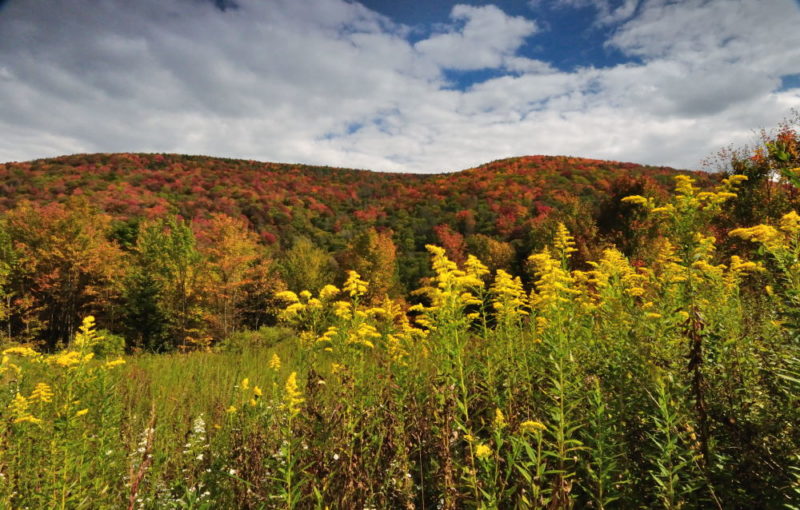
At that point, Hull’s question has quietly become larger than autumn. The landscape still contains much of what he remembered. Nuts still fall. Cold air still settles into the valleys. Warm weather can still return unexpectedly after an autumn chill, and hardwood forests still undergo their annual transformation.
Perhaps what Hull was mourning was not autumn itself but a way of inhabiting it and the people with whom he shared it.
“Where are the first things and the glory thereof?” Hull asked. His answer was brief. “They are with the vanished yesterday.”
Beautifully written.