
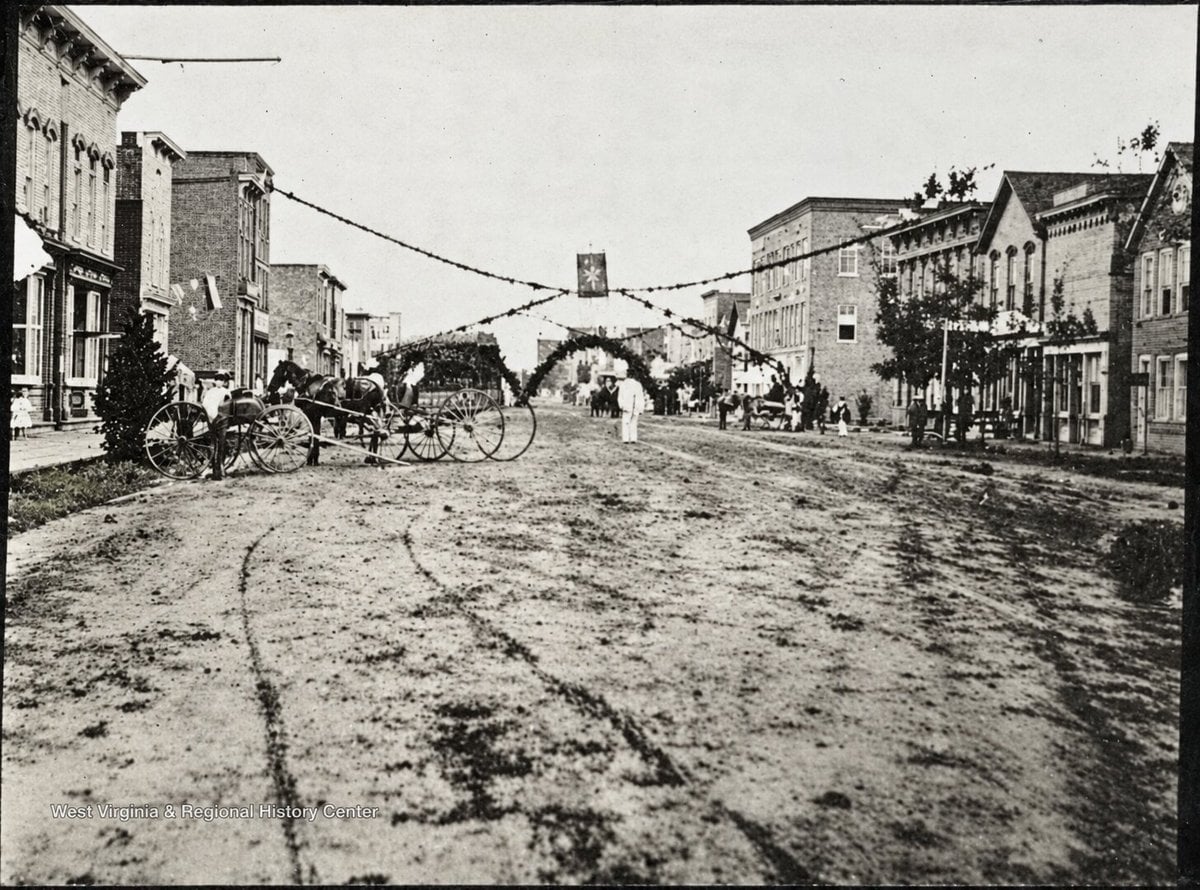
HUNTINGTON, W.Va. — One of West Virginia’s most famous outlaw stories holds that members of the James Gang rode into Huntington in 1875, robbed a bank in broad daylight, and fled toward the mountains with thousands of dollars. The robbery certainly happened, but whether the famous outlaws were responsible remains another matter.
Contemporary newspaper accounts, later historical research, and an obscure story preserved by legendary West Virginia editor Jim Comstock reveal something considerably less certain than the familiar tale. Two of the four Huntington robbers can be identified with reasonable confidence, but the identities of the two who escaped quickly became entangled with the names of America’s most notorious outlaws.
More than a century later, historian Joseph Platania was still unwilling to declare that Frank or Jesse James had participated. After extensive research into the robbery, Platania concluded that the identities of all four men might never be known. Even the West Virginia Encyclopedia today says only that the two fugitives were “supposedly Frank James and Cole Younger.”
Four men arrive in Huntington
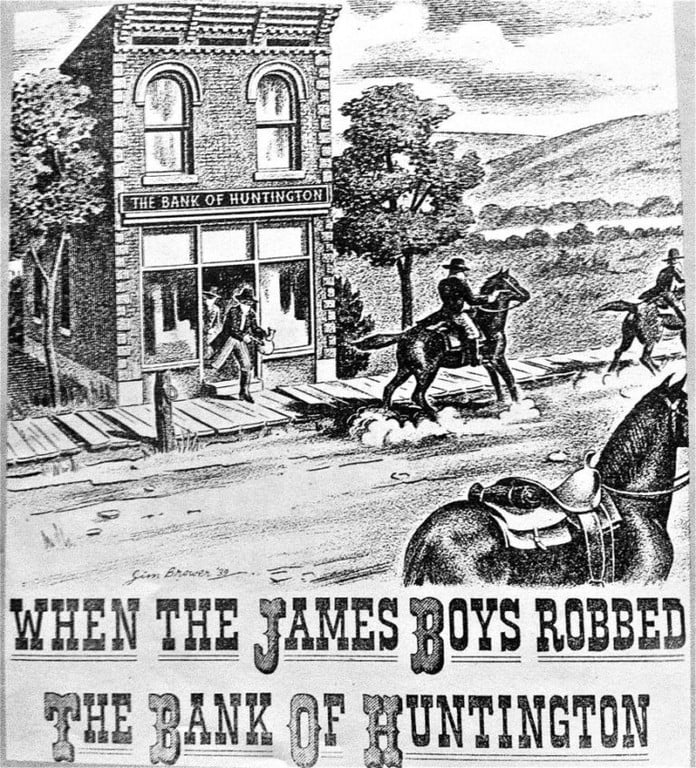
On Monday, Sept. 6, 1875, four armed men approached the Bank of Huntington in what was then a young Ohio River city. The bank president had left for lunch, leaving cashier Robert T. Oney inside. Two men entered with revolvers while two remained outside. Within minutes, the robbers took nearly $20,000, mounted high-quality horses, and fled south toward Wayne County, according to Platania’s account.
A posse pursued the robbers into Kentucky. One was later captured in Tennessee with part of the stolen money and returned to Huntington, while another was shot by Kentucky residents and died from his wounds. These two are the comparatively well-established participants in the robbery.
Authorities identified the captured man as Thomas J. Webb, who was convicted during the December 1875 term of the Cabell County circuit court and sentenced to 14 years in the West Virginia Penitentiary. The wounded man was identified as Thompson, or Tom, McDaniels. Oney identified Webb and McDaniels as members of the robbery party, but the other two men escaped without being identified with comparable certainty.
A robber becomes Jesse James—briefly
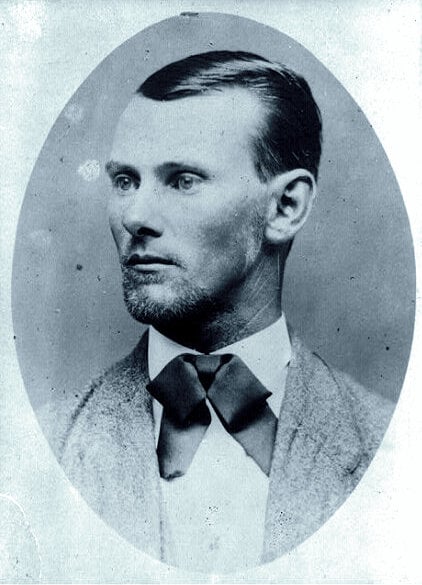
Confusion over their identities began almost immediately. After McDaniels was shot near Pine Hill, Kentucky, Louisville detective Bligh traveled there and announced that the wounded man was Jesse James. The identification was sensational enough to spread through newspapers across the country: one of the nation’s most infamous outlaws had apparently been brought down while fleeing a West Virginia bank robbery.
A special correspondent for the St. Louis Times later traveled to Pine Hill to investigate, but the wounded robber had died by the time he arrived. The dead man was identified not as Jesse James but as Thompson McDaniels. The Indianapolis Sentinel carried the account on Sept. 24 beneath the blunt headline “NOT JESSE JAMES,” and other newspapers subsequently published reports discrediting the original identification.

The episode shows how quickly famous outlaw names became attached to the Huntington robbery and how unreliable at least one supposedly authoritative identification proved. A letter later attributed to Jesse James appeared in newspapers, denying that he participated in the robbery and insisting that Cole Younger was innocent as well. The Sept. 30 edition of the Leavenworth Weekly Times was among the newspapers that published the letter.
The letter’s authenticity cannot be assumed, but its appearance shows that the James-Younger connection was being publicly disputed within weeks of the crime.
The legend becomes more certain with age
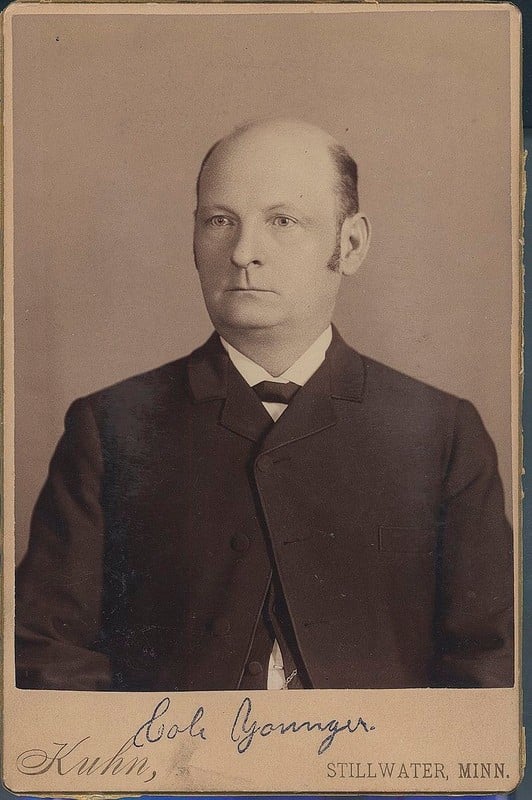
Later accounts increasingly filled in identities that contemporary evidence had left uncertain. An 1881 newspaper account presented an elaborate version in which Frank James and McDaniels entered the Huntington bank while Cole Younger and a man identified as Keen, Webb, or Hinds remained outside. Such accounts helped establish the version of the robbery that would become familiar across West Virginia.
Frank James continued to deny the story decades later. When he returned to Huntington in 1903 with the Cole Younger and Frank James Wild West show, a local newspaper confronted him about the robbery 28 years earlier. James said he had never been in Huntington before and maintained that he had been home in Missouri when the bank was robbed.
Modern historians have remained cautious. Platania, who researched the robbery for Goldenseal and later wrote the West Virginia Encyclopedia entry on the James Gang, examined the gap between the documentary record and the folklore that grew around it. That gap makes a nearly forgotten West Virginia account particularly interesting.
Jim Comstock preserved another version
In his 1974 Commonplace Book, legendary West Virginia newspaperman Jim Comstock recorded a story that directly contradicted the James Gang tradition. Comstock wrote that the Jesse James gang had visited Huntington twice in 1875, and he also included an account attributed to physician Don Roberts Elkins, who had heard it from D. D. Brown of Nicholas County.
According to Brown’s account, one of the men involved in the Huntington bank robbery later returned to Nicholas County. Comstock recorded Brown’s assertion that “the gang had no connection with the James gang.”
The account cannot establish who robbed the Huntington bank. It was recorded almost a century after the crime and had passed through several people before reaching print. But Comstock preserved another account, attributed to Hershel Kessler, describing fugitives from the Huntington robbery appearing in the Richwood area.
Kessler said his father-in-law, identified as Mr. James, had encountered the group after the robbery. His account includes peculiar details: women reportedly accompanied the men; James was given a $50 bill; members of the group went to the grave of James’ youngest son and dug into it as though searching for something; and James later helped direct the travelers toward the Yew Pine Inn.
Comstock did not claim that the account solved the mystery. Instead, he ended the passage with an observation that remains appropriate more than 50 years after he published it: “There are many questions left unanswered.”
What can actually be established?
One hundred fifty-one years after the robbery, the safest reconstruction is also the least sensational. Four armed men robbed the Bank of Huntington on Sept. 6, 1875. Webb was captured, convicted, and sent to the penitentiary. McDaniels was shot during the pursuit and died. Two other men escaped.
West Virginia folklore has long identified those fugitives as Frank James and Cole Younger, and Platania noted that the robbery exhibited characteristics associated with the James-Younger Gang. But the surviving evidence does not establish their identities with the same certainty as it does for Webb and McDaniels. Indeed, one of the earliest confident identifications in the case—the announcement that McDaniels was Jesse James—proved wrong.
Comstock’s forgotten Nicholas County account doesn’t prove the James Gang was innocent of the Huntington robbery, nor does Frank James’ denial. They do, however, point to a distinction that has largely disappeared from popular retellings: The Bank of Huntington robbery is historical fact, but the identities of the two men who got away remain a mystery.
It would be historical if there was proof it was Jesse James. I’d love to see that,a big tourist gain
I’VE HEARD THAT WHEN FRAND JAMES CAME TO HUNTINGTON HE WAS HE WAS INTERVIEWED & SAID THAT THEY HAD ROBBED ALOT OF BANKS, BUT THEY DID NOT ROB THE HUNTINGTON BANK. ALSO THERE WAS STILL A OUTSTANDING WARRANT ON FRANK & JESSE JAMES, BUT NO LAW ENFORCEMENT ARRESTED FRANK WHILE HE WAS IN HUNTINGTON. I DO NOT BELIEVE IT WAS THE JAMES GANG.