
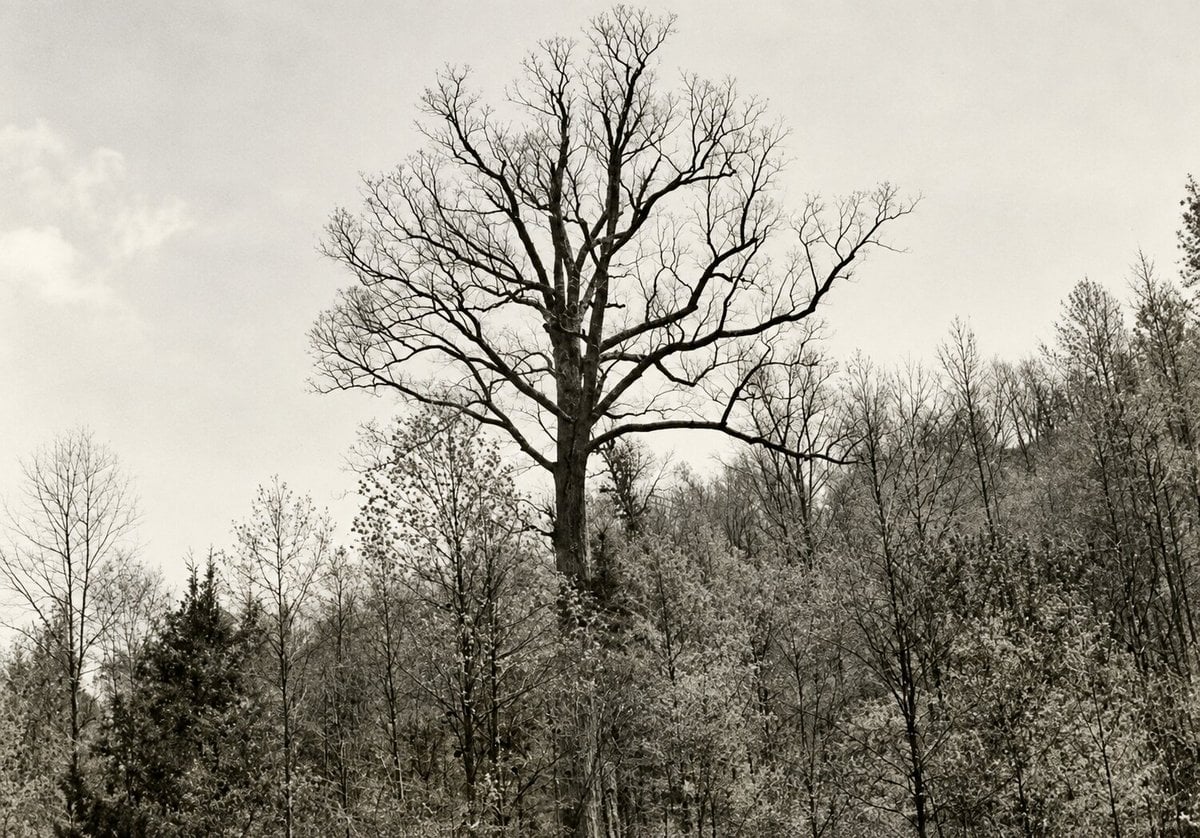
HOLDEN, W.Va. — More than 2,000 people crowded onto a mountainside in southern West Virginia on Sept. 23, 1938, to watch lumbermen pull a nine-foot saw through one of the largest white oaks ever documented in America.
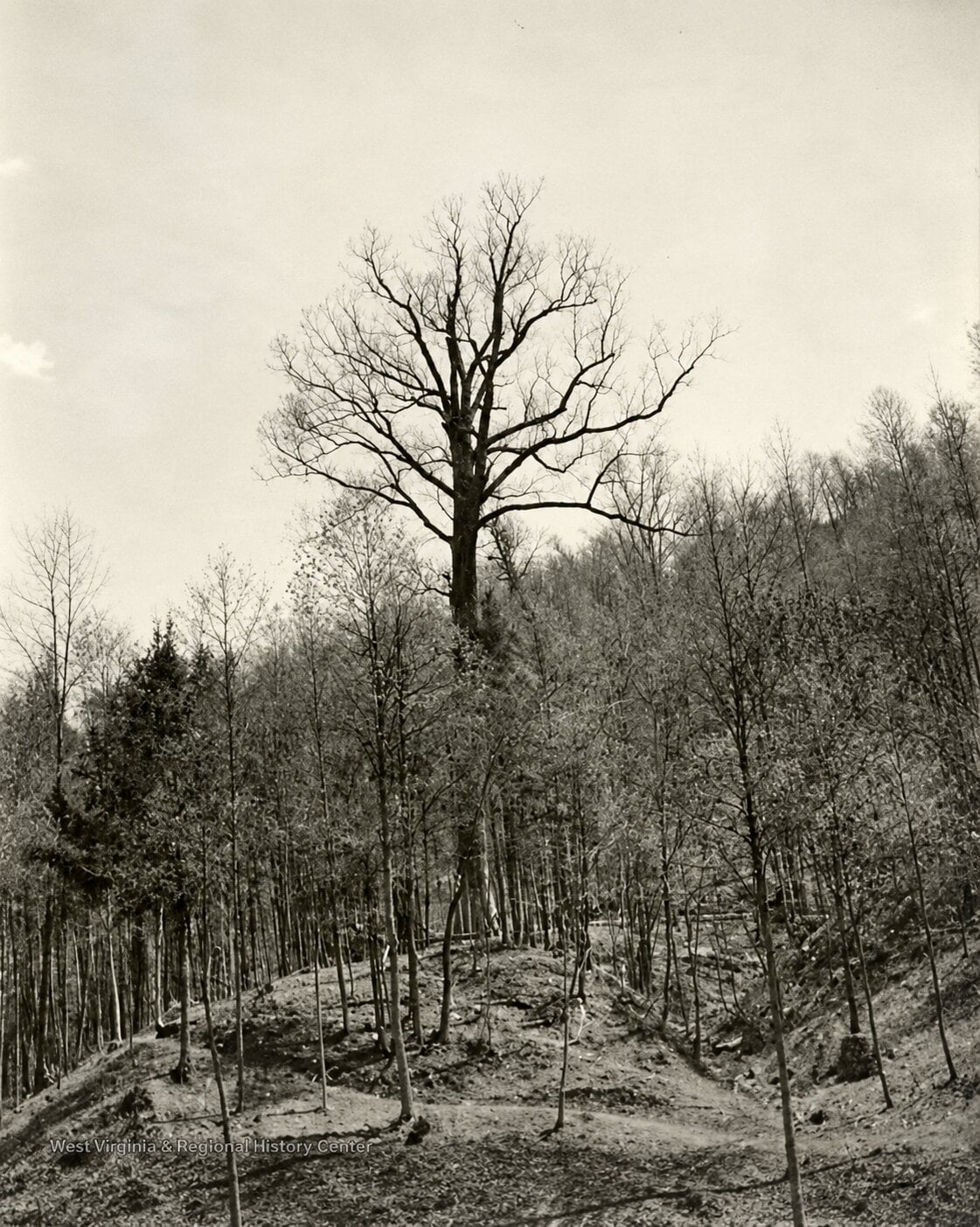
The Mingo Oak, as it was known, was already dead. What followed was not merely a logging operation but the end of an unusual preservation effort that began years earlier, when West Virginians persuaded the state to protect the enormous tree and establish a small park around it.
Documents preserved by West Virginia Archives and History help reconstruct how an oak growing on coal-company property near Holden became a celebrated landmark—and what happened when a tree that had survived for centuries finally died.
West Virginia moves to protect the tree
The Mingo Oak stood on the Trace Fork of Pigeon Creek near the boundary between Mingo and Logan counties. In November 1931, Emmett Keadle, of Williamson, wrote to Gov. William G. Conley about a white oak that had drawn attention for its extraordinary size.
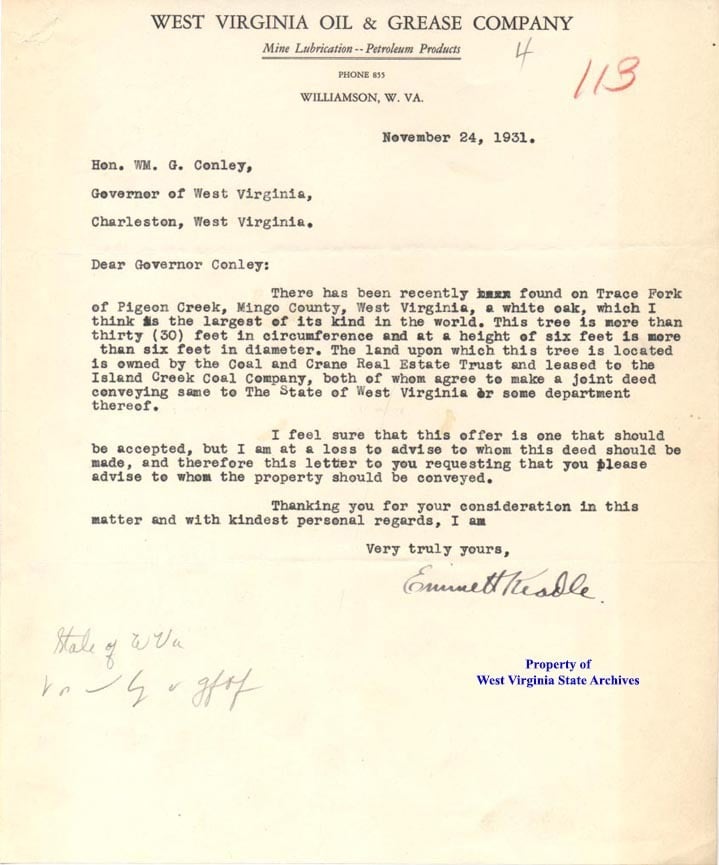
Keadle reported that the tree measured more than 30 feet in circumference at the ground and more than six feet in diameter three feet above the ground. He believed it might be the largest tree of its kind in the world and told Conley that the property owners were willing to convey the tree and surrounding land to West Virginia.
Keadle did not know which state agency should receive the property, so he asked the governor.
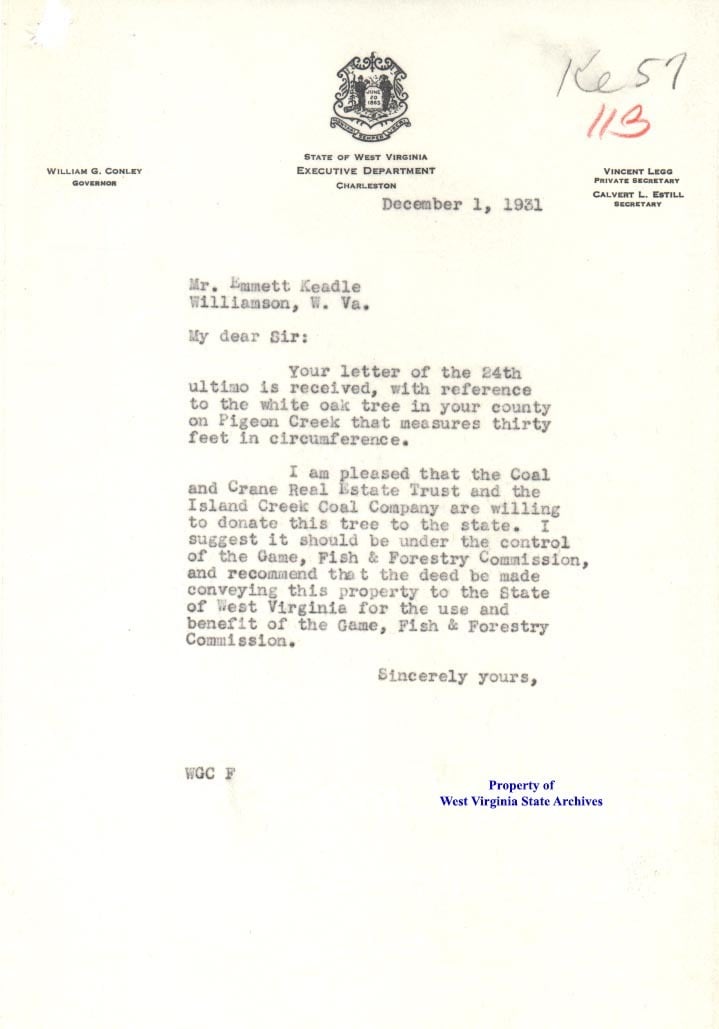
Conley answered on Dec. 1, recommending that the property be placed under the control of the state’s Game, Fish & Forestry Commission and that the deed be made to West Virginia for the commission’s use and benefit.
The preservation effort ultimately worked somewhat differently. Contemporary reporting said the state leased about 1½ acres around the oak and developed it into a small park. Workers cleared and fenced the grounds, built a rustic bridge across Trace Fork, and constructed stone steps leading toward the tree.

Its enormous size may have saved it
The Mingo Oak survived even as much of the original forest around it was cut, possibly because of its enormous size. The surrounding timberland had been leased for logging, but removing the giant oak would have been so difficult and expensive that lumbermen left it standing. The tree stood in the Williamson Coal Field, a region transformed by coal mining and timber cutting during southern West Virginia’s industrial development.
By the 1930s, the old tree towered above a younger forest. Measurements published in 1938 recorded its circumference at 30 feet, nine inches at ground level and 19 feet, nine inches at 4½ feet above the ground, equivalent to a diameter of six feet, three inches at that height. Its trunk was estimated to contain 15,000 board feet of lumber and remained unbroken for more than 80 feet.
Contemporary accounts variously described the Mingo Oak as the largest forest-grown white oak in the United States or perhaps the world. Those claims depended partly on how competing trees were measured and whether open-grown and forest-grown specimens were considered separately, but the measurements establish the Mingo Oak’s exceptional size without relying on superlatives.
How old was the Mingo Oak?
Its age was uncertain. An increment-borer examination in 1932 estimated the tree at 584 years, though the newspaper reporting the figure acknowledged a possible error of 25 or 30 years.
After the tree fell, Keadle and State Forester D.B. Griffin tried again. They counted 384 rings on a cross-section 21 feet above the ground, but decay had destroyed part of the growth record. After estimating the missing rings and the time it took the young oak to reach that height, they settled on about 470 years, placing its origin around 1468.
The giant dies
By 1937, the oak was failing. That summer, it produced only a few leaves on one or two branches and did not leaf at all the following year. Contemporary reports said foresters attributed its death to a fungus.
With the tree dead and its enormous limbs standing above the surrounding forest, officials prepared to fell it. Its size meant the job would require specialized equipment and woodsmen accustomed to handling timber on an extraordinary scale.
More than 2,000 came to watch
On Friday, Sept. 23, 1938, spectators arrived from Holden, Logan, Williamson, Huntington, Charleston, and Welch. Others came from nearby mines and mountain communities, while state forestry officials, conservation officers, law-enforcement officers, and Civilian Conservation Corps workers gathered around the site.
By 9 a.m., several hundred people were present, and the crowd eventually swelled to more than 2,000. Motion-picture and still cameras recorded the event as police kept spectators away from the enormous tree.
A conventional six-foot crosscut saw was too small for the job, so the crews brought a nine-foot saw. Lumberman Paul “Bunyan” Cris led one crew, while veteran woodsman Ed Meek led another. Before work began, Cris entertained spectators by shaving Meek with his carefully sharpened axe, drawing a small amount of blood and joking that the officials watching had made him nervous.
Then six men set the long saw against the trunk. As they worked through the wood, axemen drove wedges into the widening cut while spectators watched from the hillside and photographers crowded around the scene.
After about 30 minutes, the saw broke through. The men continued driving wedges until the upper limbs began to move and cracking sounds came from the tree. Shouts of “Timber!” followed as the Mingo Oak toppled downhill and struck the earth, its crash echoing through the surrounding mountains.
What happened to the Mingo Oak?
The tree’s fall created another problem—what to do with it?
Decay had rendered the first 24 feet of the trunk largely unusable, but lumbermen believed about 66 feet of sound log could still be recovered. The alternative was a 40-foot log averaging 54 inches in diameter.
People were already interested in preserving pieces. The Island Creek Coal Co. had received inquiries from the Smithsonian Institution and other museums, and the Williamson Chamber of Commerce wanted a cross-section for display. Company representatives also considered turning thin sections into large tabletops.
The surviving log was expected to be taken to the Meadow River Lumber Co. plant at Rainelle, which contemporary reporting said operated the largest cut-off saw in the eastern United States. Plans called for cross-sections and quartered pieces, while other wood could become lumber, tabletops, and novelty objects.
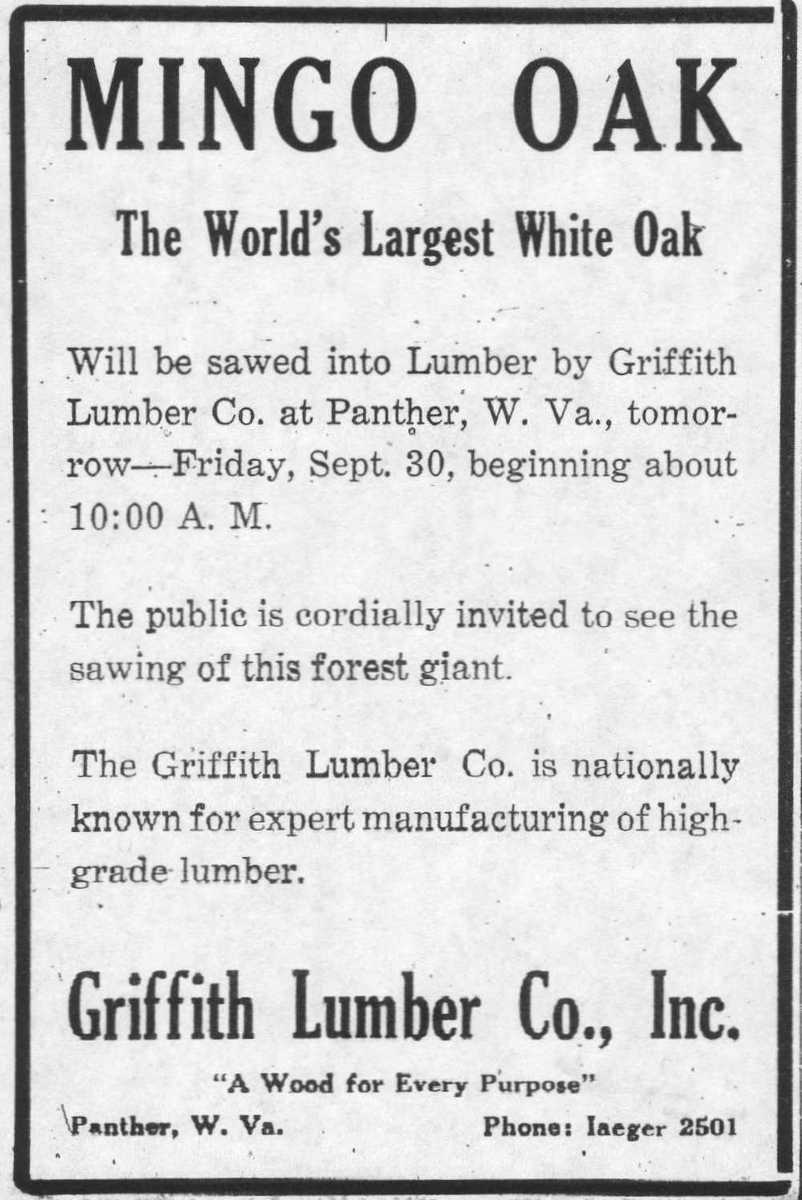
But another surviving document shows the Mingo Oak’s journey did not end there. An advertisement announced that the Griffith Lumber Co. at Panther would saw the “Mingo Oak — The World’s Largest White Oak” into lumber and invited the public to come watch.
Even after its death, the Mingo Oak attracted thousands of spectators, and cutting it remained an event big enough to draw another audience.
Where are the pieces today?
Surviving records show that people sought pieces of the Mingo Oak for museums and displays, and that other portions were intended to become lumber, tabletops, and smaller objects. They do not, by themselves, establish the eventual location of all those pieces.
That leaves an intriguing question nearly nine decades later. Pieces of the Mingo Oak may still survive in museums, public collections, or private homes, perhaps separated by generations from the story of the enormous tree from which they came.
The small park surrounding the oak did not have the same future. The 1938 account said that under the lease, the land would revert to the company after the tree was gone.

The tree disappeared from the mountainside, but its wood went elsewhere. Tracing what remains of the Mingo Oak may be the story’s last unfinished chapter.
The WVU School of Forestry has a round slice of the Mingo Oak
As I recall, it came from ninty feet above the ground.
Fascinating Story. More like it “wood” be appreciated. Simple heartwarming stories have more appeal than Fiction.
Great story ! It’s amazing to think that tree was alive and growing in West Virginia before Columbus discovered America !!!
a wonderful story about trees and how they connect with people!! Grow trees, grow!