

Coopers Rock State Forest is one of West Virginia’s premier bouldering destinations, with hundreds of established problems set among sandstone cliffs and boulder fields high above the Cheat River canyon.
Less than 15 miles east of Morgantown, it is especially popular with climbers from West Virginia University as well as Pittsburgh and Washington, D.C. Unlike the towering cliffs of Seneca Rocks or the longer routes of the New River Gorge, Coopers Rock is best known for its relatively low cliffs, accessible top-rope climbing, and an extraordinary concentration of bouldering.
A modern guidebook documents more than 400 boulder problems at Coopers Rock, while established climbing areas such as Upper Rock City, Roadside Rocks, Sunset Wall, and Tilted Tree offer a wide range of styles and difficulty levels.
Map showing Coopers Rock Climbing Area
Why climbers come to Coopers Rock
Coopers Rock’s appeal begins with the rocks. Cliffs and boulders appear throughout the forest, creating an unusually dense climbing landscape. The coarse sandstone provides ample friction and features that support technical footwork, powerful moves, and a variety of climbing styles.
Bouldering dominates the climbing scene. Because boulder problems are relatively short and climbed without ropes, climbers typically use crash pads and spotters to help manage falls.
Coopers Rock also offers opportunities for top-roping and short-roped climbs. Some areas offer relatively moderate routes suitable for climbers developing outdoor skills, while difficult boulder problems challenge experienced climbers.
More than 400 boulder problems
Coopers Rock has a long bouldering tradition. The modern Coopers Rock Bouldering Guide documents more than 400 problems across numerous formations and climbing areas. Problems include slabs, overhangs, arêtes, cracks, and technical faces, with holds ranging from positive edges to crimps and rounded slopers.
Better-known climbing sectors include Upper Rock City, Roadside Rocks, Sunset Wall, and Tilted Tree, though climbing extends well beyond these frequently visited areas.
The sheer number of individual boulders gives Coopers Rock a different character from many traditional climbing destinations. Rather than approaching a single continuous cliff, boulderers can move through the forest from formation to formation, encountering a variety of problems and styles along the way.
The geology behind the climbing
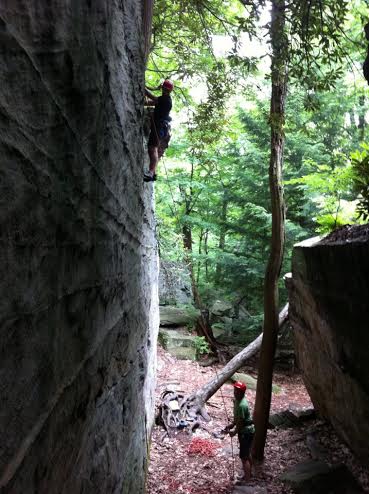
The cliffs and boulders at Coopers Rock are largely composed of resistant Pennsylvanian-age sandstone, including the Connoquenessing Sandstone Member of the Pottsville Formation. The sandstone takes its name from Connoquenessing Creek in western Pennsylvania, where geologist Israel C. White described and named the unit in 1878.
Weathering along natural joints has separated massive blocks from the bedrock at Coopers Rock, helping create the boulder fields, crevices, and maze-like rock formations that make the forest particularly well suited to climbing. The sandstone’s coarse texture provides the friction climbers prize, while cracks, edges, corners, pockets, and weathered surfaces create a remarkable variety of holds and movements.
The same resistant rock helps create the spectacular overlooks for which Coopers Rock is famous. From the main overlook area, the land drops steeply toward the Cheat River, producing one of northern West Virginia’s best-known canyon landscapes.
Popular climbing areas at Coopers Rock
Several areas have become particularly well known among climbers.
Upper Rock City
Upper Rock City is one of the forest’s principal bouldering areas. Large sandstone blocks are scattered throughout the woods, creating numerous problems within a relatively compact landscape.

Roadside Rocks
As its name suggests, Roadside offers convenient access and a concentration of established climbing. Its accessibility has helped make it one of the better-known areas at Coopers Rock.
Sunset Wall
Sunset Wall offers roped climbing and access to nearby bouldering. It is among the traditional climbing destinations most often associated with Coopers Rock.
Tilted Tree
Tilted Tree is another established bouldering sector and is part of the extensive network of problems distributed throughout the forest.
Roof Rocks
Roof Rocks offers short roped climbs and has traditionally been considered one of the more approachable places for top-rope climbing at Coopers Rock.
Climbers unfamiliar with the forest should use a current climbing guide and park map rather than relying solely on general descriptions to locate individual routes and boulder problems.
Bouldering at Coopers Rock
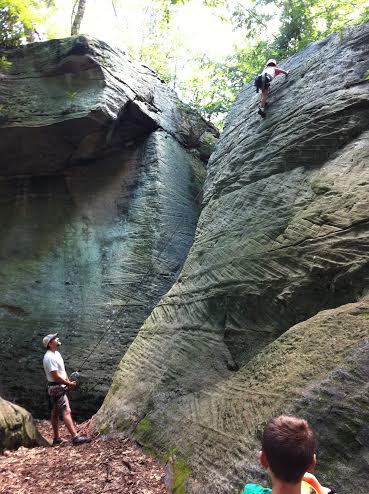
Bouldering is the activity most closely associated with climbing at Coopers Rock. Unlike roped climbing, bouldering generally involves short climbs called problems. Climbers use specialized movement to ascend a particular line and typically place crash pads beneath the climb while other climbers act as spotters.
Boulder problems in the United States are commonly rated using the V-scale, beginning with easier problems and increasing in technical and physical difficulty. Height alone should not be confused with safety. Falls onto uneven terrain, rocks, roots, or poorly positioned pads can cause serious injury, and some boulders are high enough that a fall can have severe consequences.
Climbers new to the terminology can consult West Virginia Explorer’s Rock Climbing Terms: A Beginner’s Guide to Climbing Terminology.
Top-rope and roped climbing
Although bouldering receives much of the attention, Coopers Rock also has a long tradition of roped climbing.
The relatively short cliffs lend themselves to top-rope climbing at appropriate established locations. In a top-rope system, the climbing rope passes through an anchor above the climber and returns to a belayer below, generally limiting the distance of a fall.

Some established routes are also climbed using lead-climbing techniques.
Roped climbing requires appropriate equipment and knowledge of belaying, anchors, rope systems, and other technical skills. Beginners should seek qualified hands-on instruction rather than attempting to learn these systems solely from written descriptions.
Climbing access and regulations
Coopers Rock State Forest permits rock climbing and bouldering, but climbers should observe current forest regulations and any restrictions established to protect visitors and natural resources.
Climbing is not permitted everywhere simply because exposed rock is present. Climbers should pay particular attention to restrictions around developed overlooks, visitor facilities, environmentally sensitive areas, and any locations subject to temporary closure.
Rules and access conditions can change. Check current information from Coopers Rock State Forest before climbing and observe posted signs and instructions from forest personnel.
Climbers should also minimize their impact on vegetation and soils, pack out trash, avoid damaging rock or trees, and respect other visitors using the forest.
When to climb at Coopers Rock
Spring and fall generally offer especially attractive climbing conditions at Coopers Rock, with moderate temperatures and a colorful surrounding forest.
Summer climbing is also popular, and the forest canopy can provide shade in many areas. Heat, humidity, thunderstorms, and wet rock can affect conditions.
Winter brings a different access situation. Roads and visitor facilities may close seasonally or have restrictions, and climbers may have much longer approaches when vehicle access is unavailable.
Because operating dates, road access, construction, and weather conditions can change, visitors should check current forest conditions before traveling.
Getting to Coopers Rock
Coopers Rock State Forest is located near Bruceton Mills, less than 15 miles east of Morgantown in northern West Virginia, and 60 miles west of Cumberland, Maryland.
The forest’s main entrance is off Interstate 68 near Exit 15. Roads within the forest provide access toward the main overlook and several recreational areas during the regular operating season.
Individual climbing sectors may require hiking from parking areas, and climbers should consult current park and climbing maps before setting out.
The forest’s proximity to Morgantown makes Coopers Rock particularly accessible for visitors traveling from northern West Virginia as well as western Pennsylvania and western Maryland.
More to explore at Coopers Rock
Climbing is only one reason to visit the forest. The forest protects thousands of acres along the Cheat River canyon and includes more than 50 miles of hiking and biking trails, scenic overlooks, camping, historic sites, and other outdoor recreation.
The forest’s best-known cultural landmark is the Henry Clay Iron Furnace, a massive stone furnace associated with the region’s 19th-century iron industry.
The combination of climbing, hiking, geology, history, and dramatic scenery makes Coopers Rock one of northern West Virginia’s most diverse outdoor destinations.
Plan a climbing trip to Coopers Rock
Before visiting, check current conditions and regulations with Coopers Rock State Forest, particularly during winter or periods of construction and road closures. Climbers should bring appropriate equipment for the type of climbing they intend to pursue and should not attempt unfamiliar technical systems without qualified instruction.
For more information about climbing throughout the Mountain State, explore West Virginia Explorer’s Rock Climbing in West Virginia guide, including climbing areas, terminology, safety information, maps, outfitters, and instruction.