



Dreamland murder-suicide house in Kenova, West Virginia, demolished
KENOVA, W.Va. — Every summer for nearly a century, people have flocked to Dreamland Pool in the small city of Kenova, West Virginia. On US-60 in Wayne County, it’s the first landmark drivers encounter when entering West Virginia from Kentucky. It’s also the region’s largest surviving public swimming pool and has long been a source of entertainment and nostalgia.

The Dreamland Pool complex is pictured in a colorized period postcard.
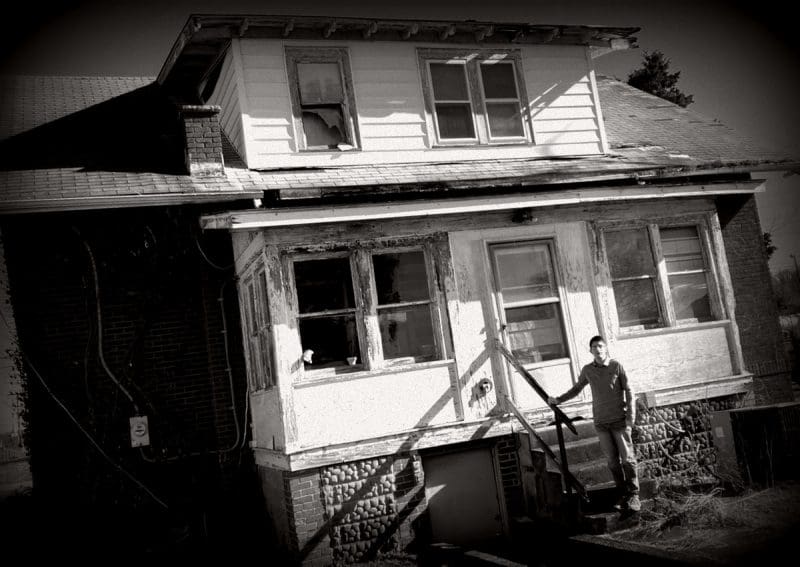
Next to the pool, but largely overlooked, stood a crumbling bungalow. Built in 1922, it was a landmark example of early 20th-century Craftsman-style architecture. These kinds of homes are common, though this house holds a dark secret that’s largely forgotten.
Here, a gruesome murder-suicide claimed the lives of its owners, leaving an unpleasant stain on the Dreamland legacy.
James Doliver “J.D.” Booth, born in 1875, and his wife, Bertha Ferguson Booth, born in 1879, were prominent in Kenova in the early 1900s. He was a successful businessman who had launched his entrepreneurial career operating a grocery store in Kenova.
He gradually acquired much real estate around the county, opened the town’s first movie theater, and founded the Kenova Ice Company. Bertha worked as a schoolteacher but eventually quit to become her husband’s business partner.
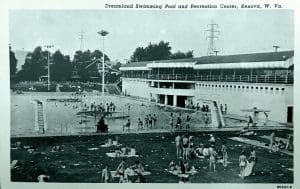
Swimmers cavort at the Dreamland Pool during its heyday.
After creating the ice company, J.D. considered other ways to commercialize water. In 1926, he constructed Dreamland Pool just south of his house on 23rd Street in Kenova.
Measuring 125 feet by 250 feet, the public pool was said to be the largest east of the Mississippi River at the time. At its front, a three-story pavilion hosted dances and live big-band concerts. Many big-name acts, such as Glenn Miller and Benny Goodman, were rumored to have performed. Louis Armstrong is even reputed to have stayed in the Booths’ house because no local hotels would accept Black customers.
While Dreamland grew in popularity, domestic tensions may have simmered within the Booth family. J.D. was said to have been a severe alcoholic to the extent that family members kept him under close supervision. The Booths also installed metal bars on the basement and first-floor windows.
According to local legend, the family grew paranoid following the sensational kidnapping and murder of aviator Charles Lindbergh’s young son in 1932 and feared they might fall victim to a similar scheme.
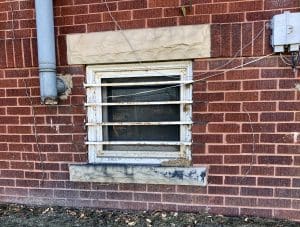
The lower windows on the Booth House were barred to deter intruders.
Sunday, May 31, 1936, began like any day at Dreamland. The pool was celebrating ten years of operation and had recently unveiled a new playground. Bertha was working in the ticket booth that afternoon.
Around 1:30 p.m., a drugstore employee arrived at the Booth home with an ice cream delivery, and Bertha and J.D. returned to their house. At 1:50 p.m., patrons at the pool reported hearing three rapid gunshots coming from the rear of the house, followed later by a fourth.
People ran to the house and found Bertha lying dead in the backyard. According to police, she had two bullet wounds in her back and a third in the neck. J.D. was found on the back porch, allegedly having shot himself in the head with a revolver. He lingered for 10 hours before dying at a local hospital. Investigators found that the handgun had fired six rounds.
Police determined that J.D. first tried to shoot Bertha inside the house. She made it outside and was running for help when J.D. shot her from behind before turning the gun on himself, they reported.
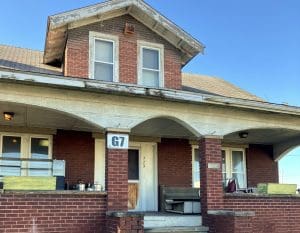
The neglected Booth House in Kenova may soon face demolition.
Family members claimed that J.D. had been suffering from heart trouble and other debilitating health conditions. This may have affected his quality of life and led him to feel depressed or frustrated.
Newspapers at the time reported that he experienced a “temporary mental derangement,” which caused him to kill his wife and himself. Mental health was not widely understood or adequately treated at the time. Did J.D. suffer from an undiagnosed mental illness? Did he take one drink too many and fly into a drunken rage?
Due to the circumstances of their deaths, J.D. and Bertha had separate burials. Bertha was interred at Ridgelawn Memorial Park in Huntington, West Virginia, while J.D. was buried in his family’s private cemetery at White’s Creek in rural Wayne County. The couple’s son, daughter-in-law, and grandson made their loyalties clear when each chose to be buried with Bertha at Ridgelawn.
J.D. and Bertha’s only grandchild, Alex Booth, Jr., was ten years old in 1936 and living with them. He was working at the pool that afternoon when the murder-suicide occurred. Eight decades later, in a biography written by his wife, he offered another reason for the tragedy. He claimed that his grandparents constantly argued and that J.D. resented that Bertha had only given him one child instead of the large family he wanted.
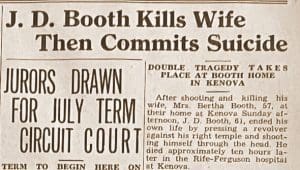
The Booth murder-suicide was a sensation in western West Virginia in 1936.
Alex was so traumatized by the deaths that he vowed to end the family bloodline by never having children—a promise he kept to his death in 2017. He grew up to become a successful coal executive and earned millions. In his later years, he donated much of his fortune to philanthropic causes, including the construction and support of churches, libraries, and retirement homes and the funding of scholarships and support for the Huntington Museum of Art.
The Booth family later sold Dreamland Pool and their house. The famed pavilion was destroyed by fire in 1973, and the pool declined in popularity thereafter, but it remains a staple of the Kenova community. People continued living in the house until the 1990s, when it became the temporary site of the Kenova Museum.
Today, the Booth house sits unused and rapidly deteriorating, making an eerie eyesore for Dreamland. It suffers from crumbling masonry, holes in the roof, broken windows, rotting wood, and flooding in the basement. The city plans to demolish the house. A haunting but captivating piece of Dreamland’s history will be lost forever when this landmark is gone.
Sign up for a FREE copy of West Virginia Explorer Magazine in your weekly email. Sign me up!
Nightfall’s Value: Light pollution can diminish real estate worth in W.Va.
WINFIELD, W.Va. — An increasing number of new West Virginia residents are being drawn to its rolling hills and quiet valleys to escape brightly lit...
Inside Appalachian Escapes: Themed rentals, escape rooms, and a love letter to West Virginia
FAYETTEVILLE, W.Va. — What began as a search for an affordable retirement option has turned into one of southern West Virginia’s most imaginative...
West Virginia bottler wins silver award at international water competition
BERKELEY SPRINGS, W.Va. — Le Sage Natural Water, of Lesage, has been awarded a silver medal for its purified water at the 36th annual Berkeley...
West Virginia uniquely prepared to dominate 21st-century outdoor economy
CHARLESTON, W.Va. — West Virginia is uniquely prepared to dominate in the 21st-century outdoor economy of the U.S., thanks to its unmatched...
Flood risk outpaces warnings, advocates say, as W.Va. considers changes to resiliency fund
CHARLESTON, W.Va. — As the W.Va. House of Delegates considers changes to Senate Bill 390, the West Virginia Rivers Coalition warns that the state...
We asked AI how its own data centers could pollute West Virginia. Here’s what it had to say
(The following article was generated partly by ChatGPT in response to a prompt about how data centers pollute. As ChatGPT is powered by data...
Inaugural W.Va. Outdoor Economy Summit to unite leaders around $2.1 billion growth
CHARLESTON, W.Va. — West Virginia’s outdoors are more than a scenic backdrop. They’re a strategic economic asset. That message will take...
West Virginia State Parks Foundation launches online merchandise store
HURRICANE, W.Va. — The West Virginia State Parks Foundation has launched an official online merchandise store, offering supporters a new way to...
West Virginia Travel Safety: What it means for residents and visitors in 2026
CHARLESTON, W.Va. — Travel safety in West Virginia is shaped less by headline-grabbing crime and more by geography, weather, and the realities of...
Did Abraham Lincoln and Jefferson Davis secretly meet in West Virginia?
PHILIPPI, W.Va. — Did Abraham Lincoln and Jefferson Davis secretly meet in what is now West Virginia just days after the first land battle of the...