
BECKLEY, W.Va. — Long before hydrogeologists, groundwater maps, or drilling contractors, families across Europe and North America sometimes sought the help of a water diviner before digging a well.

Few places, however, embraced the tradition as enduringly as Appalachia. Carried to the mountains by English and German settlers, water divining became part of everyday rural life, where isolated communities depended on springs and private wells, and local knowledge often mattered as much as formal science.
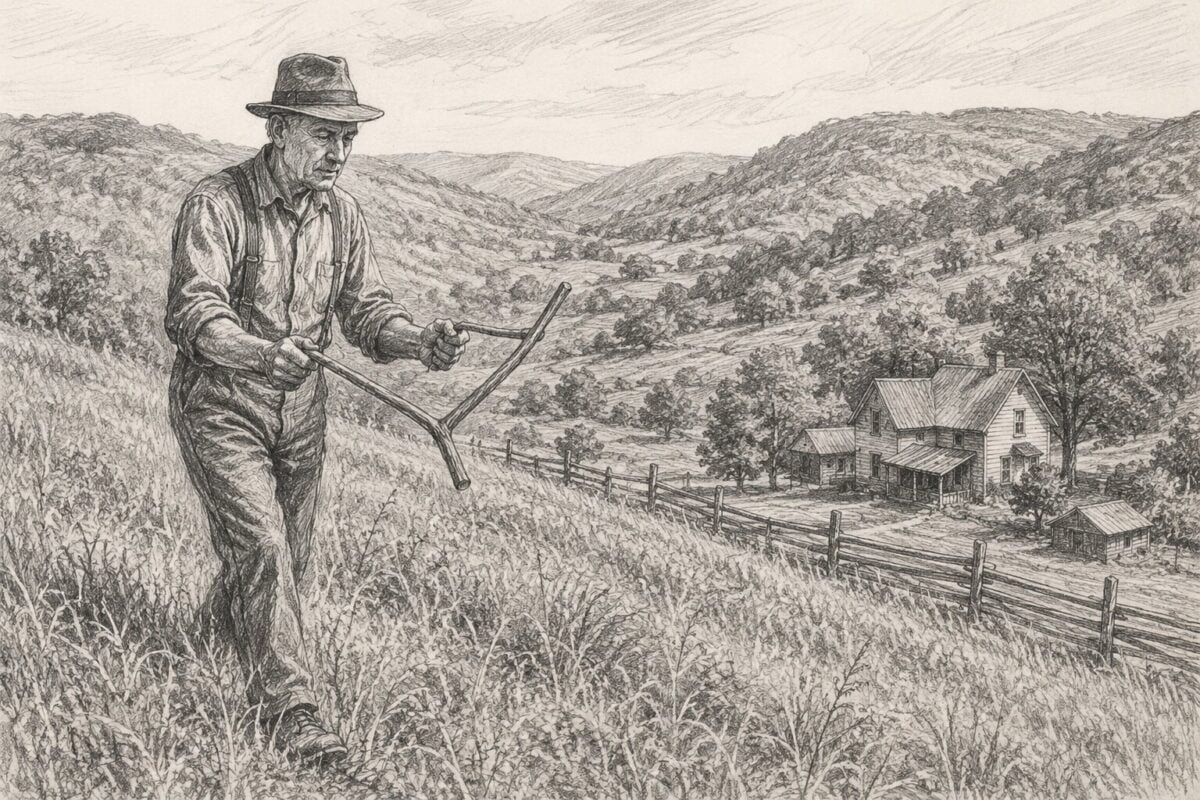
The image remains one of the most perennial in Appalachian folklore—a man walking slowly across a hillside, a freshly cut branch held lightly in both hands, waiting for it to twist toward the earth. Where it dipped, he declared, water lay below.
Known as water divining, water witching, or dowsing, the practice has occupied a curious place between practical necessity and folk tradition for centuries. While relatively few practitioners remain today, stories of successful water diviners continue to circulate throughout the mountains, where the custom survives as one of Appalachia’s most recognizable cultural heritage practices.
For many Americans outside the region, the practice seems almost mystical. Yet for generations of mountain families, there was little romance in the matter. A dependable, well-meaning, clean drinking water, healthy livestock, successful crops, and, often, the very location of a new home.
An Old World Tradition Finds a Home in Appalachia
Although many people associate water divining with Appalachia, the practice originated long before the European settlement of North America.
The U.S. Geological Survey traces its roots to Europe, where divining rods were first used to search for mineral deposits before becoming associated with underground water. The agency notes that the practice spread throughout England and continental Europe before being carried across the Atlantic by some of the earliest English and German settlers.
West Virginia folklorist Jim Comstock likewise emphasized that water divining “is not restricted to West Virginia, to Appalachia, or even to America.” Still, he observed that it had been practiced in the Mountain State since the first permanent settlements, becoming deeply rooted in the region’s rural culture.
Appalachia proved especially fertile ground for the tradition. For much of the region’s history, families depended almost entirely on springs and private wells. Drilling a dry hole could mean losing a substantial investment, and professional geological advice was rarely available in isolated mountain communities. Hiring an experienced local dowser—whether one believed in the practice completely or simply considered it worth trying—often seemed like a practical decision.
A forked branch and a walk across the hillside
Traditional Appalachian dowsers relied on remarkably simple tools. Most carried a freshly cut forked branch from a peach or witch-hazel tree, though willow was sometimes used as well. Holding one fork in each hand with the stem pointed upward, the dowser slowly crossed the property. Tradition held that when the branch passed over underground water, it would twist or dip toward the ground.
Others preferred bent metal rods, pendulums, or homemade wire devices. Some even claimed they could locate water by passing a rod over a map rather than walking the land itself.
Both Comstock and the U.S. Geological Survey recount stories from practitioners who claimed the rod occasionally twisted with such force that it blistered or bloodied their hands. Whether interpreted as evidence of hidden forces or the body’s unconscious movements, the dramatic image became one of the defining symbols of water divining.
According to the survey, some dowsers claim they can discover a water source merely from a map.
“Although most dowsing for water is done at the actual site where water is needed, some dowsers claim to be able to locate water simply by passing the stick over a map.”
A practical solution to an expensive problem
Water divining became woven into Appalachian life not because it promised mystery, but because it addressed a costly problem.

Long before modern hydrogeology, every new well represented a gamble. A drilling crew might bore through solid rock only to find little or no usable water. Compared with the expense of drilling, consulting a respected local dowser costs very little.
Many diviners were not mysterious figures living on the margins of society. They were often farmers, carpenters, or well-known members of their communities whose reputations spread through neighbors’ recommendations. Their success—or perceived success—was measured not in scientific studies but in stories passed from one generation to the next.
Comstock recounts one of West Virginia’s best-known examples. According to his account, a respected dowser successfully located a productive well at the West Virginia Turnpike’s Bluestone Glass House after geologists had failed to find water. Yet the same dowser later proved unsuccessful in locating water for the nearby Bluestone Conference Center.
Those contrasting stories illustrate why the tradition has endured. Successes became local legends. Failures became part of the folklore as well. Neither completely settled the debate.
What science says
Modern hydrologists generally explain the phenomenon differently. According to the U.S. Geological Survey, groundwater exists beneath much of the Earth’s surface. In regions with adequate rainfall and favorable geology—conditions common throughout much of Appalachia—it can be difficult to drill a well without encountering water at some point.
Read more: The U.S. Geological Survey has published a brochure on water dowsing.
Finding water, however, is only one part of the challenge. The depth of the aquifer, the quality of the water, the rate at which it can be replenished, and its long-term yield all require geological and hydrological investigation.
The survey concluded that controlled scientific studies have not demonstrated that water divining locates groundwater more successfully than chance and determined that additional testing of the practice was not justified.
Comstock acknowledged that some scientists have suggested the movement of the divining rod results from motor automatism—unconscious muscle movements that cause the branch or rods to turn without deliberate effort. Others, he noted, simply declined to speculate on the phenomenon, while still others argued that groundwater is common enough that many wells succeed regardless of where they are drilled.
A tradition that still fascinates
Today, most wells are planned using geological mapping, groundwater studies, and modern drilling techniques rather than the advice of a dowser. Even so, water divining has not disappeared.
A small number of practitioners continue the tradition, and many Appalachian families can still recall a parent, grandparent, or neighbor who once carried a forked branch across a hillside before the drilling began.
Whether viewed as folklore, psychology, coincidence, practical experience, or something more difficult to explain, water divining has earned a lasting place in Appalachian history. It belongs to the same world as herbal remedies, weather lore, moon planting, and stories shared on front porches—not because everyone believed in them, but because they reflect how generations of mountain people understood the landscape around them.
Long after science transformed the search for groundwater, the image endures: a quiet Appalachian hillside, a forked peach branch held gently in two hands, and the hope that somewhere beneath the mountains, fresh water waits to be found.
Read also: Strange tales of ‘Turkey Witches’ weren’t uncommon in early W.Va.
My father and uncles drilled water wells . All their working years . Using peach limbs off trees .
Back in the day these water diviners were called water witches. I personally knew of an old water witch who was contacted by many in WV to find there water . Especially in the Harrison County area of West Virginia. She used a divided peach tree branch for years , and then one day she saw a pair of channel lock pliers laying on the ground and picked them up and immediately it pointed to the ground . From that day forward she used channel lock pliers to locate water.
My Dad still does this for people today. None of us kids can do it, but people have tried to debunk that he can. He’s even held the branch with pliers, the branch still turned and pulled the bark off. People here call it water witching.
I worked construction for 35 years and did the underground work of water,sewer,electrical, cable and other utilities. I used a welding rods to find any thing that could possibly be buried where we dug. The utility companies always backed me up as I never missed a working line often finding dead long unused lines. We still used the service provided by utilities because of liabilities most of the time but it was nice to have a double check before we dug.
I can’t believe there are still people out there that believe this fake stuff. Hey, I got a bridge to sell you…
Dear person with common sense u are entitled to your opinion but I personally have seen a water which find water and see a successful water well drilled in the marked spot 100 per cent of the time . Clients included Doctors, country clubs etc . I think u need to read up and reconsider your opinion .
Sure 6trout, I fully believe you, even though there is zero evidence of this ever working, unless you take tall tales as evidence. I guess you believe in bigfoot, the mothman, the Loch Ness monster and everything else some nut job claims to see. Who needs evidence, someone said they saw it once….
Show me one single scientific paper on the legitimacy of finding water with a stick.
Person with common sense read more history a get out once in awhile .
Our family has used this method for numerous decades and it’s always 100% accurate. Not only to find a new well but hidden septic tanks. We will always use this method first.