
RICHWOOD, W.Va. — West Virginia has long served as a place of retreat. The wealthy have sought refuge at its mineral springs, the devout have embraced its solitude for reflection, and free spirits have been drawn to the independence afforded by its forested hills.
Among the most celebrated of those free spirits were two twentieth-century cave dwellers—Orval Brown, the famed “Wild Man of Clay County,” and Jack Franklin, the “Webster County Cave Man.” Brown reportedly spent much of his youth sleeping in caves, while Franklin maintained separate caves for summer and winter living.
Their stories were chronicled by historian Jim Comstock in his 1974 Commonplace Book. Though the state has known other cave dwellers, Comstock devoted particular attention to Brown and Franklin, recounting their lives in his distinctive storytelling style. The narrative reproduced below appears as originally published and has not been edited.
Webster County Caveman
For more than 20 years, and some say as many as 42 years, Jack Franklin lived in a Webster County cave. A former Kentuckian, he worked in the woods for many years and finally decided he preferred the forest to civilization. He found himself a cave on Cleveland Mountain, and there he holed up with his dogs. dogs. In time he expanded his unusual residence to include two caves, one for winter and one for summer use.
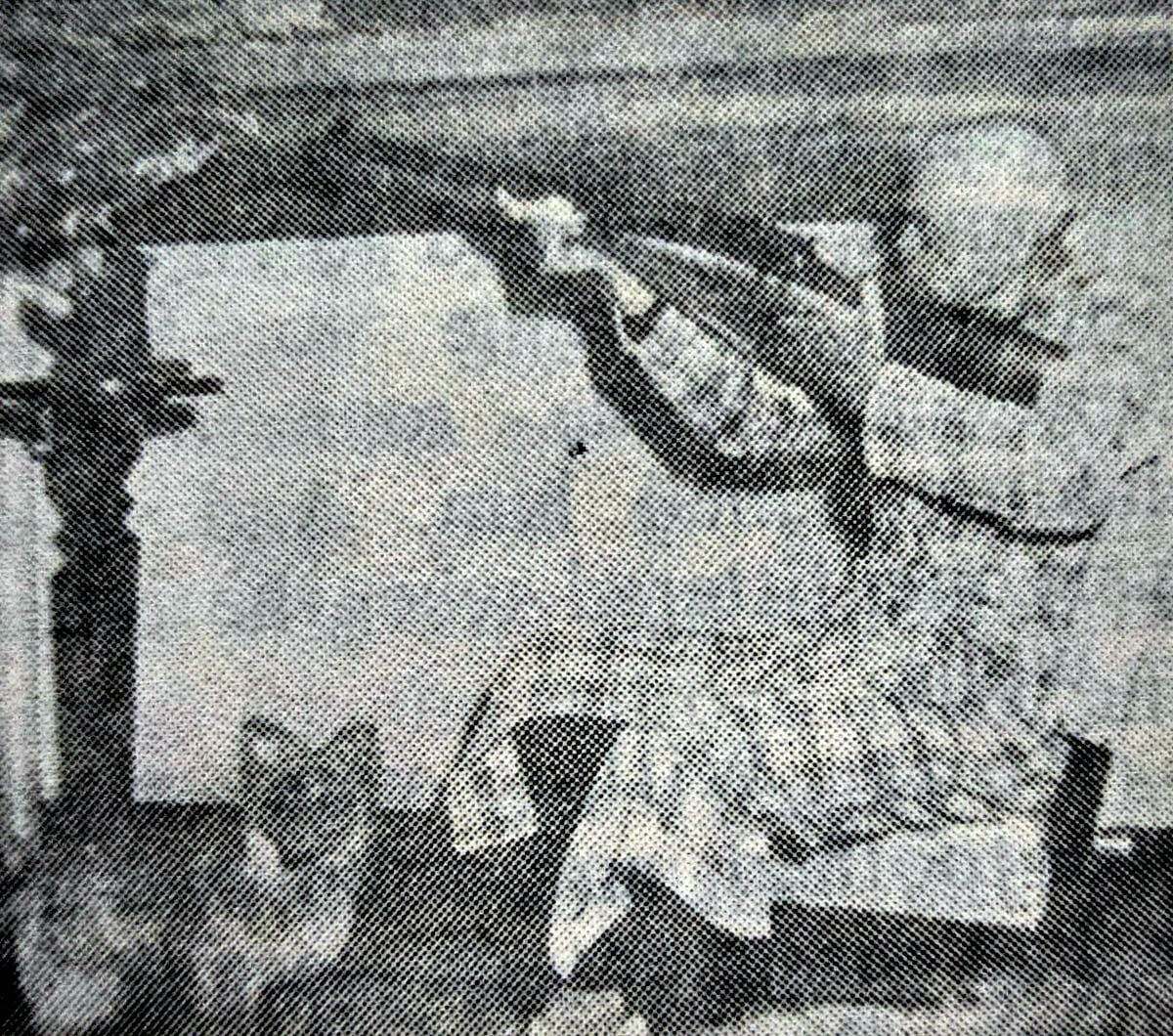
Franklin got a small relief check and used part of it to buy food, flour, salt, sugar, and, for a treat, an occasional loaf of bread and can of Vienna sausage. At the summer cave, he raised a small patch of corn in a clearing and used the grain to make corn dodgers in an iron skillet over his open fire. The shucks were used as bedding for himself and dogs. He also hunted for food, using a gun and later a bow and arrow.
Once, it was claimed, he ate one of his dogs, an animal that wasn’t much good at hunting or anything else. At the age of 78, Franklin was forced to give up his wilderness home when a particularly severe winter belied the predictions of a mistaken woolly worm. Jack Franklin contracted two badly frozen feet and had to be moved to a nursing home in Elkins, where he died.
Wild Man of Clay County
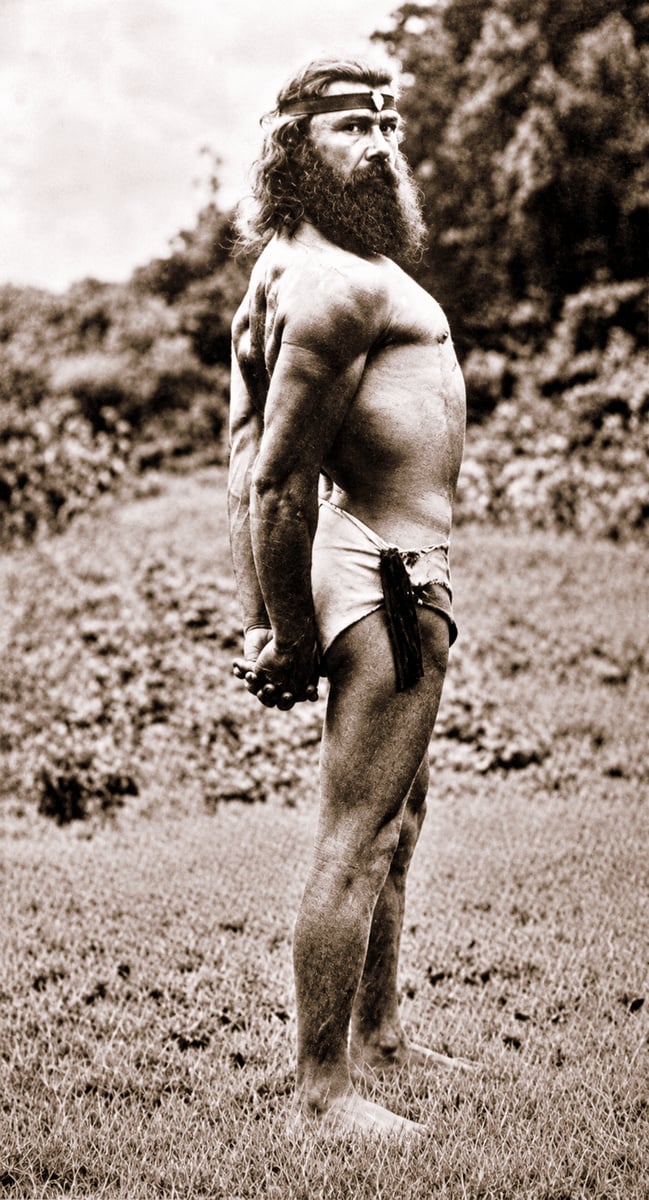
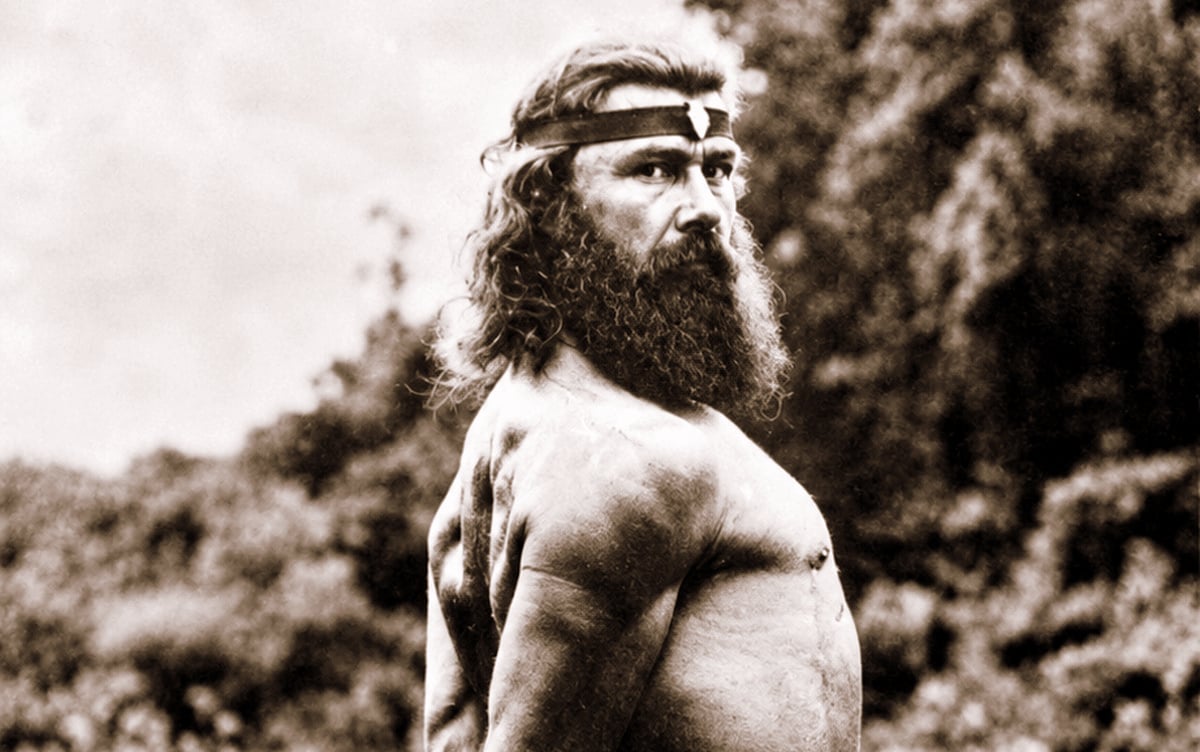
Orval Brown, the “Wild Man of Clay County,” made the newspapers from time to time in the 1930s and ’40s. He spent a good deal of time in the woods, wearing nothing but a loincloth made from groundhog skins, but his career came to an abrupt end when he was 43.
As a child, he began sleeping in caves and roaming the woods clad only in his scanty clothing. He had pictures taken of himself and sold them to tourists who made special trips through Clay County to see the “wild man.” He claimed he had discovered a gold mine in Wyoming in 1929 and served two years in the Navy during World War II.
His muscular body, long hair, and beard apparently intrigued newspaper reporters, as the “wild man” was seen in various papers across the state on many occasions. Questioned as to why he let his hair and beard grow, he said, “I fought it and fought it, and decided it was going to grow anyhow, so I just let it grow.”
Asked about his future plans, Brown once said, “How does anyone know what the future holds in store? I can just live each day and hope for the best.” Accused of the murder of Wilford Reedy, he was ruled insane and committed to the State Hospital for the Insane in Spencer.
Wild Man of Flatwoods
Comstock’s accounts of Brown and Franklin were just two of many stories about wild men that appeared in American newspapers. In 1919, Florida’s Evening Telegram published a dispatch from Flatwoods describing a mysterious figure said to roam the forests of Braxton County.
The following account was provided by Andrew Smith of the Braxton County Convention and Visitors Bureau. Smith also serves as curator of the Flatwoods Monster Museum, which interprets the history and folklore surrounding the famous 1952 Flatwoods Monster sighting in the hills south of Flatwoods.
Return of Wild Man Revives Terrors
Flatwoods, W.Va. — The belief that a wild man is still lurking in this vicinity, stealing and killing chickens and young pigs, is stronger than ever just now. A story related by Luther C. Douglas has dispelled all hopes that the terrible creature had fled to other localities. Douglas’ story follows:
“I was on my way home from lodge meeting,” said Douglas, “When I heard a noise near Ed Wiley’s barn, which is close to the road. I thought it might be a dog and paid little attention to it at first; then, as I was passing a vacant house a short distance from Ed’s place, I heard a distant door slam and a wild-looking fellow, in rags and with the same long hair and beard that others who have seen him have described, came running out of the front door of the old house, brandishing a huge knotted club and uttering the most horrifying sounds I ever have heard.

“Being convinced by his actions that I was to be assaulted and possibly killed, I drew my revolver and took two shots at him. With this, he turned and fled, screaming louder than ever. I didn’t pursue him. Not me. It would take a braver man than I profess to be to go on the trail of that horrible creature.” The authorities are again agitating the question of taking some means to capture this much-feared lunatic or whatever he is.”
According to Smith, the “wild man” article and more recent stories of an ape-like creature haunting the forests around nearby Sutton Lake imply that the region is at least fertile ground for such tales. Rumors of Bigfoot have circulated for many years and have even inspired the creation of the West Virginia Bigfoot Museum in downtown Sutton.
“Certainly, many reports have come in from the area near the lake where there’s so much tourism, but for decades, tales have come in from areas across the region,” says Smith, who attributes the county’s wealth of monstrous encounters partly to its dark skies and deep forests.
The practical challenges of cave living
Although caves have long been associated with hermits, outlaws, and so-called wild men, they have rarely been preferred places to live. Most caves are damp, dark, and difficult to heat, and many are prone to flooding or poor ventilation. Even prehistoric people, often imagined as permanent cave dwellers, likely used caves only occasionally, choosing more comfortable shelters whenever possible.
Yet caves continue to occupy a prominent place in legend and folklore. Their isolation makes them natural settings for stories of mystery, self-reliance, and escape from society. From religious ascetics seeking solitude to mountain hermits and wild men of Appalachia, cave dwellers have fascinated generations not because their lifestyle was common, but because it was unusual. The cave remains a powerful symbol of withdrawal from the ordinary world, even if few people have ever found it a desirable place to call home.
Crepuscular Caves: Ideal for a Wild Man
Unlike the vast underground chambers of West Virginia’s celebrated limestone caverns, most people who sought shelter in the state’s wilderness would have found greater utility in crepuscular caves and rock shelters. These shallow recesses, formed where softer layers of sandstone have eroded beneath harder caprock, are common throughout the Allegheny Plateau.
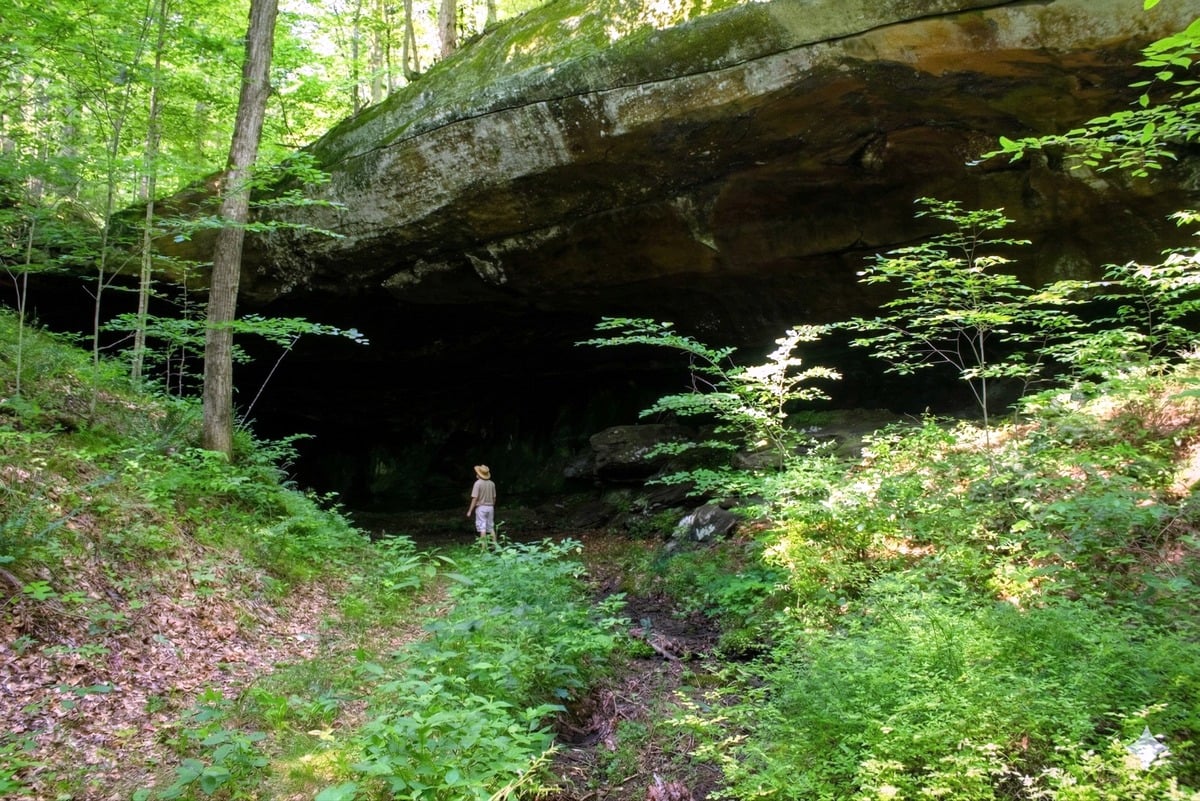
Open to daylight and often extending only a short distance into a hillside, they provide protection from rain, wind, and summer heat without the perpetual darkness, dampness, and navigational hazards associated with deep caves. For travelers, hunters, and occasional hermits and the occasional “wild man,” such shelters offered a practical refuge that required little adaptation.
The distinction is important because popular imagination often places recluses, outlaws, and legendary “wild men” in vast subterranean caverns. In reality, deep caves pose numerous challenges for long-term habitation, including cold temperatures, high humidity, limited sunlight, and difficulty maintaining fires or obtaining food.
Crepuscular caves and rock shelters, by contrast, provide natural overhangs with access to daylight, nearby water sources, and surrounding forests rich in game and edible plants. As a result, many of the locations described in folklore and historical accounts as “caves” were likely shallow rock shelters rather than the extensive cave systems for which West Virginia is also renowned.
Struggle for religious freedom in U.S. unfolds in tale of Eckerlin brothers
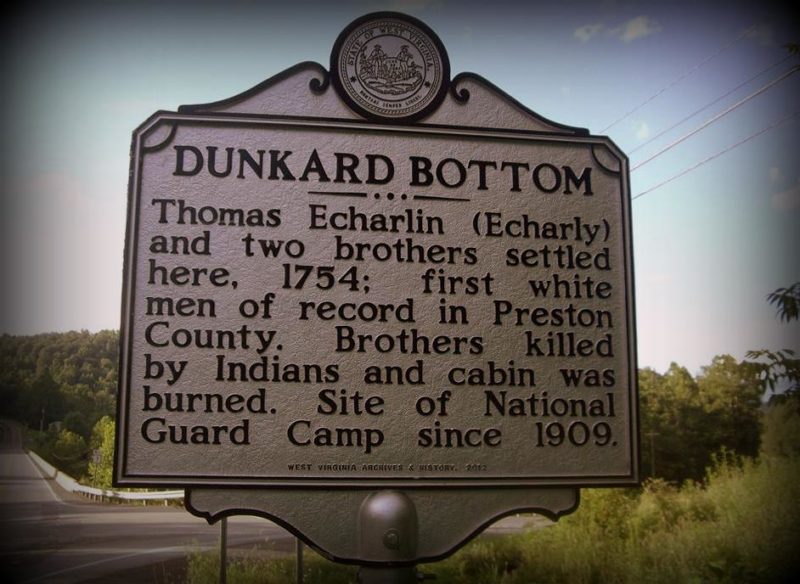
One such story is that of the Eckerlin Brothers, who were Dunkards, a branch of Anabaptists (as are the Amish and Mennonites). The Dunkards were known for fully immersing, or dunking, their baptized. Dunkard Creek, in Monongalia County, and Dunkard Bottom, in Preston County, are both named for the Eckerlins, Anabaptists believed to have been among the first Europeans to settle in the vast wilderness west of the Allegheny Mountains. READ THE FULL STORY OF THE BROTHERS HERE.
Have another story of a Wild Man of West Virginia? Please share in the comments below.