
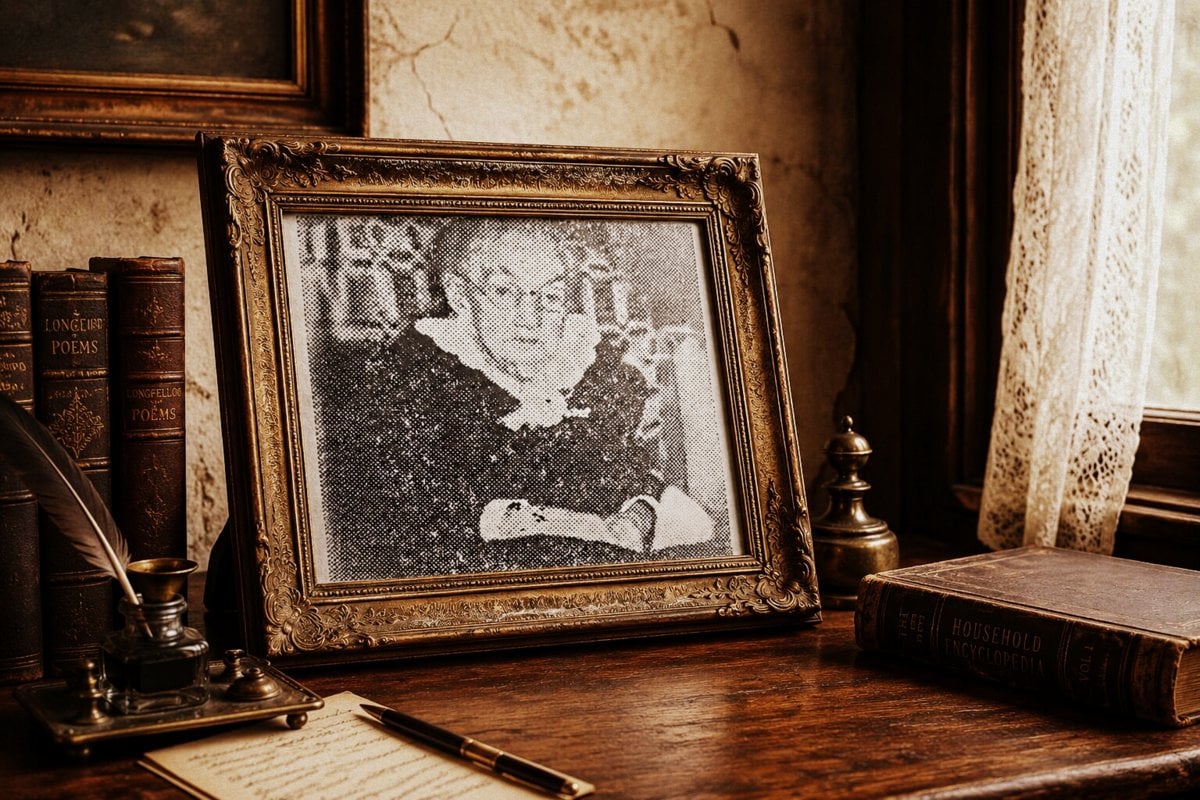
PURSLEY, W.Va. — A Tyler County woman who lived to 100 years old claimed her family unknowingly sheltered John Wilkes Booth, the assassin of President Abraham Lincoln, shortly after Lincoln’s death in 1865.

The account was published in Volume 14 of the W.Va. Heritage Encyclopedia, compiled by West Virginia historian and publisher Jim Comstock. It appeared in a profile of Effie “Aunt Effie” Wells of Pursley Creek, who celebrated her 100th birthday in 1958.
According to the encyclopedia entry, Wells recalled being about six years old when a man and woman arrived at her family’s home seeking a place to stay for the night. The woman reportedly explained that her husband had injured his leg, and the travelers were permitted to stay overnight before continuing their journey.
Years later, Wells said her father became convinced the injured man was John Wilkes Booth after seeing newspaper photographs of Lincoln’s assassin.
Booth’s flight after Lincoln’s assassination
On April 14, 1865, Booth shot Lincoln while the president was attending a performance at Ford’s Theatre in Washington, D.C., and the president died the following morning.
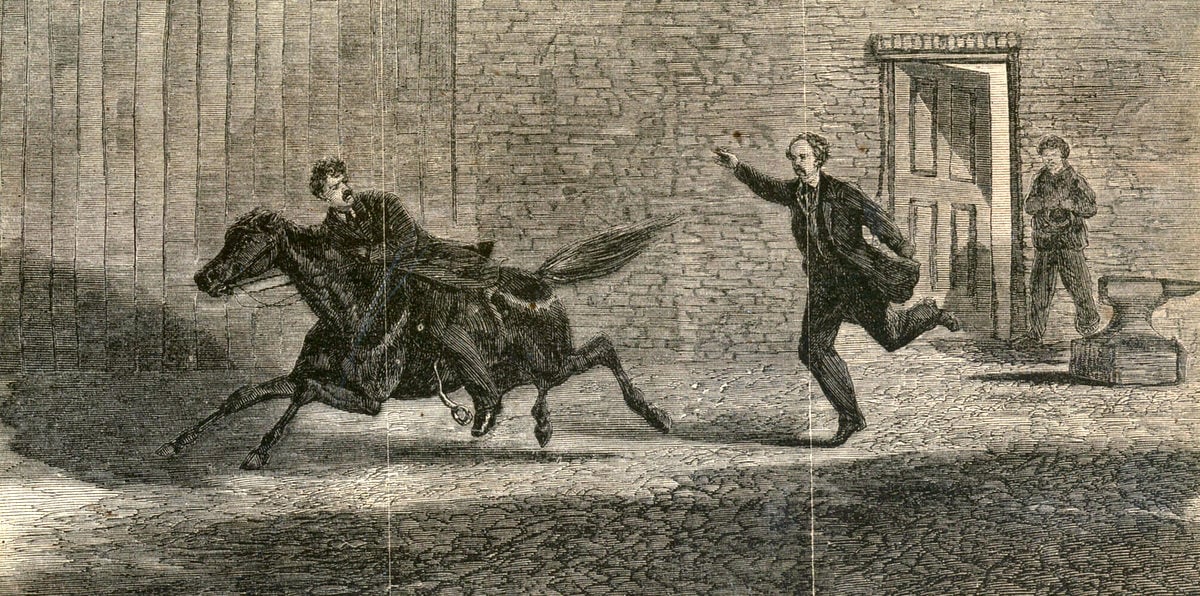
Booth fled the city with David Herold, a 23-year-old accomplice who helped him escape, after which federal authorities immediately launched a manhunt that became one of the largest in the nation’s history.
Historical records indicate Booth suffered a broken leg during his escape from the theater, and the injury became one of the most widely known details of the case, reported extensively in period newspapers.
Booth and Herold traveled through Maryland before crossing into Virginia, and evaded authorities for nearly two weeks before being located at a tobacco farm near Port Royal, Virginia, about 70 miles south of Washington.
On April 26, 1865, Union soldiers surrounded the farm, and Booth was shot during the confrontation and died shortly afterward. Herold surrendered and was later tried and executed for his role in the conspiracy.
Because Booth’s injured leg was widely publicized, Wells’s recollection attracted attention when Comstock later recorded it.
A story preserved in local history
The encyclopedia entry does not present Wells’s account as established fact, but Comstock considered the story important.
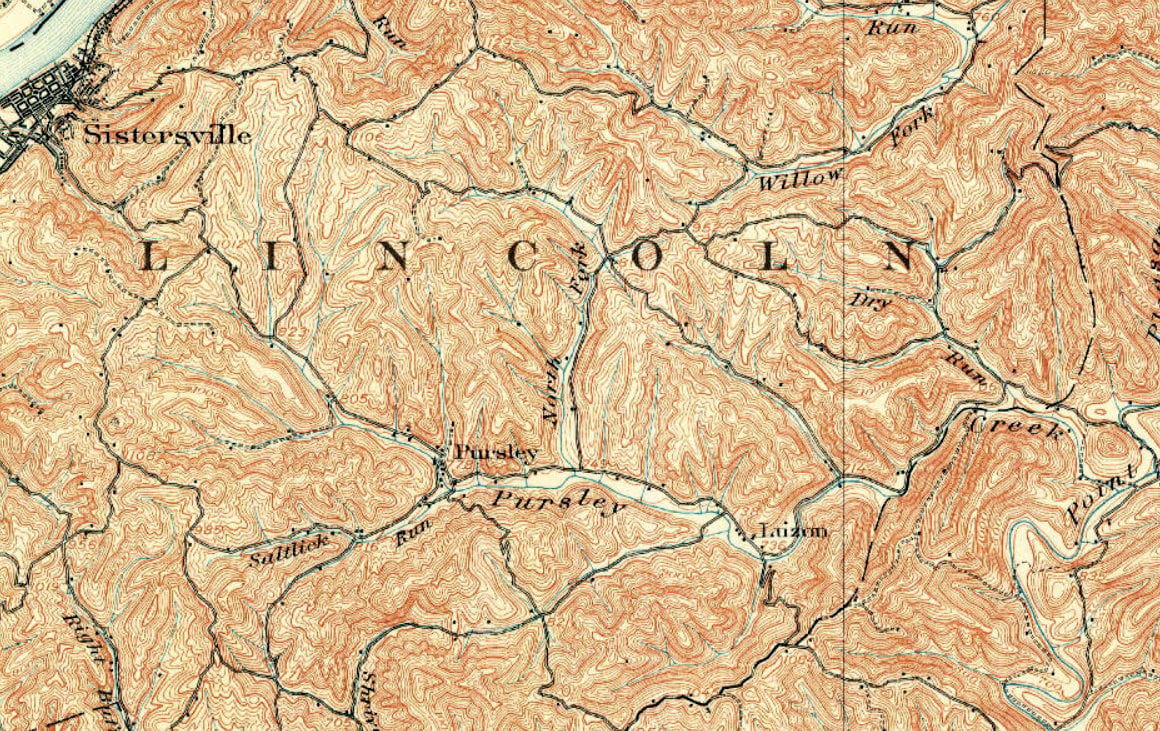
No known military records, newspaper reports, or contemporary documents place John Wilkes Booth in Tyler County during his flight, and historians generally agree that his route stayed much farther south in Maryland and Virginia rather than 300 miles away in Pursley, a stone’s throw from the Ohio River at Sistersville.
At the same time, Wells maintained that her father believed the injured traveler resembled Booth after seeing newspaper photographs published after the assassination. The account was recorded decades after the events it describes and is best viewed as a family recollection preserved through oral history.
“Booth was shot in a burning barn on April 26, near Port Royal, Virginia,” Comstock points out, “a fact which neither confirms nor denies the possibility that Booth and a companion may have stayed with Aunt Effie’s family as she reported.”
Such stories were not uncommon in the decades after the Civil War. Across the country, people reported alleged sightings of Booth and other figures linked to major historical events. Some claims were supported by evidence, while many remained local traditions passed from one generation to the next.
A similar story was recounted by Comstock in which Lincoln and Jefferson Davis met in secret in the covered bridge at Philippi, West Virginia. Whether the traveler who stayed at the Wells home was Booth cannot, of course, be verified by the historical record.
Life along Pursley Creek
The encyclopedia profile focused primarily on Wells herself rather than the John Wilkes Booth story. Born around 1858, she spent her entire life in the Tyler County area and witnessed dramatic changes in American society over the course of a century.
As a child, she experienced the Civil War and remembered the uncertainty that accompanied the conflict in what was then northwestern Virginia. West Virginia, of course, became a state in 1863, while the war was still underway.
According to the profile, Wells said her brothers served in the Home Guard, a unit organized to protect local communities from raids, theft, and violence during wartime—”to defend their home from marauders who would have taken all they own,” she recounted to Comstock.
Many residents of the region faced difficult conditions as Union and Confederate sympathizers competed for influence and control throughout the area. Wells’s memories offered a firsthand connection to that period of state history.
A century of change
By the time Wells celebrated her 100th birthday in 1958, the world around her had changed dramatically. She had been born before electric lights, automobiles, airplanes, radio broadcasting, and television became common.
She witnessed the growth of railroads, the expansion of industry, the First and Second World Wars, and the beginning of the Space Age. Comstock notes that Wells considered electricity, telephones, and modern heating systems among the greatest changes she experienced during her lifetime.
“Aunt Effie’s mother came from Germany, and her grandfather was with Napoleon on the long, bitter retreat from Moscow,” Comstock wrote.
“Despite her memories of an age of antiquity, Mrs. Wells adapted well to the wonders of the 20th century, believing that electricity, gas heat, and the telephone were wonderful inventions.”
Her recollections provided readers with a direct link to a period of history that was already fading from living memory by the mid-twentieth century.
Jim Comstock’s effort to preserve West Virginia history
The account endures largely because of the work of Jim Comstock, publisher of the West Virginia Heritage Encyclopedia, who spent years collecting historical material from across the state, including newspaper articles, biographies, family histories, oral traditions, and local records.
The encyclopedia eventually grew to 51 volumes and remains a frequently cited source on West Virginia communities and families.
While historians often distinguish between documented events and oral traditions, Comstock’s work preserved thousands of stories that might otherwise have been lost. The account of Effie Wells and the improbable possibility that her family once hosted Lincoln’s assassin is one such story.
No evidence has emerged to prove the claim or likely ever will. Yet the recollection remains part of the encyclopedia’s historical record, offering a glimpse into how one West Virginia family remembered the events of April 1865.
More than 160 years after Lincoln’s assassination, the question raised by Wells’s account remains unanswered.
Who was the injured traveler who resembled John Wilkes Booth? A stranger passing through Tyler County whose influence on the world inspired this very article more than a century and a half later.
Was John Wilkes Booth ever connected to West Virginia?
While historians have found no evidence that John Wilkes Booth ever traveled through what is now West Virginia, the Mountain State was not entirely disconnected from the events surrounding Lincoln’s assassination.
Everton Conger, a former officer in the 3rd West Virginia Cavalry, helped lead the federal manhunt that tracked Booth to a Virginia farm, where the fugitive was killed on April 26, 1865. The connection has led to occasional speculation and local legends linking Booth to West Virginia, though none have been verified by historical records.
There is also a longstanding local tradition that John Wilkes Booth’s relatives lived in the Harper’s Ferry area of eastern West Virginia, near Washington, and that he may have visited them before the assassination. However, this appears to be folklore rather than documented history.
Very interesting article. Thanks.
David Sibray: Interesting article. Nevertheless, the evidence is overwhelming that John Wilkes Booth did not escape justice. There was a 1995 trial in Baltimore in which Booth escaped-justice proponents filed a Petition in court for an order that Green Mount Cemetery allow an exhumation of the body of John Wilkes Booth from the Booth family plot. The court denied the Petition and an applelate court affirmed the denial. The evidence at the trial that Booth did not escape was overwhelming. The courts held that the alleged historical basis for an exhumation was not credible and that Maryland law does not permit exhumation (and the disturbing of human remains) without a substanial basis. I represented the Cemetery at the trial, and I wrote a book about the trial — “Confronting Bad History — How a Lost Cause and Fraudulent Book Caused the John Wilkes Booth Exhumation Trial.” It was published in 2025. You can buy it on Amazon or from a retail bookstore. I hope you read the book. Thank you. Francis J. Gorman, http://www.boothtrial.com, 03July2026