
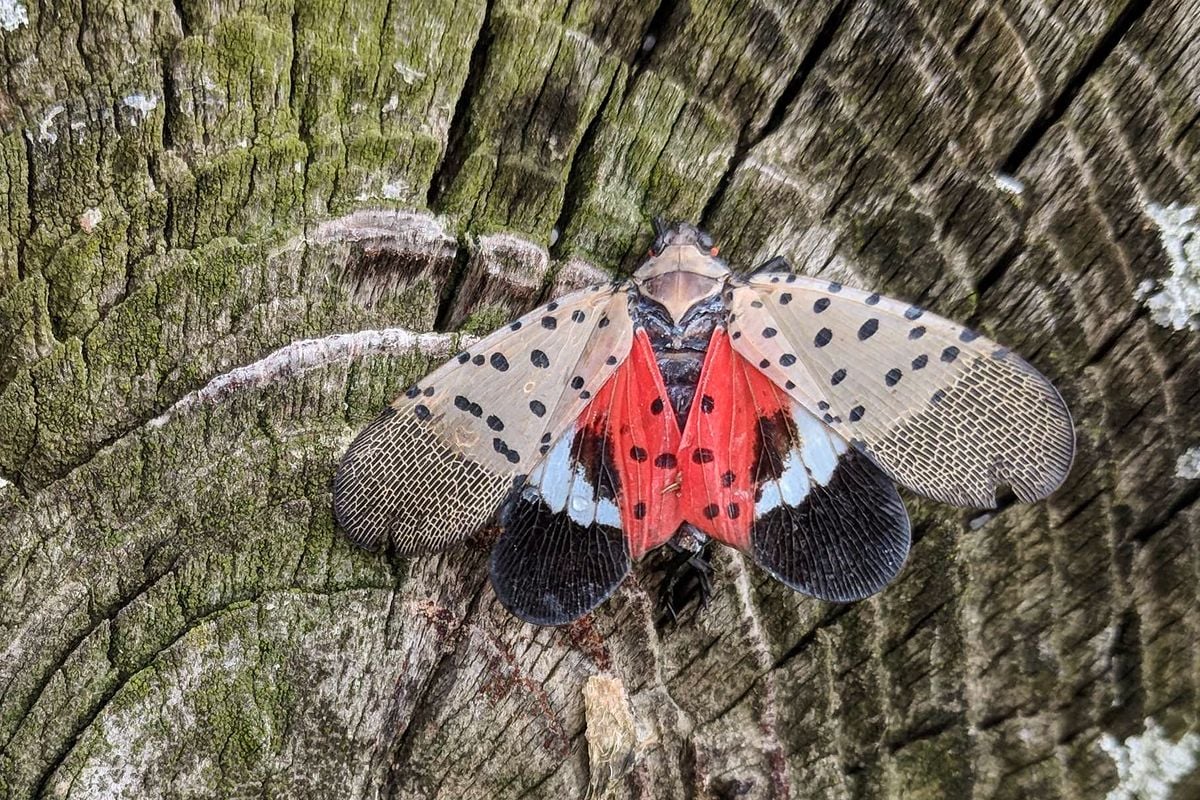
MORGANTOWN, W.Va. — A fast-moving invasive insect that has spread across much of the eastern United States is continuing its march through West Virginia, where experts warn it threatens vineyards, orchards, hardwood forests, and other economically important crops.

The spotted lanternfly, an invasive species native to Asia, was first discovered in Berkeley County, West Virginia, in 2019. Since then, it has steadily expanded its range into Brooke, Grant, Hampshire, Hancock, Hardy, Harrison, Jefferson, Marion, Marshall, McDowell, Mercer, Mineral, Monongalia, Morgan, Ohio, Pendleton, Preston, Taylor, Wetzel, and Wood counties.
For many visitors, the insect’s appearance may be their first clue that something is wrong. During summer, immature lanternflies become especially conspicuous as they climb tree trunks in search of food. Early nymphs are black with white spots before developing vivid red patches as they approach adulthood.
According to West Virginia University Extension entomology specialist Carlos Quesada, now is one of the best times of year for residents to slow the insect’s spread.
“The spotted lanternfly lays eggs from September to December, which hatch from May to June, so you will see them in their nymph stage during the summer,” Quesada said. “The nymphs are black with white spots, and they eventually develop bright red patches as they near adulthood.”
Why people outside West Virginia should care
Although West Virginia is known for its forests, the spotted lanternfly is not just a local concern. Since first arriving in the United States about a decade ago, the insect has spread across much of the Mid-Atlantic and Northeast, hitchhiking on vehicles, campers, trailers, outdoor furniture, firewood, and other equipment.
Travelers passing through affected states can unknowingly transport egg masses to new locations.
The insect feeds on more than 70 plant species, including grapes, hops, fruit trees, maples, black walnut, and willow. Grapevines are among its favorite hosts, making wineries and vineyards particularly vulnerable.

West Virginia’s growing wine industry, fruit orchards, and hardwood timber economy all face potential impacts if infestations continue to expand.
How the insect damages trees
Unlike insects that chew leaves, spotted lanternflies feed by piercing plants with a needle-like mouthpart and extracting sap.
Heavy infestations weaken trees and vines by removing nutrients, causing leaves to curl and wilt while branches gradually die back. Severe damage has already been observed on black walnut, willow, staghorn sumac, and maple trees.
Adult lanternflies also favor the invasive tree-of-heaven, where they commonly gather to feed and lay eggs.
Another nuisance comes from the insect’s sugary waste product, known as honeydew.
The sticky substance coats leaves, decks, patios, and outdoor furniture while encouraging the growth of black sooty mold. Although the mold typically does not kill plants, it reduces photosynthesis and creates an unsightly mess that attracts wasps and other insects.
What homeowners can do
Quesada encourages residents to destroy lanternflies whenever they encounter them.
Because summer nymphs repeatedly crawl up tree trunks, specially designed circle traps can capture large numbers without harming wildlife. While sticky bands are also available, they can unintentionally trap birds, beneficial insects, and other small animals, making circle traps the preferred option.
Perhaps even more important is preventing the insect from spreading to new areas.
Before traveling, people should inspect vehicles, trailers, campers, grills, lawn furniture, and other outdoor equipment for egg masses or insects that could be transported to another location.
Reporting new sightings
While spotted lanternflies have already been confirmed across much of northern and eastern West Virginia, several counties have not yet reported established populations.
Anyone who believes they have found the insect in a county where it has not been documented is encouraged to report the sighting online or to bugbusters@wvda.us.
“Understanding the biology, restricting human-mediated transport, and reporting sightings are the most critical actions society can take to manage invasive species such as the spotted lanternfly,” Quesada said.
As the insect continues expanding across Appalachia, experts say early detection and public awareness remain the best tools for slowing one of North America’s fastest-spreading invasive pests.