
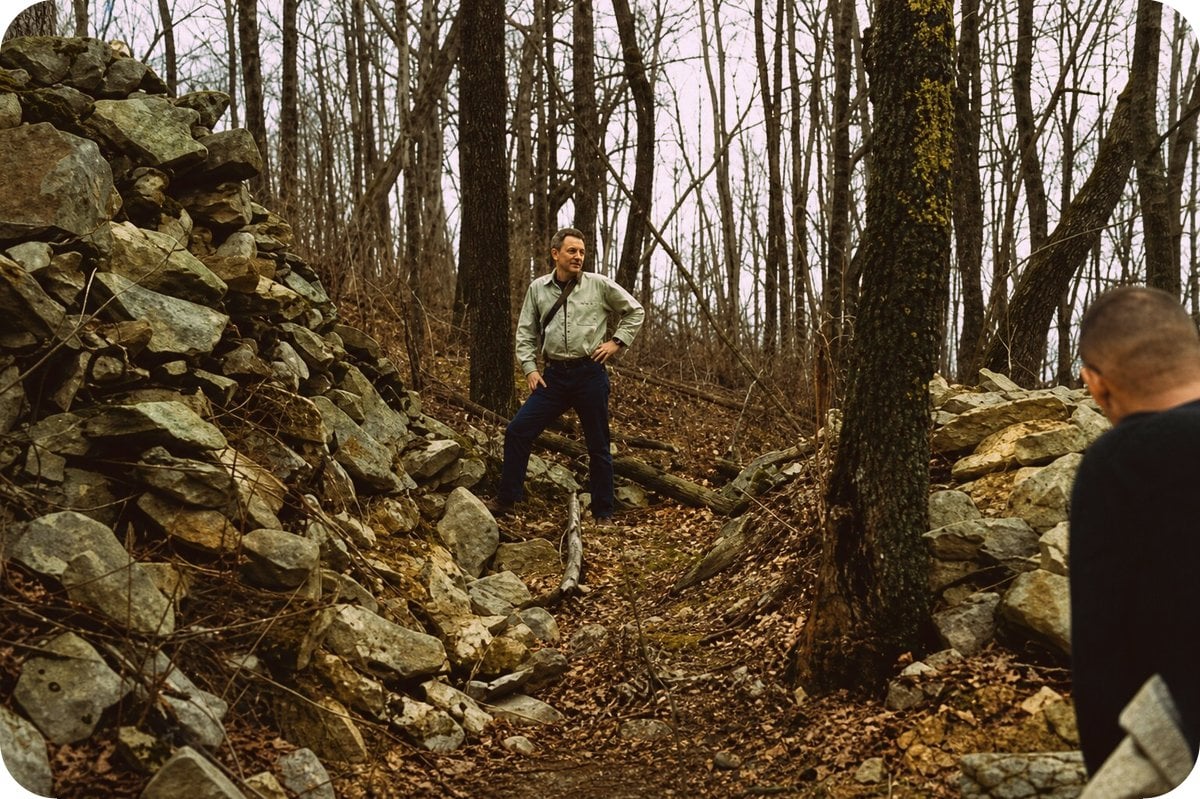
MONTGOMERY, W.Va. — If you grew up in southern West Virginia, you might have heard old-timers speak of the mysterious stone walls on Armstrong Mountain, strange ruins hidden in the woods just beyond the New River Gorge National Park and Preserve.

Handed down as fireside tales, stories of their construction and purpose may have become the stuff of legend, but scholars have confirmed that they’re hardly born of imagination.
The walls are real, though the objectives of their construction are as little understood today as they were 200 years ago, when European settlers first chanced upon them in the wilderness. Were they enormous pens for giant livestock? Fortresses raised against a terrifying enemy?
Why did the walls inspire such secrecy?
Three archaeologists presented their discoveries about the site to the West Virginia Archaeological Society and concluded that those questions could not then be answered. Sigfus Olafson, Joseph W. Inghram, and Edward V. McMichael spent much time visiting the locale and reviewing written records that hearkened back as far as 1876:
The first definite comment on the walls would probably be in 1818, for Atkinson (1876) relates that Dr. Thomas S. Buster, who told Atkinson about the walls, had first seen them 58 years earlier. Dr. Buster took title to several tracts of land in the area of the mouth of Armstrong Creek and appears to be the first permanent settler in the immediate area of the walls, though Paddy Huddleston was living across the river at an earlier date. The senior Buster, however, appears to have had little interest in the walls, having lived at a time when Indians were still a threat, not a curiosity.”
Olafson, Inghram, and McMichael spent a good part of 1958 exploring the mountain and provided this, the best description of the site so far:
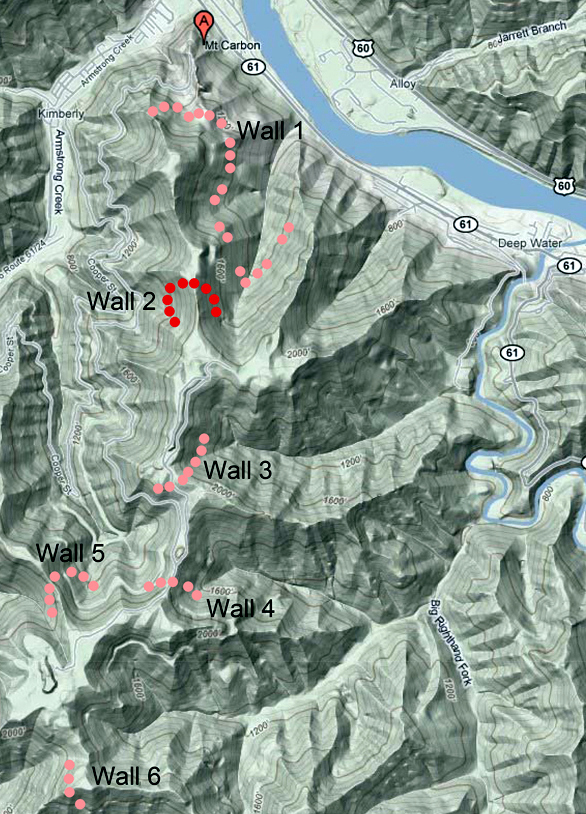
“The northernmost limit of the site is about one mile south of the mouth of Armstrong Creek, and from this point, it extends southward for an airline distance of about three miles, or five miles if the meanders of the ridge top are followed. The principal feature of the site is, of course, the “stone walls”. Actually, windrows would be more appropriate in that these are not laid-up walls but rather crude rows of loosely piled rock…
“Beginning on the north, the first encountered (See Map 2). has been designated Wall 1. This is a U-shaped windrow of loosely piled rocks crossing the ridge as it slopes down to the Kanawha, just east of the mouth of Armstrong Creek. It is about one-half mile south of the river, but it lies 1,200 feet above the river level or 1,790 feet above sea level. This structure rests on a fairly level bench or shelf where it crosses the ridge and is well preserved. It is about two feet high and about 20 feet wide.”
More detailed information on the site can be perused here: Mount Carbon Stone Walls.
The three archaeologists concluded in their report that despite their best efforts, the origin of the walls might forever remain a mystery. Of the three options proposed for their origin, the three revealed that the most mysterious was also the most likely:
Were the walls defensive?
“The writers cannot regard these walls as defensive for several reasons. They are not well situated for defense, generally on steep slopes rather than on the brows of the ridges where they would have had to be placed to be effective. They are not high enough to afford much protection, unless used to hold upright a log stockade or other such superstructure, and there is no evidence that such was used. Furthermore, the very size of these enclosures, if that is what they were, rules out consideration of a stockade.”
Were the walls intended as an enclosure?
“It also does not seem likely that these were enclosures into which game animals were driven, after the manner of some western tribes. The buffalo, about the only animal that could have been so taken, seems to have been a late arrival in the area, since no evidence of its presence is found in any sites except possibly very late ones. It was also an animal that disliked rugged terrain, and Mount Carbon is about the last place one would expect to find them. The idea that these were fences to keep animals out of fields hardly needs further comment.”
Were the walls ceremonial?

For lack of any other explanation, perhaps so. “This, then, leaves the possibility that these structures may have had some ritualistic or ceremonial significance in the life of the people who built them. However, this is only supportable by virtue of the fact that other explanations are inadequate and are eliminated.”
Like many other scholars, I tend to agree with Olafson, Inghram, and McMichael: the origin of the walls may never be known, unless some pioneer in the field comes forth with new information.
Perhaps in years to come, our understanding of the cultures that inhabited the region in ancient times will deepen. For now, these walls attest that humans inhabited the mountains here for eons before the arrival of Europeans and that their intentions appear to have been as ceremonial as those of the Egyptian pyramids and Mesoamerican ruins.
Think you’ve found an archaeological site? Here’s what to do next

Some of the most common requests fielded by the Council for West Virginia Archaeology come from members of the public who have found what may or may not be an archaeological site.
Invariably, there’s a lot of excitement as the mystery of the site begins to take hold. How old might it be? What artifacts might it contain? Will the government be willing to excavate the site? Read the full story here.
Sign up to receive a FREE copy of West Virginia Explorer Magazine in your email weekly. Sign me up!