
BURNT HOUSE, W.Va. — For generations, the unusual name of this Ritchie County community has been explained by a dark tale involving murdered travelers, a burning tavern, and an enslaved woman whose ghost reportedly haunted the site. But one of the county’s earliest published histories tells a substantially different story, raising questions about how much of the familiar Burnt House legend can be traced to the historical record.
In 1911, historian Minnie Kendall Lowther attributed the name “Burnt House” to the destruction of John Groves’ home, an early resident and slaveholder. Lowther recorded two conflicting accounts of how the house burned, but neither included the Harris family, murdered peddlers, or other elements that later became central to the ghost story.
The discrepancy does not prove that the later story is fiction, but it offers an unusual opportunity to examine how a West Virginia legend changed as it was passed down. Historical sources show that Burnt House was already a recognized community name in the 19th century, while the more sensational version appears in sources published much later.
A house burns in Ritchie County
Burnt House developed along an important transportation corridor through what was then western Virginia. The Staunton-Parkersburg Turnpike crossed the mountains from the Shenandoah Valley toward the Ohio River, carrying travelers through a sparsely settled region where farms, inns, and small communities developed along the route.
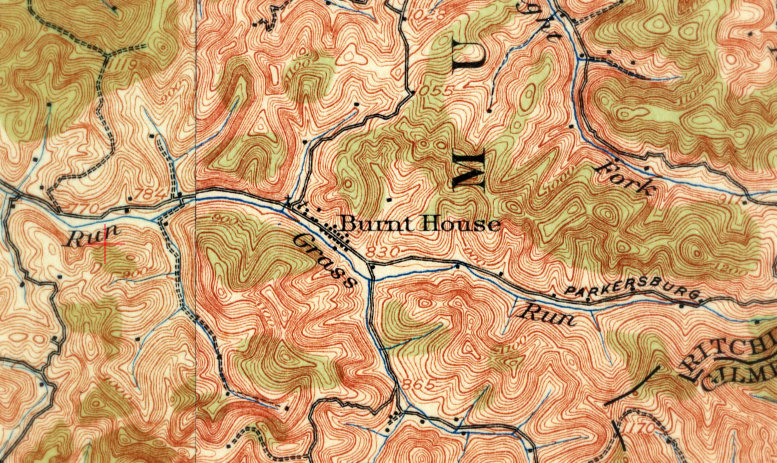
Lowther’s History of Ritchie County provides an early published account of the fire that apparently gave Burnt House its name. According to one tradition she recorded, Groves had sold an enslaved Black girl who, angered by the sale, set fire to clothing in an upstairs room before leaving. The flames spread through the house and destroyed it.
Lowther also recorded another version that directly contradicted that account. In the second telling, the girl had not been sold by Groves but had been lent to his wife by her father, identified as Rogers of Waynesboro, Virginia. Groves was away, returning the girl to Rogers, when the house accidentally caught fire.
Although Lowther could not resolve how the fire started, both accounts identified the Groves residence as the building whose destruction gave Burnt House its name. She also provided a clue to when the fire occurred, noting that Henry Fling acquired the Groves farm in 1859 and became the first to rebuild on the site, placing the earlier house’s destruction before that year.
The name was firmly established in the decades that followed. A Burnt House post office opened in 1875, showing the name was in official use less than two decades after Fling acquired the property. The post office remained in operation for more than a century, closing in 1986.. The post office would remain in operation for more than a century, closing in 1986.

The legend becomes darker
The story later associated with Burnt House is considerably more elaborate and centers on a roadside establishment known as the Harris Tavern. According to versions preserved in Appalachian folklore, Jack Harris came from New York with his son, William, and three enslaved people, and established a tavern to serve travelers moving through the region.
Peddlers and other travelers reportedly stopped at the tavern, but rumors spread that some who entered never left. In one version, a stable boy witnessed William Harris kill a peddler with a corn knife, and the bodies of other victims were supposedly carried into a nearby ravine that became known as Dead Man’s Hollow.
The legend also introduces an enslaved woman named Deloris, sometimes called Delsie, who was reportedly involved with William Harris. Residents allegedly grew suspicious after seeing her with clothing and merchandise resembling goods carried by peddlers who had disappeared along the road.
As suspicion increased, according to the story, a stagecoach company hired the Pinkerton Detective Agency to investigate the disappearances. Jack and William Harris sold the tavern to Susan Groves and fled west under the names Jeff and Tex Howard, while Deloris and another enslaved person remained behind as part of the sale.
The story then shifts from alleged crime to the supernatural. While residents were attending church one Sunday, they reportedly smelled smoke and discovered the tavern burning. Deloris was said to have been seen in an upper portion of the building as the flames spread, and she died when the structure collapsed.
Reports of her ghost subsequently became part of the Burnt House tradition. Later versions described her apparition appearing near the ruins on damp or foggy nights, sometimes crying or dancing before disappearing toward Dead Man’s Hollow. The story was eventually preserved in collections of West Virginia folklore, including James Gay Jones’ Appalachian Ghost Stories and Other Tales, published in 1975.
Earlier history raises questions about the legend
Lowther’s account, published more than six decades before Jones’ collection, complicates efforts to treat the later legend as a straightforward historical account. Her history places the Groves family at the center of the event, identifies their residence as the building whose destruction produced the name Burnt House, and makes no mention of the Harris family, murdered peddlers, the Pinkerton agency, Dead Man’s Hollow, or Deloris dying in the flames.

The two traditions share an intriguing detail. In the later ghost story, Jack and William Harris sell the tavern to Susan Groves before leaving West Virginia. Lowther’s earlier account also places Susan Groves and her family at Burnt House, though without the Harrises or the alleged murders.
The overlap could indicate that elements of an older Groves family story survived as the legend developed, but the available evidence does not establish how the two accounts became connected. The later story could preserve events omitted from Lowther’s history, combine separate local traditions, or include details added during decades of oral retelling.
Another dramatic element of the legend has also proved difficult to document independently. According to later accounts, William Harris escaped to Texas under the name Tex Howard and continued a life of crime until he was hanged for robbery and murder in 1882.
The legend maintains that on the day of his execution, a violent storm swept through Burnt House and Deloris appeared one last time, dancing above or near the ruins before disappearing into Dead Man’s Hollow. A search of readily available historical sources did not independently establish that a William Harris from Burnt House was executed in Texas as Tex Howard in 1882, so the episode cannot presently be treated as documented history.
A name older than the ghost story
Whatever happened at the site, Burnt House was firmly established as a place name long before the better-known ghost story appeared in the published sources examined for this account. The post office’s establishment in 1875 shows that residents were already using the name in the 19th century, and surviving postal material indicates the Burnt House postmark remained in use into the early 20th century.
Lowther’s 1911 history also shows that disagreement over the fire was not new. Even then, she encountered competing explanations, one blaming the blaze on an enslaved girl angered by being sold and another maintaining that the fire was accidental. Both accounts consistently identified the Groves residence as the house whose destruction gave the community its name.
By the time the story was preserved in later Appalachian folklore, the narrative had grown substantially. A burned residence had become associated with disappearing peddlers, murder, an enslaved woman who died in the flames, fugitives fleeing west, an alleged execution in Texas, and a ghost whose appearances continued for decades.
Those later elements cannot all be confirmed by the historical sources available for this account, but their absence from Lowther’s earlier history does not, by itself, prove they were invented. Oral traditions can preserve events omitted from written records and can accumulate details through repeated telling, and additional contemporary evidence could change what is known about the Burnt House story.
The historical record supports the event at the center of the community’s name. A house associated with the Groves family burned in Ritchie County before the Civil War, and by 1875 the resulting place name had become official enough that the federal government established a Burnt House post office.
The building disappeared generations ago, but the name it left behind remains on the West Virginia map.