
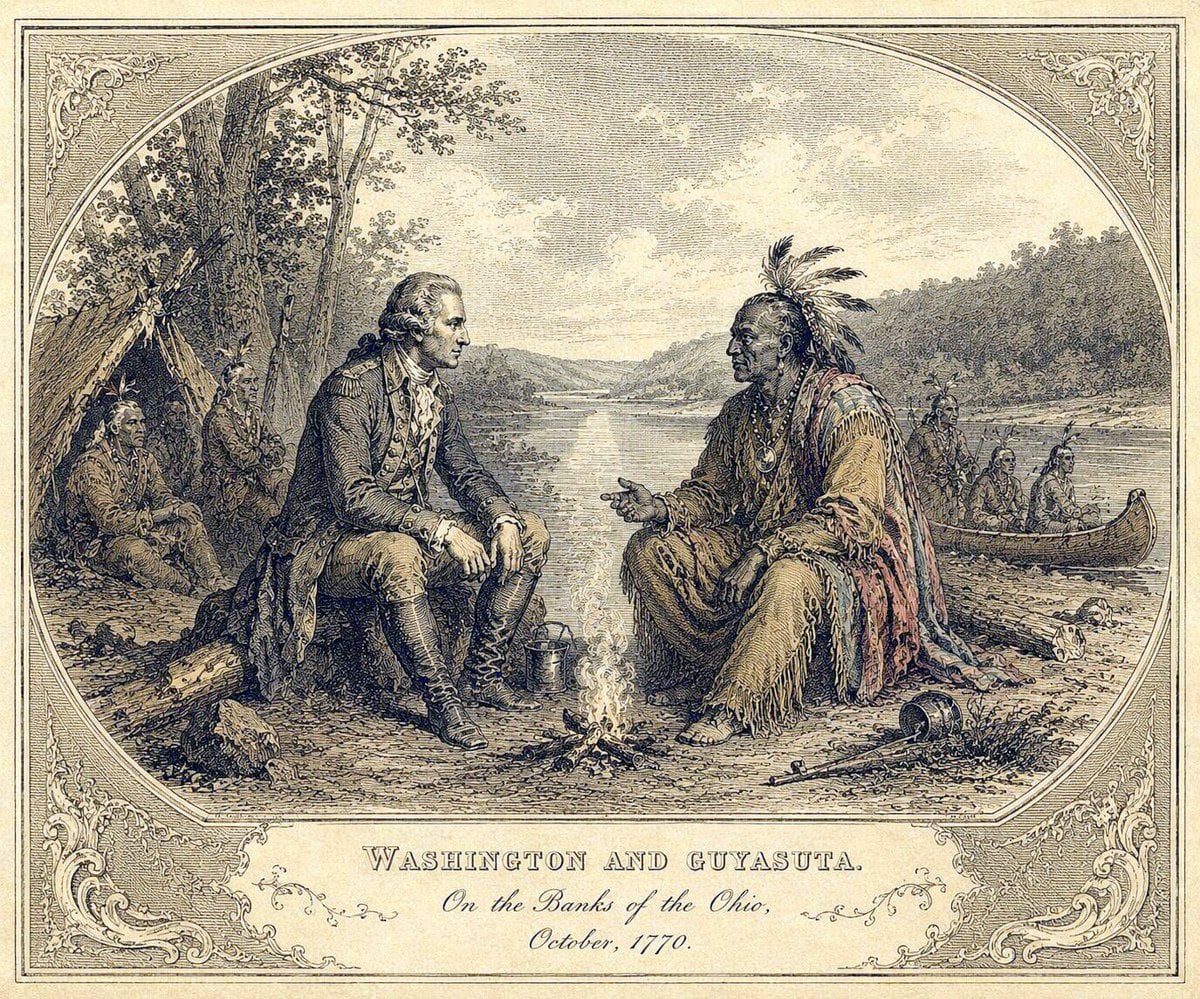
RAVENSWOOD, W.Va. — Six years before the Declaration of Independence and nearly two decades before he became the first president of the United States, George Washington embarked on one of the most remarkable journeys of his life.
The 38-year-old Virginian rode horseback across the Allegheny Mountains, climbed into a canoe at Fort Pitt, and spent nearly three months exploring hundreds of miles of wilderness along the Ohio and Great Kanawha rivers. Much of that journey unfolded in what is now West Virginia.
His journal tells of towering sycamores, buffalo grazing in fertile river bottoms, meetings with influential Native American leaders, and valleys he believed would become among the most valuable land in America.
Nearly 255 years later, historians say Washington’s expedition offers one of the clearest windows into a vanished American frontier and into the ambitions of the man who would later become the father of the nation.
A journey in search of opportunity
George Washington was no stranger to the western frontier. As a young officer during the French and Indian War, he had traveled the Ohio Country and seen firsthand its strategic importance. But by 1770, his mission had changed.
Like many Virginians, he had become captivated by the promise of western lands, according to historian Dean W. Moore. Moore surveys much of Washington’s affairs on the Ohio in his 1971 book Washington’s Woods: A History of Ravenswood and Jackson County, West Virginia.
“There was much talk of the rich western lands of the Ohio Valley,” Moore wrote, “and George Washington began to get ‘land fever,’ too.”
Washington had received western acreage for his military service and had purchased fellow officers’ claims. Now he intended to inspect those lands personally.
Jackson County historian Mark Wayne said Washington understood that the opportunity to invest in the Ohio Country would not last forever.
“He wrote that anyone who didn’t seize the chance to acquire western land would never have that opportunity again,” Wayne said. “He recognized very early what the future of this country was going to be.”
On Oct. 5, 1770, Washington left Mount Vernon. Traveling over Braddock’s Road to Fort Pitt, he assembled a small expedition that included Col. William Crawford, Dr. James Craik, and several companions, then launched canoes onto the Ohio River.
America before America
The Ohio River that young Washington encountered has almost disappeared from memory. Long before locks and dams transformed it into a navigation channel, it flowed as a wild river of rapids, rock shelves, gravel bars, and broad pools winding through an almost unbroken forest.
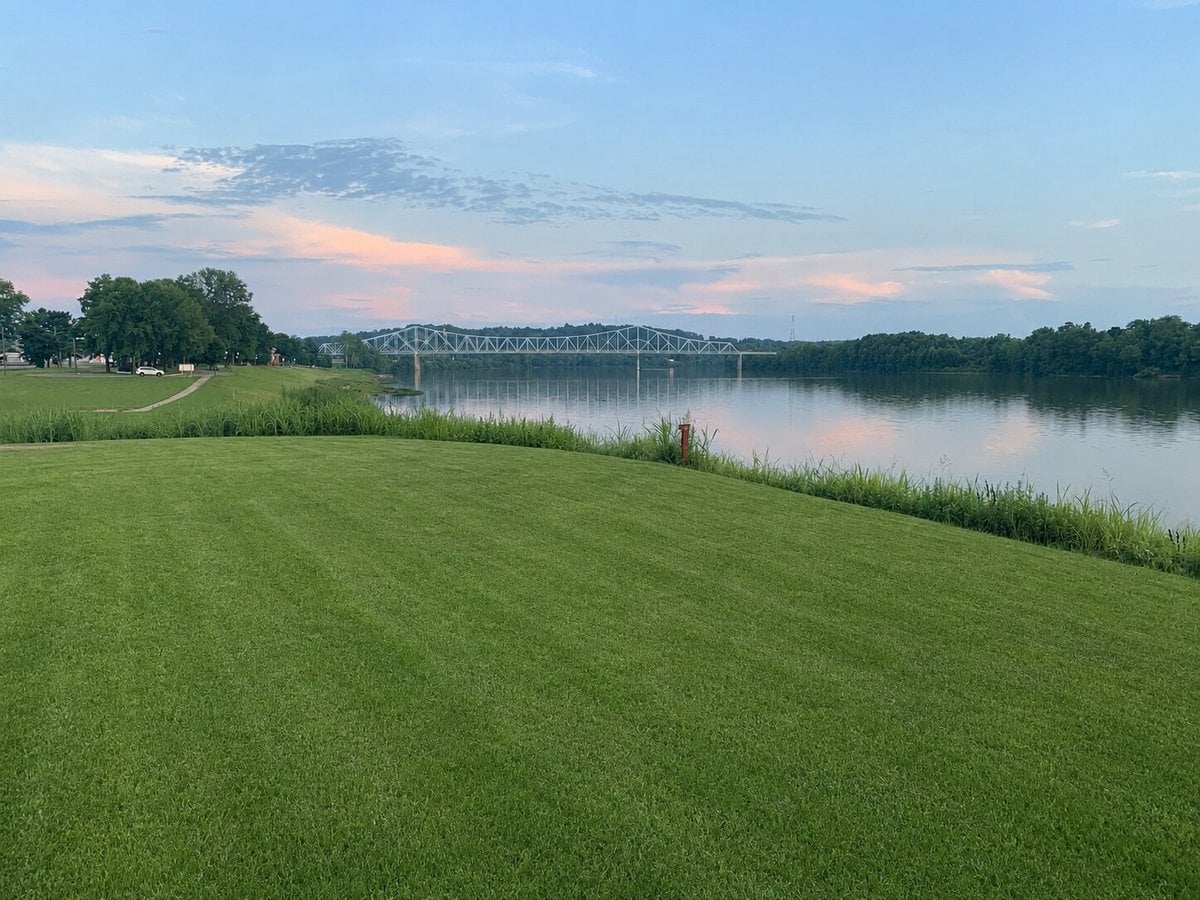
“Washington made some comments in his journal that the Ohio River must have been one of the most beautiful rivers in the world,” Wayne said. “Before the Army Corps of Engineers, it was like a giant, wide trout stream.”
Every day, Washington recorded what he saw. He noted streams suitable for settlement, fertile bottomlands, forests filled with valuable timber, and stretches of rich soil that seemed destined for farms.
His journal reads less like a travel diary than the notebook of an investor surveying the future.

The wilderness that became West Virginia
As Washington drifted south, today’s familiar place names did not yet exist. Instead, he described the landscapes.
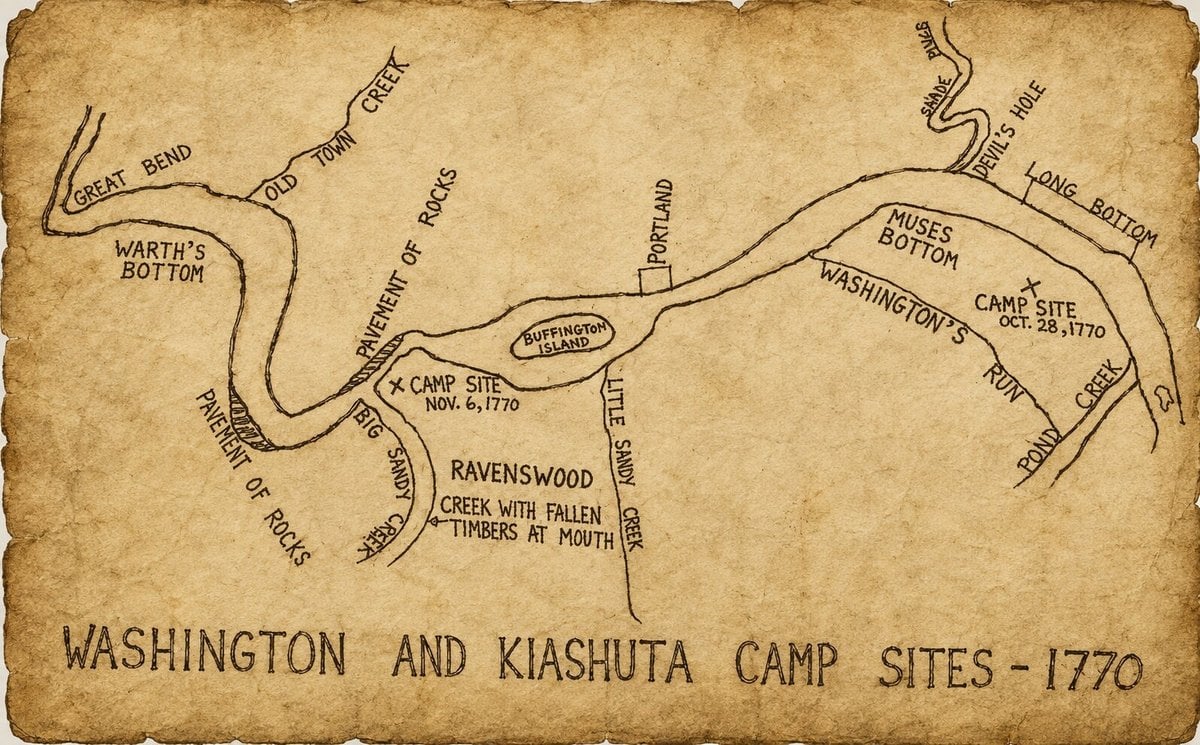
Near present-day Ravenswood, he observed broad river bottoms, rocky ledges exposed at low water, and creek mouths that Native American guides identified as excellent hunting grounds.
He was especially impressed by the land around what is now Big Sandy Creek. “There are about three or four thousand acres of EXCEEDINGLY VALUABLE land,” he wrote, capitalizing the words for emphasis.
Moore painstakingly matched Washington’s descriptions to modern landmarks, identifying Lee Creek, Big Sandy Creek, Goose Island, Warth’s Bottom, and the former Letart Falls from the explorer’s journal.
For today’s readers, the journal provides one of the earliest detailed descriptions of western Virginia before permanent American settlement transformed the landscape.
A reunion with Guyasuta
Perhaps the expedition’s most remarkable encounter came not with the landscape, but with a man. Near present-day Ravenswood, Washington reunited with Guyasuta, the influential Seneca leader he had known during the French and Indian War.
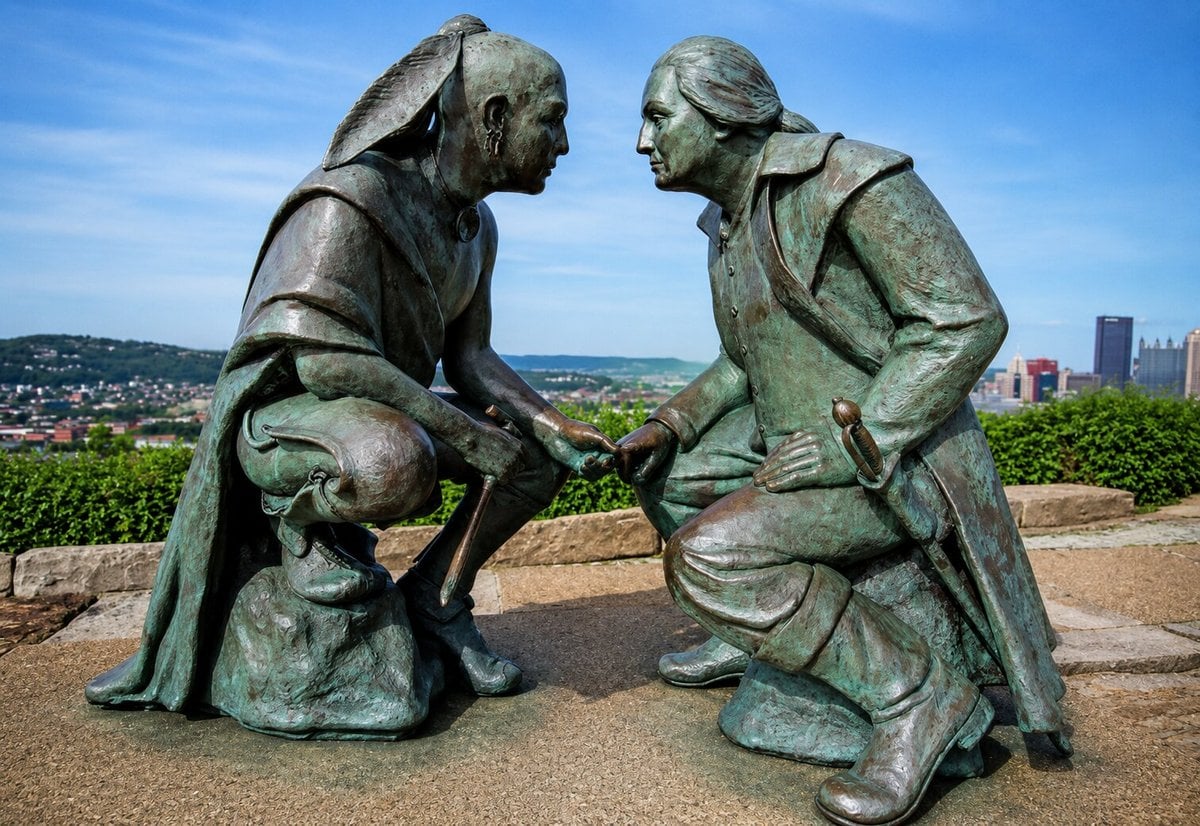
Wayne believes the meeting deserves far greater recognition. “Guyasuta was no run-of-the-mill Native American,” he said. “He was a very prominent Seneca leader.”

Washington camped with Guyasuta’s hunting party near the mouth of Big Sandy Creek before continuing north the following morning. His journal records that Native ceremonial customs delayed his departure while the two men discussed the country lying farther west along the Ohio River and in the valley of the Great Kanawha. Moore identified the campsite with the future location of Ravenswood.
Wayne said the encounter reminds readers that the history of the frontier belongs to more than one culture. “We tend to dismiss the Native American elements of our story,” he said. “But Guyasuta was a major figure.”
A lost wilderness
As Washington continued toward the mouth of the Great Kanawha River and upstream into what is now the Charleston area, he encountered a landscape almost unimaginable today.
He measured sycamore trees so large they reached approximately 45 feet in circumference. He observed buffalo grazing near the rivers. He carefully recorded waterways, forests, and fertile bottoms that he believed would someday support prosperous settlements.
Nearly every page reveals a frontier still dominated by nature rather than civilization.
The frontier that shaped a president
Washington returned to Mount Vernon shortly before Christmas after nearly three months on the frontier. The journey helped confirm what he had suspected from the beginning—that the lands west of the Appalachians represented one of the greatest opportunities in North America.
He would eventually own thousands of acres in what is now West Virginia, inspiring the title of Moore’s history—Washington’s Woods.
Yet perhaps the expedition’s greatest legacy is neither political nor financial. It’s the remarkable journal Washington left behind.
Thanks to his observations—and to historians such as Moore and Wayne—we can still accompany a young surveyor as he paddled through a wilderness that has largely disappeared, years before history would remember him as the father of a nation.
Along the banks of the Ohio River, the future first president and the Seneca leader Guyasuta shared a campsite and spoke of the country stretching westward. Neither could have known that within a generation, the American Revolution, westward settlement, and the birth of the United States would transform that wilderness forever.
Other places in West Virginia connected to George Washington
Washington’s 1770 expedition touched only part of what is now West Virginia, but his life intersected with the state in several important ways.
Harpers Ferry
Perhaps the most famous Washington site in the state, Harpers Ferry, was selected by George Washington as the location of the second federal armory in 1796 because of its strategic location at the confluence of the Potomac and Shenandoah rivers. The armory later became the site of John Brown’s 1859 raid and played a pivotal role in the Civil War.
Berkeley Springs
As a young surveyor in 1748, Washington visited the warm mineral springs at what was then called Bath. He praised the waters and returned several times throughout his life. Today, Berkeley Springs State Park preserves the famous springs that attracted colonial visitors, including Washington.
Charles Town
Washington’s younger brother, Charles Washington, founded Charles Town in 1787, giving the community its name. George Washington visited frequently and maintained close ties to the town during his presidency.
Shepherdstown
Washington often crossed the Potomac near Shepherdstown while traveling between Mount Vernon and western Virginia. Several buildings in the town preserve connections to the Washington family and the colonial era.
Fort Ashby
Built in 1755 during the French and Indian War, Fort Ashby is the only surviving frontier fort personally associated with George Washington. He ordered its construction as part of Virginia’s frontier defense system after Braddock’s defeat.
St. Albans
Washington traveled up the Great Kanawha River as far as the vicinity of present-day St. Albans while inspecting western bounty lands. Local tradition and historical markers commemorate his visit.
Many of the places Washington visited during this expedition—including Ravenswood, Point Pleasant, Berkeley Springs, Harewood, and Great Cacapon—can still be explored today.
Read our companion guide: George Washington’s Lost West Virginia: Five Places You Can Still Visit Today.
Thanks for this interesting article. I live in Texas but will always be a West Virginian.
Just watched the new movie
Young George Washington
Great article , I remember seeing a sign saying Washington Lands somewhere south of Moundsville . Been thru Point Pleasant and Ravenswood and always wondered what this land looked like back in his time . Again great article !
The things he seen before us an the air he breathed id like to go back then an see an feel what life was like at the exact same moment!
Good article , lived in Ravenswood for 56 years . Still have family that loves there .
George Washington and Lord Fairfax Wow Surveyors what they seen
Wonderful History
Don’t forget that he visited the Blennerhassett’s mansion on Blennerhassett Island in Wood County and surveyed land there presently called Washington Bottom in Wood County.