

MORGANTOWN, W.Va. — Visitors often come to West Virginia expecting mountain breezes and cooler temperatures, but the state’s humid summers can make outdoor adventures far more demanding than the thermometer suggests.

Whether exploring a state park, attending a county fair, paddling one of the state’s rivers, or hiking in the New River Gorge National Park and Preserve, paying attention to the heat index may be just as important as checking the forecast.
Read more: Why more Americans are choosing West Virginia for summer road trips
According to Brian Leary, assistant professor and director of tactical performance physiology in the West Virginia University School of Medicine Division of Exercise Physiology, humidity can dramatically increase the body’s heat stress by preventing sweat from evaporating efficiently.
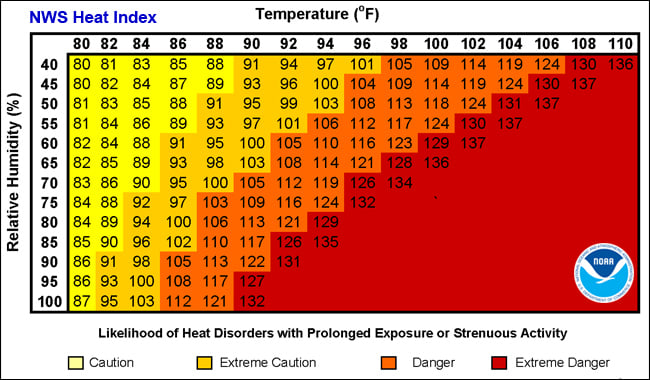
“The heat index takes into account both temperature and humidity,” Leary said. “When the heat index is greater than 80 degrees Fahrenheit, individuals should begin to exercise caution, especially if they are responsible for youth or older adults.”
While many people watch only the air temperature, weather apps that display the “feels like” or apparent temperature often provide a more realistic picture of outdoor conditions.
Why humidity matters
Sweating is the body’s primary cooling system.
When humidity is low, sweat evaporates quickly, carrying heat away from the body. During humid Appalachian summers, however, evaporation slows dramatically, allowing body temperature to rise even when the air temperature may not seem extreme.
That’s one reason an afternoon in West Virginia can feel considerably more oppressive than a similarly warm day in the arid western United States.
The danger increases during strenuous activities such as hiking steep trails, mountain biking, whitewater rafting, fishing, and construction work.
Outdoor recreation brings additional risks
Summer is one of West Virginia’s busiest seasons for outdoor recreation. Visitors flock to destinations such as Blackwater Falls State Park, Seneca Rocks, Dolly Sods Wilderness, and the Monongahela National Forest.
Although mountain elevations are often cooler than the surrounding lowlands, trails, overlooks, and exposed rock formations can still be dangerously hot, particularly in the middle of the day.
Leary recommends planning strenuous outdoor activities for the morning or evening whenever possible, wearing lightweight, light-colored clothing, drinking water regularly, and taking frequent breaks in the shade.
Who faces the greatest danger?
Children, older adults, and people with chronic medical conditions face a higher risk of heat-related illness.
Children generate body heat more quickly and are less efficient at regulating temperature, while many medications taken by older adults can reduce the body’s ability to cool itself.
Outdoor workers also face elevated risks because physical exertion generates additional internal heat, and protective clothing can trap body heat.
Recognizing the warning signs
Early symptoms of heat stress often include thirst, dry mouth, fatigue, dizziness, and lightheadedness.

If conditions worsen, heat exhaustion may develop, with heavy sweating, weakness, headache, nausea, and vomiting.
Anyone experiencing these symptoms should stop activity immediately, move to an air-conditioned or shaded location, drink water or a sports drink, and remove unnecessary clothing.
Heat stroke is a medical emergency. Signs include confusion, loss of consciousness, seizures, rapid, shallow breathing, and a body temperature above 105 degrees. Anyone suspected of heat stroke should receive emergency medical attention immediately.
Preparing for hot weather
Leary said the body can gradually become more efficient at coping with heat through a process called heat acclimatization.
Rather than jumping into strenuous outdoor activities after weeks indoors, he recommends starting with short walks that produce light sweating, then gradually increasing both duration and intensity over one to two weeks.

That adaptation allows the body’s natural cooling system to work more effectively while reducing the risk of heat-related illness.
For hikers, paddlers, and anyone planning to explore West Virginia this summer, checking the heat index before leaving home may be just as important as packing water and sunscreen.
Read More
- Most visitors never see this side of the New River Gorge
- More New River Gorge hikers are leaving Endless Wall for the Grandview Rim Trail
- The 12 best swimming holes in West Virginia for ideal summer escapes
- Fireflies Are Peaking Across West Virginia This Week
- Why West Virginia May Be the Wildest State East of the Mississippi