
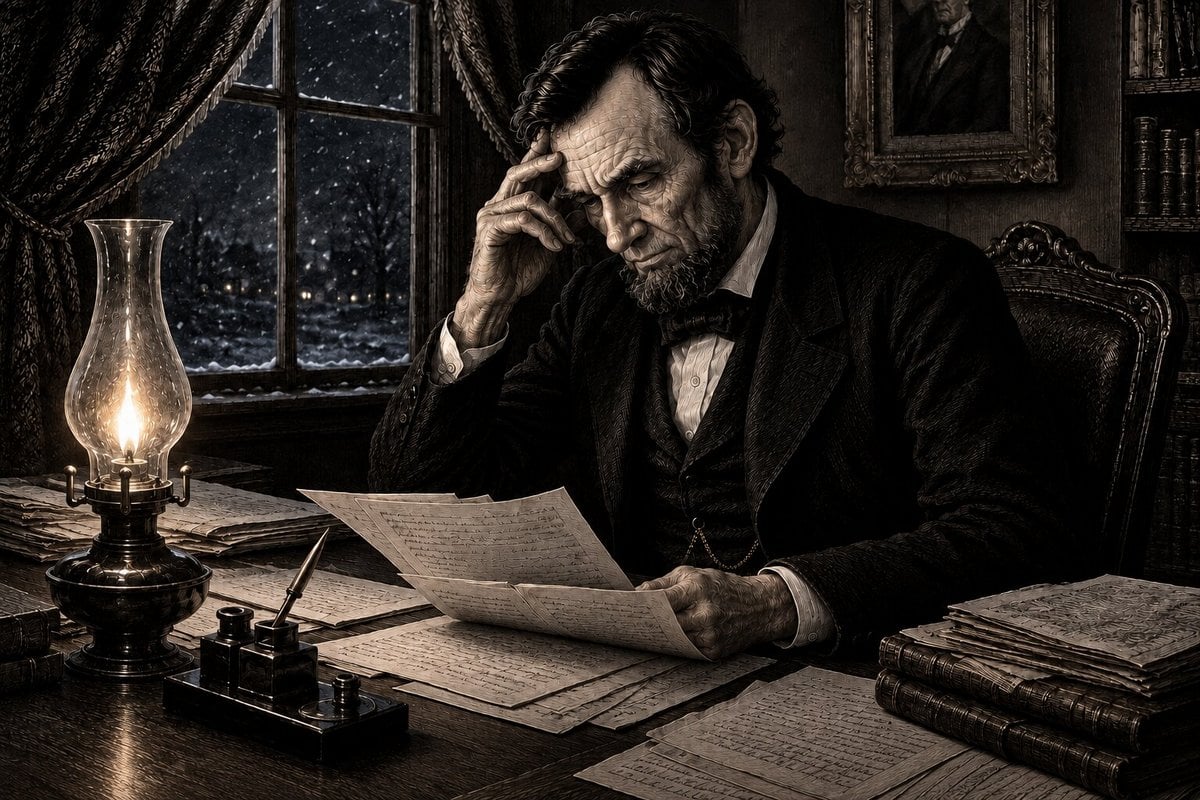
CHARLESTON, W.Va. — By the final days of 1862, President Abraham Lincoln faced one of the most unusual decisions of his presidency. The Civil War had entered its second winter, Confederate armies still occupied much of the South, and the Union’s future remained uncertain.

Yet waiting on Lincoln’s desk was legislation unlike anything any previous president had considered—a bill asking him to approve the creation of an entirely new state from territory claimed by Virginia.
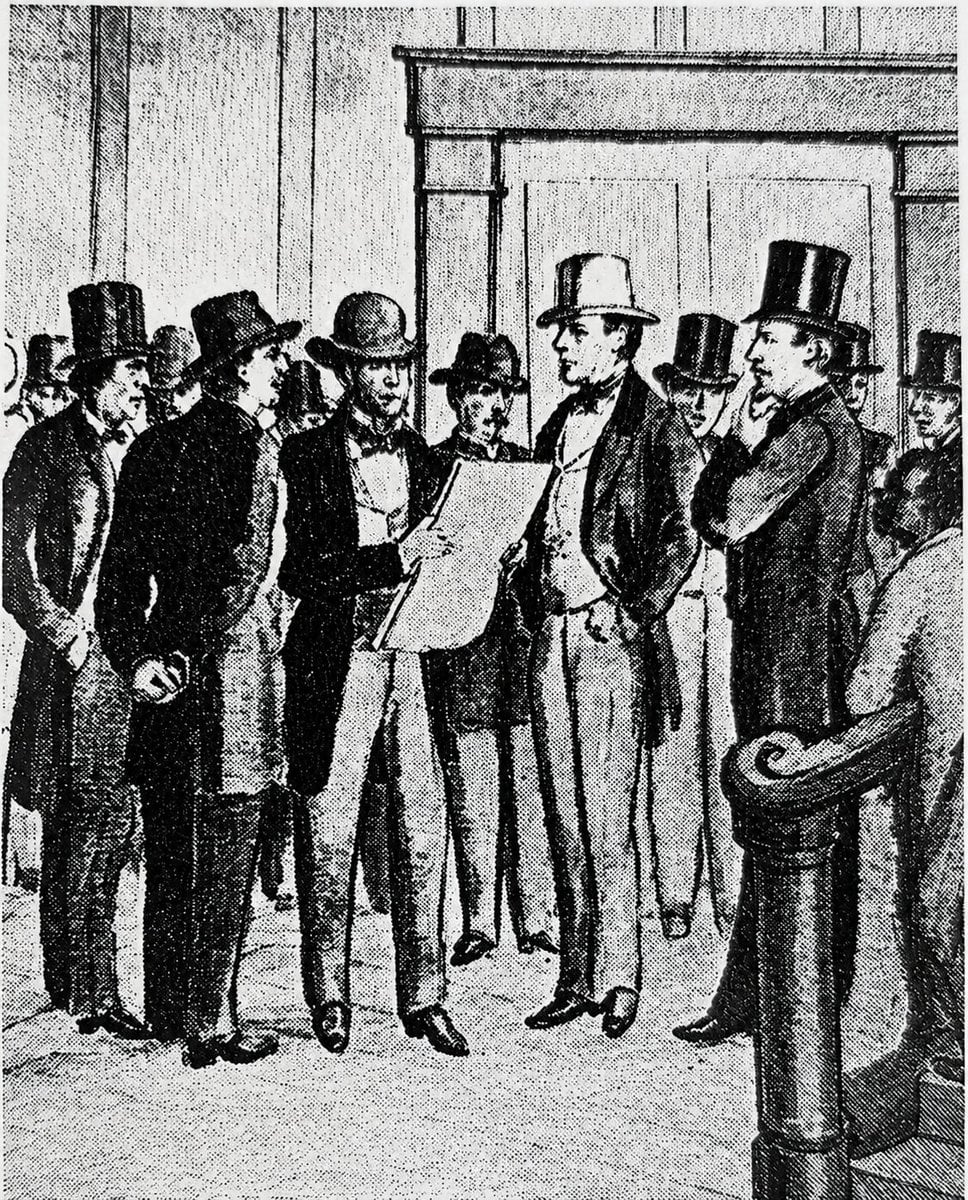
The proposal promised important military and political advantages for the Union, but it also presented a constitutional question unlike any Lincoln had faced. Could a new state legally be carved from Virginia while Virginia itself claimed to have left the Union?
For 10 days, Lincoln sought written opinions from every member of his Cabinet before deciding whether to sign the bill that would create what became the nation’s 35th state.
Read also: For readers unfamiliar with how the state came into existence, see our companion feature explaining why the U.S. has two Virginias.
A movement begins in western Virginia
The proposal that reached the White House had been nearly two years in the making. After Virginia voted to secede from the Union in April 1861, many residents of the state’s western counties rejected the decision. Delegates meeting in Wheeling organized the Restored Government of Virginia, declaring it to be the lawful government of the state despite the Confederate government operating from Richmond.
Under Gov. Francis H. Pierpont, the restored government won federal recognition, giving supporters of statehood the legal foundation they believed they needed to move forward.
Delegates soon approved an ordinance authorizing the creation of a new state, a proposal that voters overwhelmingly endorsed. At first, however, the new state was not called West Virginia.
It was named “Kanawha,” a title later abandoned after delegates debated alternatives including “Allegheny, “Augusta,” “Columbia, “New Virginia,” and “Potomac” before settling on West Virginia.
Historians Phil Conley and William Thomas Doherty recount that one delegate argued “Kanawha” should be dropped because it was too difficult to spell, prompting laughter from colleagues familiar with the frequent misspellings of Monongahela.
The delegates then drafted a constitution establishing a new state government, creating a public school system and defining the powers of its courts. Slavery proved the convention’s most divisive issue, and the debate followed the proposed state to Washington.
The constitutional steps leading to statehood remain one of the most closely studied episodes in West Virginia history and are detailed by the West Virginia Encyclopedia.
Senator Waitman T. Willey eventually broke the impasse with a compromise calling for gradual emancipation, a provision that secured congressional approval while preserving support for statehood among western Virginians.
The question lands on Lincoln’s desk
When the legislation reached Lincoln on Dec. 21, 1862, most of the political work had already been completed. Western Virginians had organized a loyal government, written a constitution, won approval from voters and persuaded Congress to pass a statehood bill. Yet one question remained unresolved: Had the Constitution truly been satisfied?
Article IV of the U.S. Constitution requires the consent of a state’s legislature before another state can be created from its territory. Because Virginia had joined the Confederacy, Lincoln had to determine whether the Restored Government of Virginia possessed the constitutional authority to give that consent. It was a question with no clear precedent.
Rather than relying solely on his own judgment, Lincoln asked each member of his cabinet for a written opinion.
Even Lincoln’s closest advisers could not agree. Treasury Secretary Salmon P. Chase, Secretary of State William H. Seward, and Secretary of War Edwin M. Stanton urged him to approve statehood. Postmaster General Montgomery Blair, Attorney General Edward Bates, and Navy Secretary Gideon Welles argued that he should veto the bill.
Many of Lincoln’s wartime papers and presidential documents are preserved in the Library of Congress Abraham Lincoln Papers collection.
A decision that changed American history
Lincoln ultimately concluded that admitting West Virginia was both lawful and necessary to preserve the Union. While acknowledging the constitutional uncertainty, he believed the loyal citizens of western Virginia had earned the nation’s support after refusing to follow the Confederacy.
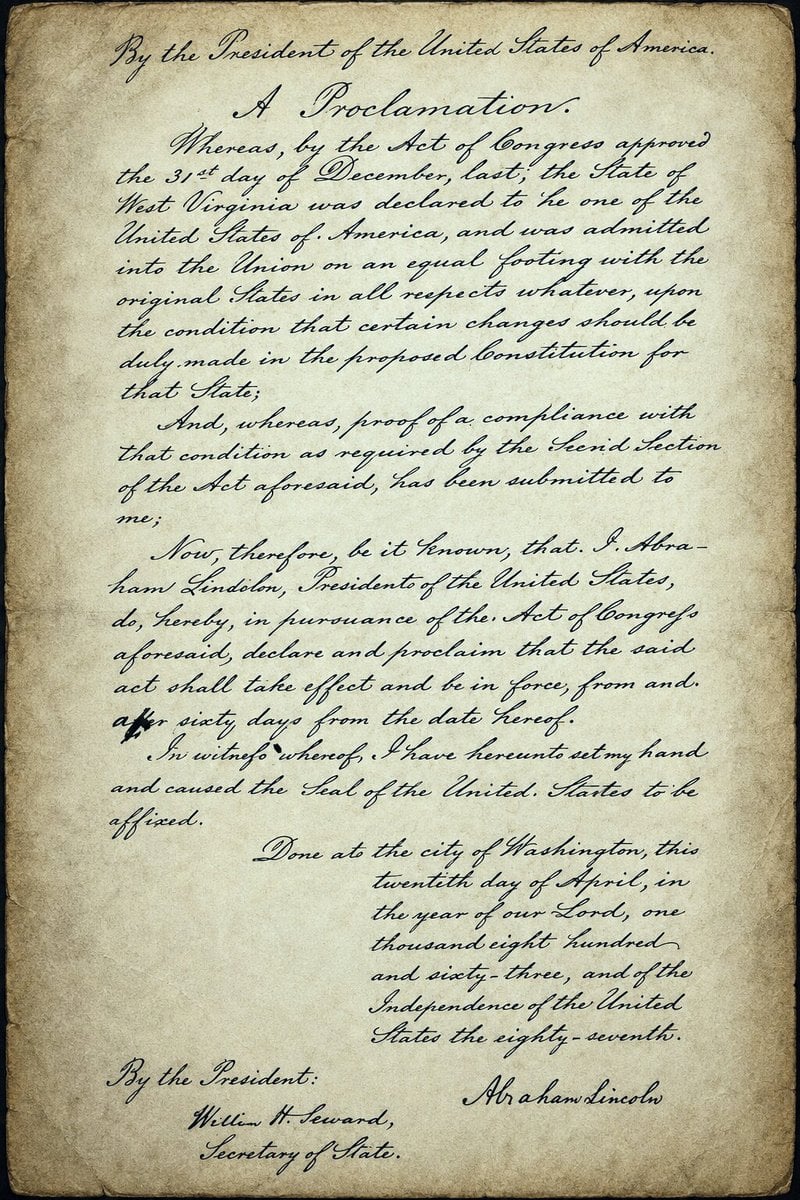
Explaining his decision, Lincoln wrote that the Union could scarcely afford to lose West Virginia’s support “in Congress and in the field” and observed that admitting the new state would also move additional slave territory toward eventual freedom. On Dec. 31, 1862, he signed the bill.
One final vote remained. West Virginians approved the Willey Amendment in March 1863, allowing Lincoln to issue a proclamation declaring that the new state would enter the Union sixty days later.
On June 20, 1863, West Virginia officially became the nation’s 35th state, with Arthur I. Boreman sworn in as its first governor while Francis H. Pierpont continued leading the Restored Government of Virginia in the portions of the state that remained under Union control.
Lincoln is remembered for preserving the Union, issuing the Emancipation Proclamation and delivering the Gettysburg Address. His decision to approve West Virginia’s statehood, however, remains one of the least familiar episodes of his presidency.
Conley and Doherty observed that the state was not created by a single act of secession or a lone presidential signature, but through a carefully orchestrated sequence of conventions, elections, legislative actions, congressional compromises, and executive judgment.
Without Lincoln’s approval on New Year’s Eve 1862, the map of the United States—and the history of West Virginia—might look very different today.
Abraham Lincoln never saw the state he created
Although Abraham Lincoln signed the legislation that made West Virginia possible and proclaimed its admission to the Union, historians believe he never actually visited the new state. When West Virginia entered the Union on June 20, 1863, Lincoln remained focused on directing the Civil War, and the demands of the presidency kept him in Washington until his assassination less than two years later.
His closest encounter with what is now West Virginia likely came before the war, when he traveled through Virginia as a young lawyer on the expanding railroad network. The state whose creation required one of his most difficult constitutional decisions would remain one he knew largely through reports, correspondence and military dispatches rather than personal experience.
Read more: Readers interested in Lincoln’s presidency and his Civil War leadership can explore additional exhibits and historical resources through the Abraham Lincoln Presidential Library and Museum.
Are the Eastern Panhandle counties of Berkeley and Jefferson constitutional?
To this day scholars still debate the United States Supreme Court case Virginia vs. West Virginia (1871), whereby in a 6-3 ruling West Virginia was granted jurisdiction.
That is because the very constitutionality of the State of West Virginia itself had yet to be determined as statehood has long claimed to have been achieved through extralegal political means to advance the Union effort during the Civil War.
In fact, former Virginia Governor and Confederate General Henry A. Wise once stated that West Virginia was the “bastard child of political rape.”
But it is an historical fact that West Virginia’s Founders, President Lincoln, and Congress went to great lengths in 1861-63 to ensure that the formation of the nascent state would pass Constitutional muster.
That’s because statehood proponents knew that the enabling language was in the United States Constitution and could be traced back to the very beginnings of the Republic when the plight of western Virginians helped determine how it was written.
Indeed, the legal foundation for West Virginia statehood was specifically advocated by Luther Martin, a little known and much-derided Founding Father who represented Maryland in the Constitutional Convention in 1787.
As delegates argued the merits of population¬ based bicameral representation, Martin focused on the “unreasonableness of forcing and Guaran¬ teeing the people of Virginia beyond the Mountains, the Western People … to continue under the States now governing them, without the consent of those States to their separation.”
To Martin, the United States Constitution needed to be written to provide representative protection to the “Western country of Virginia” to stanch the powerful aristocratic landowners in the east who’d most assuredly oppose statehood at a later date.
As a result, the Framers serving on the Committee of Style compromised by leaving the door open to the Old-World concept of “rump states” as memorialized in Article IV, Section 3:
New States may be admitted by the Congress into this Union; but no new State shall be formed or erected within the Jurisdiction of any other State; nor any State be formed by the Junction of two or more States, or Parts of States, without the Consent of the Legislatures of the States concerned as well as of the Congress.
As a result, the very Framers of the United States Constitution formally recognized the then¬ existing grievances of western Virginians, et al, and even foresaw the move towards statehood should Virginia “still keep the injured parts of the States in subjection” as Martin stated.
And almost prophetically, decades later animosity between western Virginia and tidewater delegates was so great that state constitutional reforms were enacted during the Virginia Convention of 1829,30, but the “injured parts of the state” continued to endure underrepresentation in Richmond as only nominal changes were codified.
This dissatisfaction with the new Virginia Constitution was such that western Virginia del¬egates Philip Doddridge and Alexander Camp¬ bell warned that the disparities between the slaveholding interests and those of the mountain people would continue to create political unrest.
Underscoring the fact in 1851, American Statesman Daniel Webster publicly stated that should Virginia ever secede from the Union, a new state would form from the western counties.
“Daniel Webster warned Virginia in the plainest and most unmistakable terms that in the very day in which she should make this attempt her western counties would arise in their strength and throw off her authority and form an independent state,” stated the Wheeling Daily Intelligencer.
Accordingly, on the advent of the Civil War the Lincoln Administration was strategically aware of not only the longstanding political strife within western Virginia, but also the con¬ situational path to West Virginia statehood.
As Lincoln stated in his first Inaugural Address, secession from the United States was illegal; therefore, when Virginia seceded, all state offices were declared vacant and the
“Restored government” of Virginia in Wheeling was then recognized by both the President and the Congress, who seated two Senators and the Representatives on July 13, 1861.
Virginia would now be represented in both the United States of America and the Confederate States of America, albeit with the former compliant with the U.S. Constitution.
As such, the restored government in Wheel¬ing proceeded constitutionally through convention and statewide referendum on the formation of the new State of Kanawha, later modified to the State of West Virginia, then subsequently obtained a consent from their own “restored legislature” of Virginia for their act.
While legal arguments rightfully claim that the Commonwealth of Virginia did not provide legal approval for the partitioning of western Virginia, and the Wheeling lawmakers were engaged in duplicitous legal maneuvering, the fact remains that West Virginia’s Founders,’ President Lincoln and Congress fulfilled their constitutional requirements “in due form.”
Undeterred, immediately after the war in 1865, the Commonwealth of Virginia would pass an act repealing their consent for West Virginia statehood seeking reunification and challenged additionally the transfer of Berkeley an, Jefferson counties on the grounds that Congress had not approved of the transfer (that would follow the fact in 1866).
That resulted in Virginia vs. West Virginia (1871), whereby the United States Supreme Court ruled 6-3 in favor of West Virginia and her jurisdiction over Berkeley and Jefferson counties and provided de facto statehood recognition with the decision.
But it would not be until another United States Supreme Court decision, Virginia vs. West Virginia (1911) that disputes over antebellum public debt would result in Virginia formally acknowledging the legality of the Mountain State’s secession from the Commonwealth of Virginia for payment of 1/3 of the debt.
That decision presumably subordinated the last remaining issue – that pesky second semi¬ colon in Article IV, Section 3, of the U.S. Constitution governing conditions for admitting new states – the lynchpin of a 100-page, California Law Review article in 2002 entitled, “Is West Virginia Unconstitutional? ”
HOWARD SWINT is the author of this article that appeared in the June 16, 2013, edition of the Journal.