
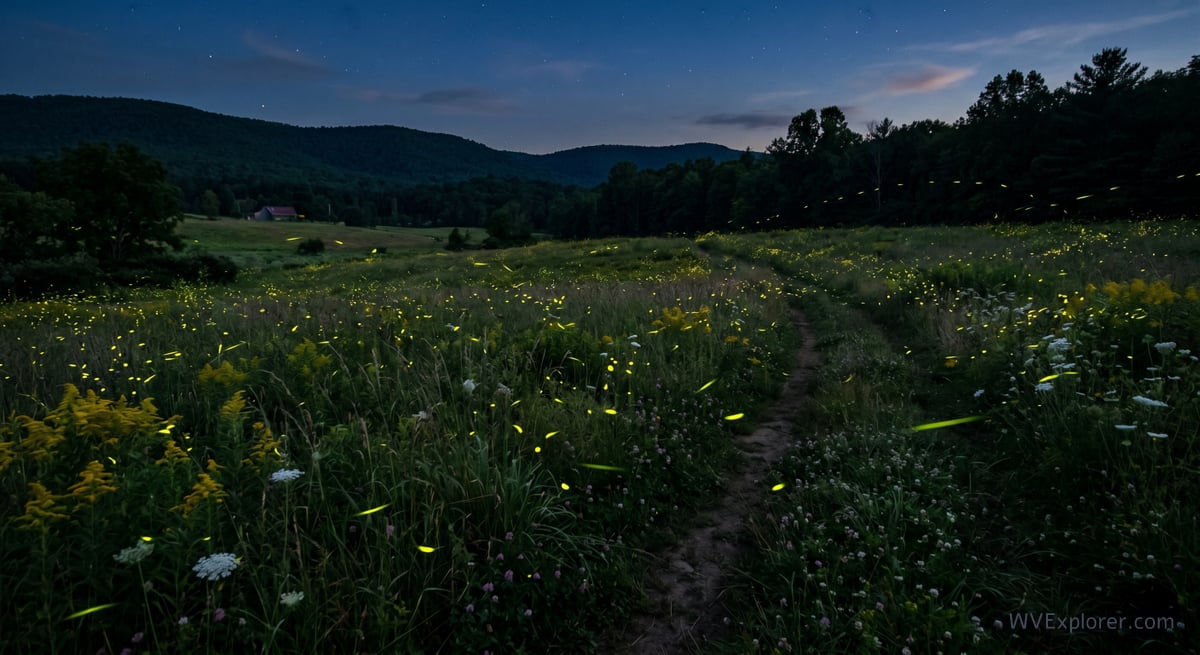
CHARLESTON, W.Va. — Warm evenings, lush forests, and some of the darkest skies in the eastern United States are combining to create one of West Virginia’s most enchanting summer spectacles.
Across much of the Mountain State, late June and early July typically mark the peak of firefly season, when thousands of lightning bugs emerge after sunset, filling meadows, forest edges, and quiet country roads with their distinctive flashes.
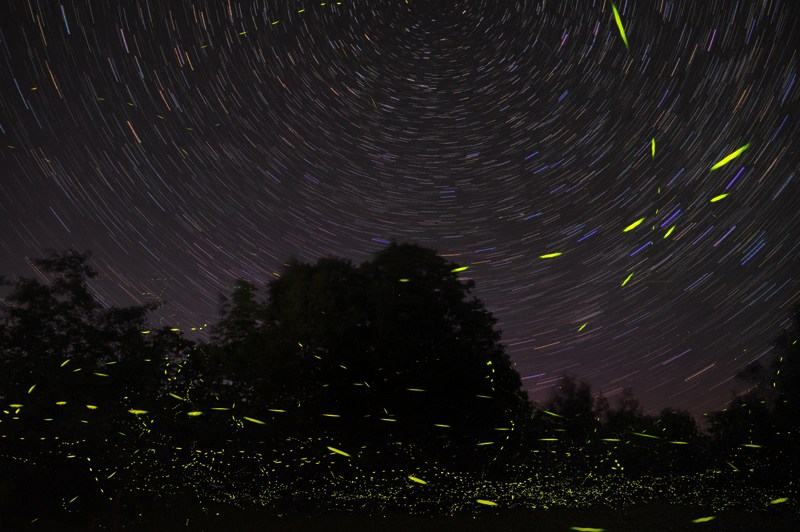
This year’s recent stretch of warm, humid weather has created ideal conditions for evening displays, making the coming week one of the best opportunities of the summer for residents and visitors hoping to see the insects in their natural habitat.
Unlike many parts of the eastern United States, West Virginia still offers extensive forests, rural valleys, and protected public lands where artificial lighting remains limited. These conditions provide an ideal habitat for dozens of firefly species, whose flashing displays are part of an intricate courtship ritual that unfolds for only a few weeks each year.
Where to look
Some of the state’s best firefly viewing occurs where forests meet open fields and human development is sparse.
Among the most promising locations are the mountain valleys of the Monongahela National Forest, the broad meadows of Canaan Valley, the high plateau of Dolly Sods, Watoga State Park, Calvin Price State Forest, and quiet rural landscapes bordering the New River Gorge. Many state parks and wildlife management areas also offer excellent viewing opportunities away from city lights.
Fireflies typically appear about 20 to 30 minutes after sunset, with activity often increasing over the next hour as darkness deepens. Warm, humid evenings with little wind typically produce the most impressive displays.
A brief but remarkable season
Although they may seem to flash randomly, fireflies use precisely timed light signals to find mates. Males patrol above grasses and along woodland edges, while females respond from nearby vegetation with species-specific flash patterns. Scientists have documented dozens of firefly species throughout Appalachia, each with its own timing and behavior.
Because adult fireflies live only a short time, the annual display usually peaks over a few weeks before gradually fading as July progresses.
Watching responsibly
Visitors can help protect the insects by arriving before sunset, staying on established trails, and avoiding bright flashlights or flash photography after dark. If a light is necessary, experts recommend using a flashlight with a red filter, which is less disruptive to both fireflies and other visitors.
Observers should also avoid collecting fireflies or walking through meadows where the insects are actively displaying. Many of the state’s best viewing locations are on private land, so it is important to respect posted property boundaries and seek permission before entering fields or farms.
For those willing to linger after sunset, the reward can be one of West Virginia’s most memorable summer experiences—a landscape illuminated not by streetlights or fireworks, but by thousands of tiny flashes rising from fields and forests across the Mountain State.
Make an Evening of It
Many of West Virginia’s best firefly viewing locations are close to campgrounds, scenic overlooks, and small towns where visitors can turn a night of firefly watching into a full summer outing. Packing a picnic dinner, arriving before sunset, and staying long enough to watch the landscape transition from daylight to darkness can make the experience especially memorable.
As the last birds fall silent and the first stars appear overhead, the flashing lights of fireflies gradually spread across fields and forest edges, creating a spectacle that has captivated generations of West Virginians. For families, photographers, and anyone looking to slow down for an evening, few summer traditions capture the quiet beauty of the Mountain State as well as watching fireflies under a dark Appalachian sky.
Read also: Why West Virginia may be America’s best place to see fireflies