
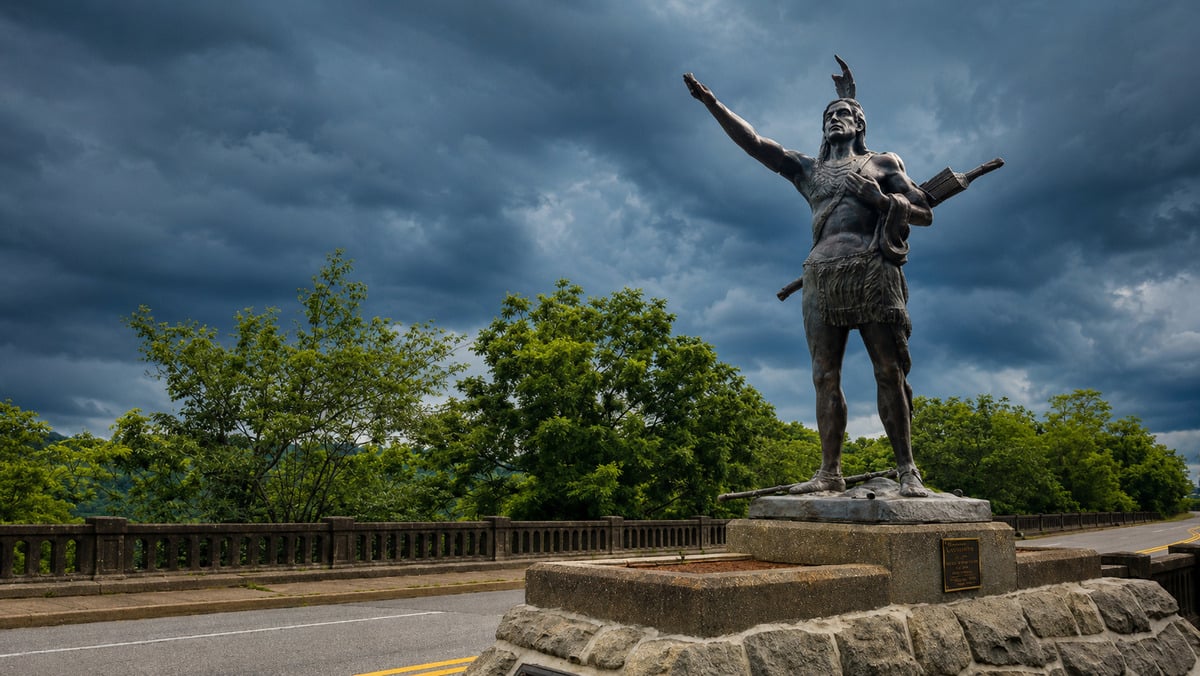
WHEELING, W.Va. — For nearly a century, a bronze Native American figure standing atop Wheeling Hill has greeted travelers arriving in the Ohio Valley.

Known simply as “The Mingo,” the statue is among Wheeling‘s most recognizable landmarks. Thousands of motorists pass it each year without realizing that the monument represents a people whose history is deeply intertwined with the settlement of the Ohio Valley and the early history of what would become West Virginia.
Dedicated in 1928, the statue overlooks the historic National Road (US-40) as it climbs Wheeling Hill. Its inscription describes the figure as the “Original Inhabitant of this Valley,” extending greetings and peace to travelers.
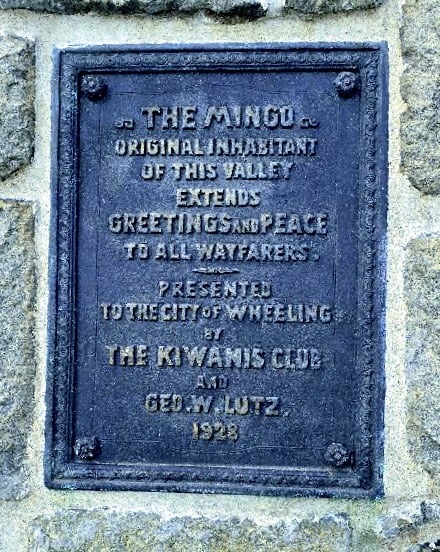
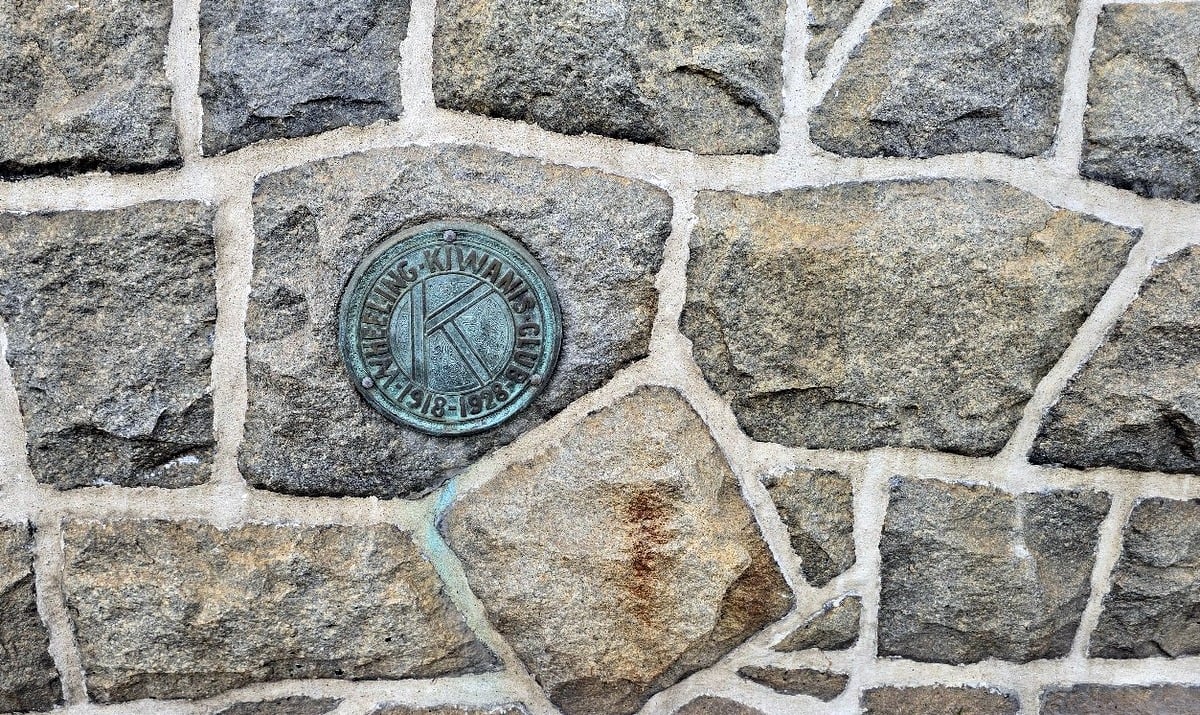
According to the Ohio County Library, the monument was presented to the city by the Kiwanis Club of Wheeling and businessman George W. Lutz, while local artist Henry Beu created the bronze sculpture.
For generations, residents have simply called it “The Mingo.” But who were the Mingo?
The People Behind The Name
Despite popular assumptions, the Mingo were not a single tribe as many imagine.
Historians generally describe the Mingo as a collection of Native peoples, primarily Seneca and Cayuga members of the Haudenosaunee (Iroquois Confederacy), who migrated westward into the Ohio Country in the eighteenth century. Other Native groups, including Susquehannock survivors and adopted members of neighboring nations, also became associated with Mingo communities.
The name itself was not commonly used by the people. It originated from an Algonquian term that European settlers later adapted to describe Iroquoian-speaking peoples living in the Ohio Valley. Over time, “Mingo” became a convenient label for Native communities that occupied territory spanning present-day eastern Ohio, western Pennsylvania, and northern West Virginia.
By the mid-1700s, Mingo settlements were found throughout the upper Ohio River region.
At the time, Wheeling and much of the surrounding valley remained a contested frontier where Native nations, British colonists, French interests, and later American settlers competed for influence and control.
The Ohio Valley Frontier
The Mingo played a major role in many events that shaped the upper Ohio Valley during the colonial era.
Among the best-known Mingo leaders was Logan, often remembered as Logan the Orator. A Cayuga leader associated with the Mingo, Logan became one of the most famous Native figures in frontier history after the murder of members of his family during escalating tensions between settlers and Native communities in 1774. His response and later speech, known as “Logan’s Lament,” became one of the most widely circulated examples of Native American oratory in early America.
The conflicts of that era helped transform the Ohio Valley. As settlement expanded westward after the American Revolution, Native peoples throughout the region increasingly lost control of their lands. Many Mingo communities relocated farther west, first into Ohio and later to Kansas and present-day Oklahoma, as part of federal Indian removal policies during the nineteenth century.
A Monument To A Vanishing Frontier
When Wheeling leaders commissioned the Mingo statue in the 1920s, they were creating more than a roadside landmark. The monument reflected a widespread belief of the era that Native peoples belonged primarily to the region’s past. Civic leaders sought to commemorate the Ohio Valley’s Native history while celebrating Wheeling’s growth as a modern city.
The statue’s location was carefully chosen. Before Interstate 70 was built, the National Road served as the principal gateway into Wheeling. Travelers approaching the city encountered the bronze figure, with an outstretched arm, welcoming them into the valley below.
The monument has weathered its own challenges. In 1982, vandals cut the statue from its pedestal and removed it from the site. It was later recovered, restored, and returned to its place overlooking the city, where it was rededicated in 1983.
The Mingo: More Than A Landmark
Today, the Mingo statue remains one of Wheeling’s defining landmarks, but historians increasingly view it as an opportunity to explore a deeper story.
The people represented by the statue did not simply disappear from history. Descendants of the Ohio Valley Mingo ultimately became part of the federally recognized Seneca-Cayuga Nation in Oklahoma, where their descendants continue to preserve their cultural traditions and tribal identity.
For visitors arriving in Wheeling, the bronze figure still serves its original purpose as a welcoming symbol.
Yet nearly a century after its dedication, the statue also reminds travelers that the history of the Ohio Valley began long before the arrival of the National Road, the city of Wheeling, or even the state of West Virginia. The story of the Mingo remains part of that landscape.
Once again another great article, so interesting. History is my thing and not growing up in the East
or in the West Virginia area I don’t know much about it’s history, My husband however is from WV and his family is steeped in WV history from the beginning of this countries inception.
No I didn’t grow up here but I am finding that I indeed had Ancestors from the East ( New England)( Canada) ( PA) & ( Central US) before they all ended up in CA somehow.
Keep them coming I am so interested in all this history !!!!
The Mingo, especially Chief Logan, The Dawson Families & Chief Red Jacket History for many years. I have a booklet called The History of the Ohio River Valley published about 90 years ago at East Liverpool, Ohio; it’s stories were also from 100 years earlier. I have learned a lot from it!
my relatives are from w va, love to visit
love to visit., beautiful state
Xxx
I pass by this statue all the time
Thanks David, I have lived here for 35 years, always wondered why they erected an Indian statue on the site since locals refer to that a spot as McColloch’s Leap. The story as I have heard it, in @ 1777 Major Samuel McColloch rode his horse down the steep drop of Wheeling Hill in a desperate attempt to escape the Indian party that had separated him from his troops. The statue marks the site of his “leap”. Part jump, part ride, the legend has grown of course. He had come with a relief party to help locals fight off an attack on Fort Henry but got separated from his men. He made the suicidal “leap” to avoid most certain death if captured as he was being chased down by the Indian attackers. Both McColloch and his horse survived.
That’s the story I’ve also heard for many,many years,I wonder if that actually also happened there, maybe it’s fiction but I’ve heard it all of my life.
My husband said he remembers there being a statue of a man on a horse there when he was young. That would have been about 70 years ago. His father told him the story about the man escaping the Indians by riding down the mountain.
The Mingo statue in Wheeling is sick and twisted—a masterclass in historical revisionism that weaponizes the “noble savage” trope to mask violent displacement. You don’t steal a homeland and then cast the people you forced out in bronze to wave motorists into town. No indigenous inhabitant would ever consent to act as an accessory to their own erasure.