
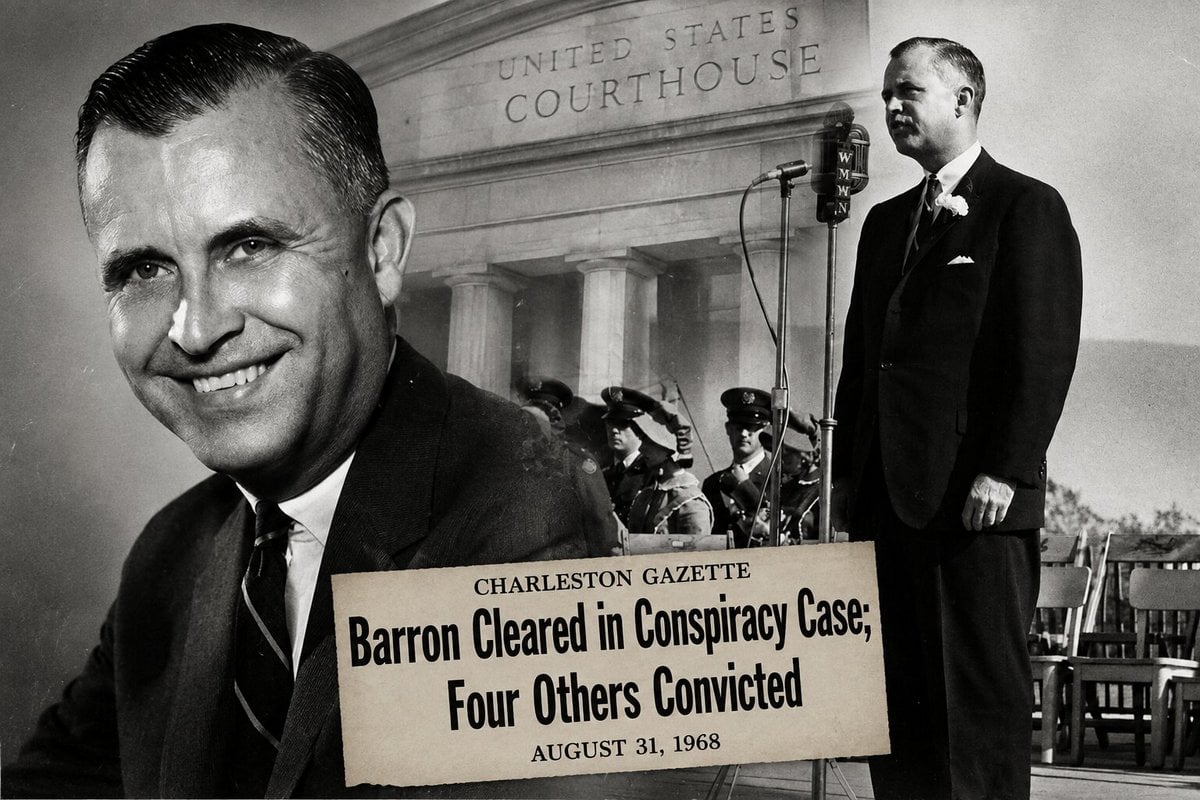
CHARLESTON, W.Va. — Fifty-eight years ago this week, one of the most extraordinary political corruption cases in West Virginia history began in a federal courtroom in Charleston, where a former governor and five other men stood accused in a conspiracy involving state contracts, secret payments and money moving through corporations hundreds of miles away.

The trial of former Gov. William Wallace Barron began Aug. 12, 1968, and would end more than two weeks later with what appeared to be a remarkable personal vindication for the former governor. Four of his co-defendants were convicted, but Barron walked out of the courtroom a free man.
His victory would prove short-lived. Within three years, Barron would plead guilty to federal charges stemming from the revelation that $25,000 had been paid to the foreman of the very jury that acquitted him, an extraordinary conclusion to a scandal that reached from the highest levels of West Virginia government into the jury room itself.
The case remains a striking chapter in the state’s political history, not simply because a former governor was accused of participating in corruption, but because the judicial process intended to determine his guilt was itself corrupted.
A former governor goes on trial
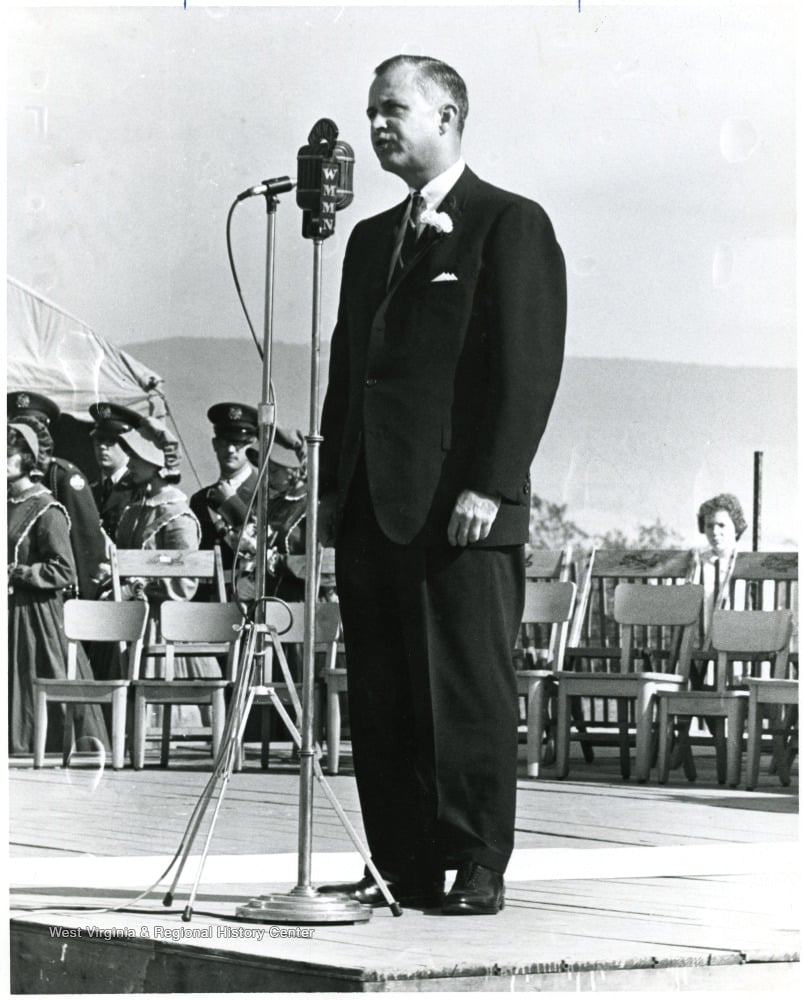
Barron, a Democrat from Randolph County, had been elected governor in 1960 after a career in law and state politics. Born in Elkins in 1911, he attended Washington and Lee University and the West Virginia University College of Law. He took office at a particularly difficult moment in West Virginia history, when declining employment in the coalfields and a historic population loss were reshaping the state.
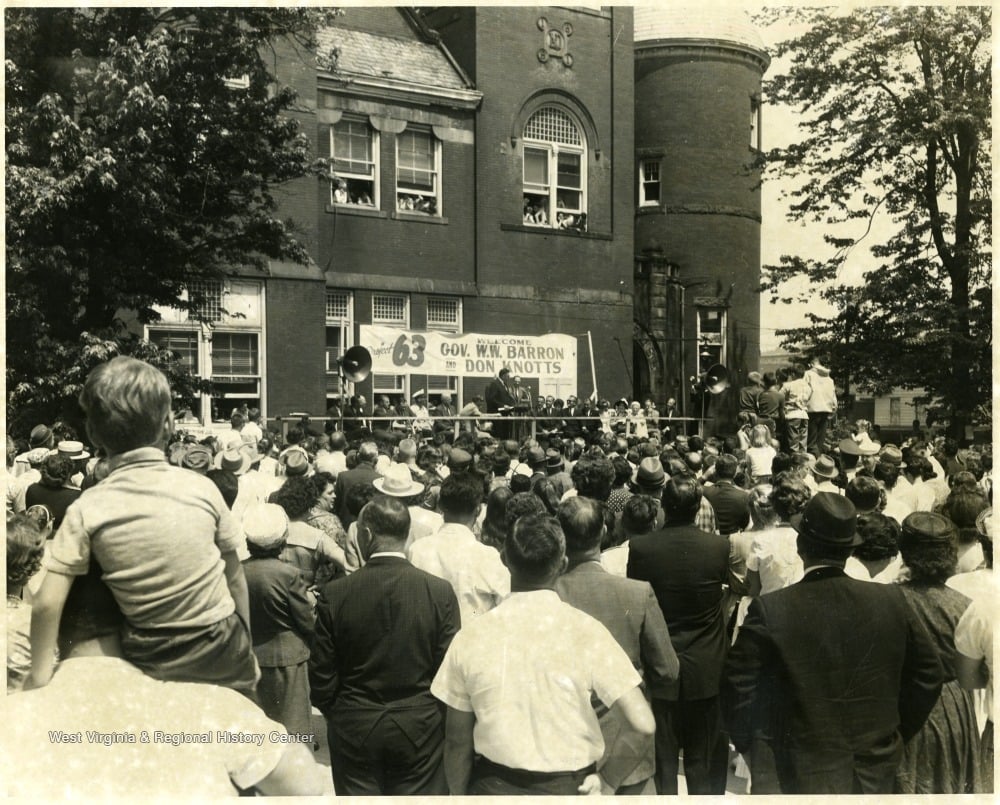
In his 1961 inaugural address, Barron described a state struggling with unemployment and enormous economic change. Coal employment, he said, had fallen from 112,000 to 50,000 during the previous decade as automation and mechanization eliminated jobs, while thousands of West Virginians had left in search of employment elsewhere.
The 1960 census showed the state had lost nearly 8 percent of its population during the 1950s. Barron promised improvements in roads, education, conservation and state institutions as part of an effort to rebuild the state’s economy.
Seven years later, the administration that had begun with those ambitions was at the center of a federal courtroom drama. Barron and five other defendants appeared in federal court in Charleston on Aug. 12, 1968, accused of conspiring to use interstate facilities in connection with bribery involving state contracts.
The other defendants included former State Road Commissioner Burl A. Sawyers, former Deputy Road Commissioner Vincent J. Johnkoski, former Finance Commissioner Truman E. Gore, Elkins attorney Bonn Brown and Clarksburg automobile dealer Alfred W. Schroath. All six pleaded not guilty.
The proceedings immediately took on the dimensions of an exceptional trial. Seventy-six prospective jurors were assembled before seven women and five men were chosen, along with six alternates, and Special Federal Judge J. Robert Martin Jr. ordered all 18 confined for the duration of the trial.
They were housed at Charleston’s Daniel Boone Hotel, with their telephone calls and access to television, radio, and newspapers monitored to some extent. Among those selected was Ralph E. Buckalew, a Dunbar city councilman and Union Carbide employee who was chosen jury foreman. That seemingly routine decision would eventually become central to the entire scandal.
Money moved through corporations outside West Virginia
The government’s case concerned an alleged system in which money associated with West Virginia state contracts flowed through corporations in Ohio and Florida. Prosecutors presented evidence that 17 firms sent a combined $166,570 to corporations that were subsequently dissolved or consolidated.
According to the indictment, Schroath and Brown established corporations that received money from companies doing business with West Virginia state government, and prosecutors contended that the payments were effectively kickbacks.
One of the government’s most important witnesses was Charleston businessman Isadore Lashinsky, who was himself under indictment for income-tax evasion and testified under immunity. Lashinsky told jurors that he had left $50,000 in sealed envelopes during visits to Johnkoski’s office between 1961 and 1963, describing the money as commission payments based on business he conducted with the state.
The government ultimately called 31 witnesses and introduced 186 exhibits, while the defense called none. The defendants were not required to present evidence, and their attorneys instead sought to persuade jurors that prosecutors had failed to prove the conspiracy beyond a reasonable doubt.
The jury struggles to reach a verdict
After 15 days of courtroom proceedings, the case went to the jury, where deliberations stretched beyond 18 hours. At one point, the jurors appeared unable to reach unanimous agreement, prompting Martin to deliver what was known as an Allen charge, an instruction encouraging jurors in the majority and minority to reconsider their positions while maintaining their individual judgment.
The jury subsequently returned to the courtroom with an important question: “If two or more defendants are found guilty and the rest are found not guilty, are all defendants considered guilty?”
Martin again explained the law of conspiracy, emphasizing that jurors first had to determine whether a conspiracy existed and then decide which defendants had participated in it. He held up two fingers to emphasize that a conspiracy required at least two people and explained that one or more defendants could be acquitted while two or more were convicted. Two hours later, the jury returned with its verdicts.
Barron hears ‘not guilty’
Shortly after 6 p.m. on Aug. 30, jury foreman Ralph Buckalew handed a piece of paper containing the verdicts to Martin. The judge examined it and passed it to the court clerk, who read Barron’s name first: “not guilty.” Barron initially appeared impassive, according to contemporary reporting in the Charleston Gazette, but moments later smiled and became emotional as he embraced his wife, Opal, and attorney Robert G. Perry.
The result was dramatically different for four of the other defendants. Sawyers, Johnkoski, Brown and Schroath were convicted, while Gore was no longer before the jury because a mistrial had been declared in his case during the proceedings.
Barron told reporters that he intended to remain in Charleston, practice law, participate more in civic affairs and spend more time exercising. He also thanked the thousands of people who had been kind to him and his wife during the ordeal. For the former governor, a case that had threatened his freedom and reputation appeared to be over.
Rumors begin circulating about the jury
Questions subsequently emerged about how Barron had escaped conviction when four men charged alongside him had not, and rumors eventually began circulating that a juror had been bribed. Federal investigators would focus on the man who had handed Barron’s not-guilty verdict to the judge—Ralph Buckalew.
A later federal indictment alleged that $25,000 had been paid to Buckalew to influence the other 11 jurors. Buckalew pleaded guilty to bribery, conspiracy and obstruction of justice charges and initially received a 20-year prison sentence.
The allegations went considerably further. According to the later indictment, attorney Bonn Brown had provided at least $10,000 toward the $25,000 payoff, while Barron’s former attorney, Robert Perry, was accused of delivering $25,000 to Barron for transfer to Buckalew. The man entrusted with leading the jury had become part of another alleged conspiracy, and the investigation was now headed directly back to Barron.
Barron admits his guilt
Federal prosecutors ultimately charged Barron, Perry and Brown with conspiracy, bribery and obstruction of justice in connection with the jury payoff. This time, Barron did something very different from what he had done when he entered the Charleston courtroom in 1968: He pleaded guilty.
According to the contemporary account, Barron stood before the court with his hands clasped behind his back and said he was guilty “in substance” to the charges, although he disputed the accuracy of some dates contained in the indictment.
The court initially sentenced the former governor to 25 years under a procedure that allowed the sentence to be reconsidered following a federal classification study. His attorneys asked that he be transferred immediately to the Federal Medical Center in Springfield, Missouri, citing his health.
It was an astonishing reversal for the former governor who had walked away from the federal courthouse amid embraces and congratulations after hearing the words “not guilty,” only to later admit participating in crimes connected to the corruption of the proceeding that cleared him.
A trial unlike any West Virginia had seen
Even before the jury-bribery scandal emerged, contemporary observers understood that Barron’s trial represented something exceptional. The Gazette described it at the time as a trial unlike any previously held in West Virginia, with a former governor among the accused alongside former senior state officials and prominent political and legal figures.
Nationally known trial lawyer Edward Bennett Williams appeared in the case, while Peter Taft, grandson of President William Howard Taft, attended much of the trial as a member of Williams’ firm.
Yet what happened after the courtroom emptied transformed the case from a major political corruption trial into something considerably more extraordinary. The government had initially accused members of Barron’s administration and their associates of corrupting the process by which West Virginia awarded state business, only for the process intended to determine responsibility for that alleged corruption to itself become corrupted.
Barron’s acquittal, celebrated in a Charleston courtroom in August 1968, therefore became only the midpoint of the story: The jury foreman who delivered it would plead guilty, the former governor who received it would plead guilty, and a trial that seemed to have cleared William Wallace Barron instead became the beginning of one of the most remarkable political scandals in West Virginia history.
Well written article! I appreciated reading about the history that I only knew part of.
Yes, a good article.
I respectfully suggest that you publish a similar piece on Arch Moore, who likewise was acquitted in a first and convicted in a second federal trial.