
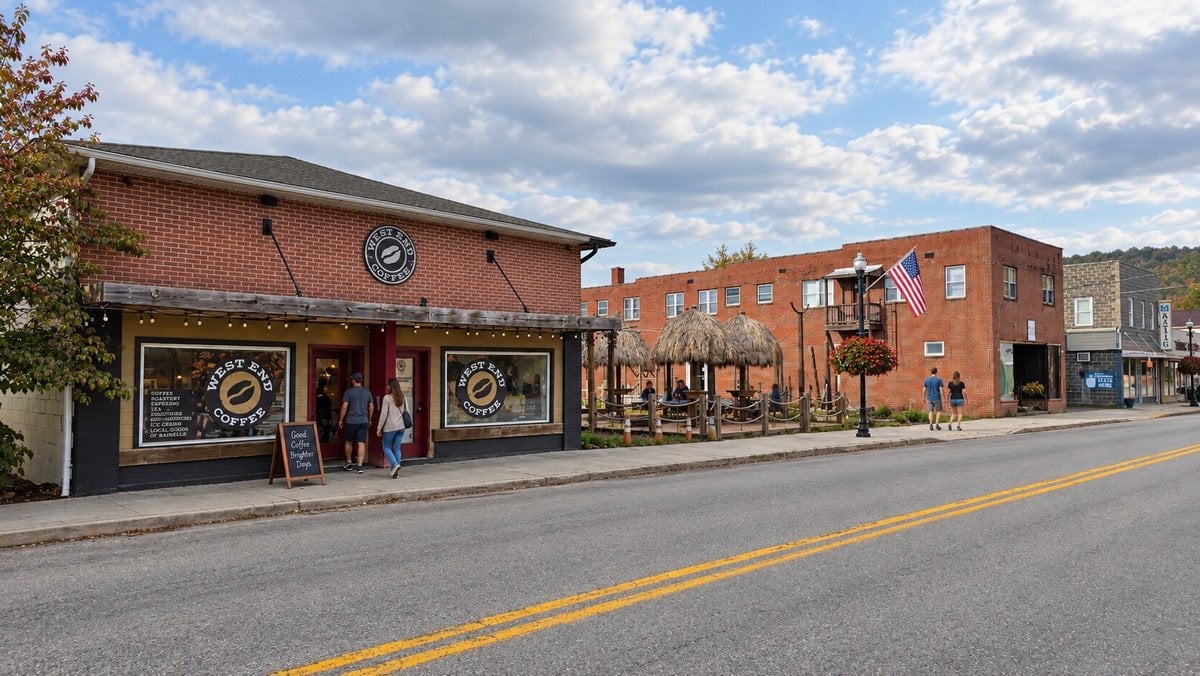
Rainelle, West Virginia, is a historic lumber town on the Meadow River in southern West Virginia. Built around one of the world’s largest hardwood sawmills in the early 20th century, the community today is a gateway to the Meadow River Rail Trail and the mountain country between the Greenbrier Valley and the Gauley River.

Situated at the western foot of Sewell Mountain, the town occupies an unusual place in southern West Virginia’s geography. U.S. 60 crosses the town on the historic route of the James River and Kanawha Turnpike, while W.Va. 20 provides a north-south connection through western Greenbrier County. The Meadow River flows through town before turning toward increasingly rugged country downstream.
Map of Rainelle, West Virginia
Rainelle was built around a giant lumber mill
Brothers Thomas and John Raine organized the Meadow River Lumber Company during the first decade of the 1900s and acquired approximately 32,000 acres of timberland in western Greenbrier County. They built a sawmill and a railroad to reach the surrounding forests and the community that became Rainelle.
The mill began operating around 1910 and eventually became an industrial operation of extraordinary scale. At its peak, the Meadow River Lumber Company operated what the Historic American Engineering Record describes as the world’s largest hardwood sawmill. The Library of Congress preserves an extensive federal photographic and engineering record of the complex, including 56 photographs and measured drawings.
At its peak, the mill could cut an average of 110,000 board feet per day. Production reached a record 31.6 million board feet in 1928, while the company’s plants turned hardwood into flooring and other products, including millions of wooden shoe heels during the 1930s.
Rainelle consequently grew not beside the lumber industry but largely because of it. The company developed the town to house and serve the workforce needed to operate the mill and railroad, and the community’s fortunes remained closely tied to the company for much of the 20th century.
When the mill closed, Rainelle changed
Rainelle reached a population of 2,408 in 1950, but changes in the timber industry eventually altered the economy that had sustained the town. Georgia-Pacific purchased the Meadow River Lumber Company in 1970 and closed the Rainelle mill in 1975.
Population declined during the decades that followed. By the 2020 census, Rainelle had 1,190 residents, less than half its mid-century peak. The town suffered another severe setback during the catastrophic flooding that struck southeastern West Virginia in June 2016.

Yet the same geography and transportation corridors that once made Rainelle an industrial center are beginning to provide the community with another role.
Meadow River Rail Trail gives the old railroad a new purpose
An abandoned railroad corridor that once served the industrial economy of the Meadow River Valley now carries bicyclists, hikers and horseback riders into the countryside downstream from Rainelle.
The Meadow River Rail Trail extends approximately 18 miles from Rainelle to Nallen, following the river through Greenbrier and Fayette counties. Completion of the final section into Rainelle in 2026 established the town as the western gateway to the continuous trail.
The transformation is particularly appropriate in Rainelle. Railroads were essential to the development of the Meadow River timber industry because the rocky river was poorly suited to the log drives commonly used elsewhere. Railroad transportation finally opened the watershed’s extensive hardwood forests to large-scale harvesting after 1900.
More than a century later, the railroad grade serves almost the opposite purpose. Instead of carrying timber out of the Meadow River country, it carries visitors into it.
The Meadow River changes below Rainelle
Rainelle also stands near a remarkable transition in the character of the Meadow River.
The 52.6-mile river begins in the high country near the Greenbrier-Summers county line and flows northwest through the broad Meadow River Valley. From near Rainelle downstream, it forms county boundaries as it moves toward progressively rougher terrain. Its lower reaches become a rocky, turbulent stream before the Meadow joins the Gauley River near Carnifex Ferry Battlefield State Park.
That transformation helps explain the rail trail’s appeal. Visitors leaving Rainelle can follow a relatively gentle former railroad grade into a landscape that becomes increasingly isolated and mountainous downstream.
Farther west, the lower Meadow flows partly within Gauley River National Recreation Area, where the river and its sandstone canyon draw whitewater paddlers, climbers, and other outdoor recreationists.
Rainelle stands on an older route across the mountains
Rainelle’s transportation history predates the lumber railroad.
U.S. 60 through town follows the historic corridor of the James River and Kanawha Turnpike, later promoted as the Midland Trail. For generations, the route was a principal east-west passage across southern West Virginia, climbing over Sewell Mountain just east of Rainelle. It remained an important highway until Interstate 64’s completion shifted much of the region’s through traffic away from the older road.
The mountain itself bears the name of Stephen Sewell, one of the earliest Europeans known to have lived west of the Allegheny Front in what became West Virginia.
By 1749, Sewell and Jacob Marlin had established themselves at present-day Marlinton. After they separated, Sewell eventually built a cabin on the eastern side of Sewell Mountain along what became known as Sewell Creek near present-day Rainelle. Historical accounts indicate he was killed there, probably in 1756 during the French and Indian War.
Sewell Mountain and Sewell Creek preserve his name in the landscape today.

A gateway between two West Virginia tourism regions
Rainelle occupies a useful position for travelers because it sits between the Greenbrier Valley and the outdoor-recreation country associated with the New and Gauley rivers.
The Meadow River Rail Trail now gives visitors another reason to stop rather than simply pass through on U.S. 60. From Rainelle, the trail heads west along the river toward Nallen, while the highway continues across Sewell Mountain toward the New River Gorge region. To the east and southeast lie communities and attractions throughout the Greenbrier Valley.
That location gives modern Rainelle something in common with the town created by the lumber industry more than a century ago: its future remains closely tied to the routes that converge there and to the surrounding landscape.
Lodging near Rainelle
Regional Information
Rainelle is located in the Greenbrier Valley Region in southeastern West Virginia near the New River Gorge Region.