
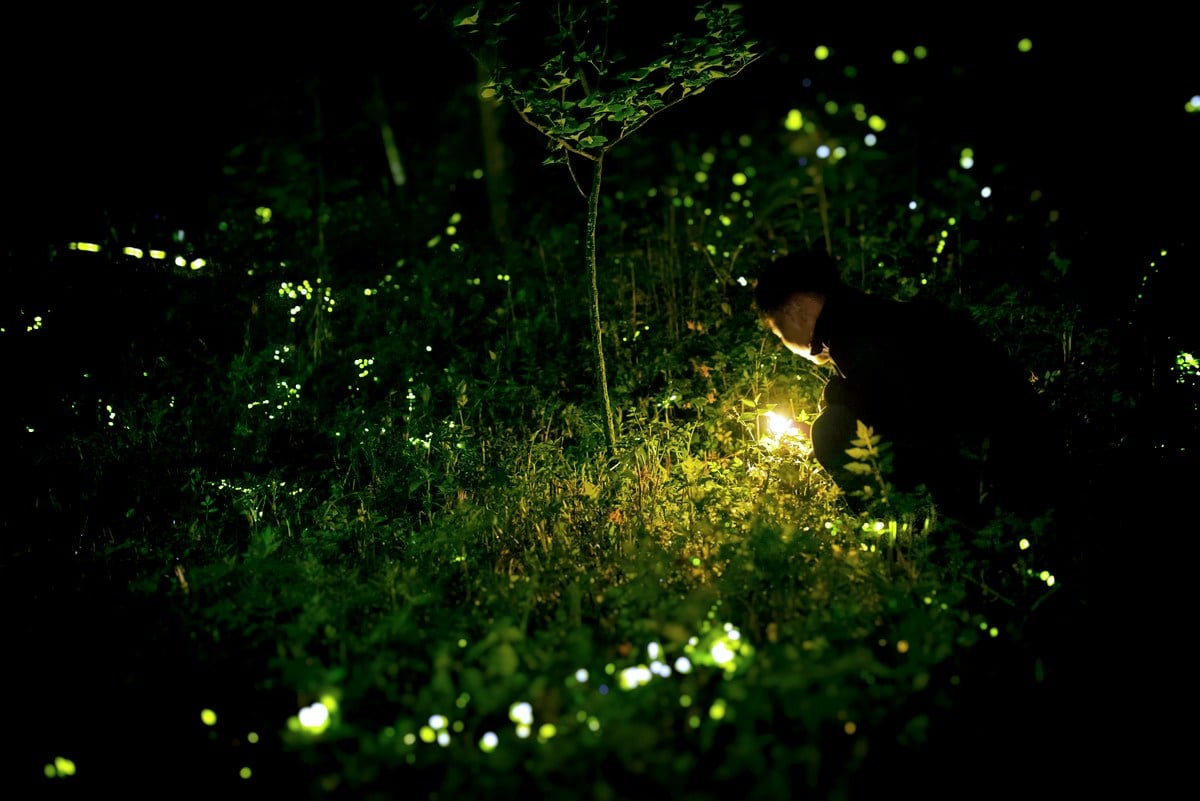
WATOGA, W.Va. — As fireflies begin their annual summer display across West Virginia, scientists say one of the insects’ greatest allies may be something many residents take for granted—darkness.

Across much of the eastern U.S., artificial lighting continues to expand as development spreads into rural areas. Streetlights, security lighting, and commercial development have transformed nightscapes that remained largely dark for generations. Researchers studying fireflies say this trend may be affecting the insects’ ability to reproduce, raising concerns about their long-term future.
West Virginia, however, occupies a somewhat different position. Although light pollution has increased in parts of the state, large areas remain significantly darker than many surrounding regions. According to biologists, those darker skies may help preserve the conditions fireflies need to survive.
Related: Why West Virginia Remains One of America’s Best Places to See Fireflies
Krista Noe, a vegetation ecologist with the W.Va. Division of Natural Resources, says that the Mountain State has been a refuge for summer’s tiny lanterns and hopes communities can sustain that quality.
“West Virginia’s kind of been a haven,” Noe said. “There’s been less increase in light pollution here than in our surrounding states, but it is still growing.”
The issue has drawn increasing attention from scientists who study nocturnal wildlife. Fireflies rely heavily on darkness to communicate, and researchers say even modest increases in nighttime lighting can disrupt behaviors that have evolved over millions of years.
Fireflies depend on darkness
The flashing displays that appear over fields, roadsides, and forest edges in June and July are not random, Noe says. They are part of a complex communication system that males and females use to locate one another during the breeding season. “Frankly, they’re just trying to mate.”
Each species has developed its own flashing pattern, she says. Some emit a single pulse every few seconds, while others flash rapidly. The timing, brightness, and color of those signals help ensure that males and females of the same species find one another.
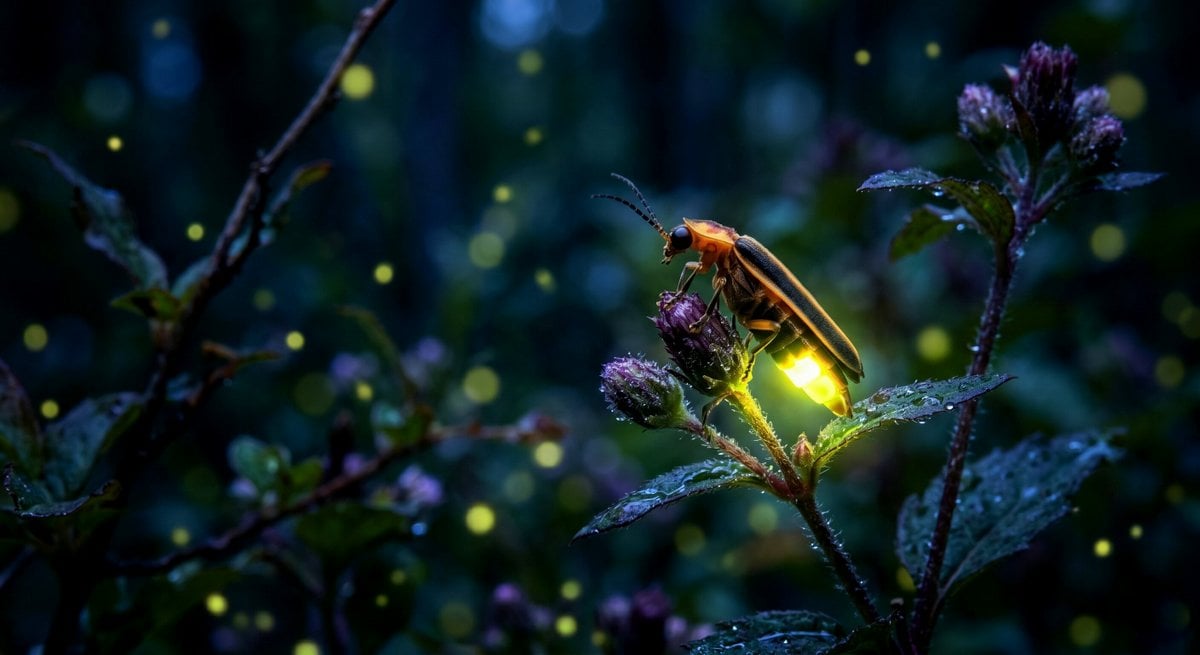
Scientists believe the system works because it evolved in darkness. For thousands of generations, fireflies communicated against a backdrop of moonlight, starlight, and occasional lightning. Modern artificial lighting introduces something entirely new and poisonous to that environment.
Security lights, parking lots, decorative landscape lighting, and illuminated buildings can overwhelm the flashes that fireflies use to communicate. When those signals become harder to see, finding mates becomes more difficult.
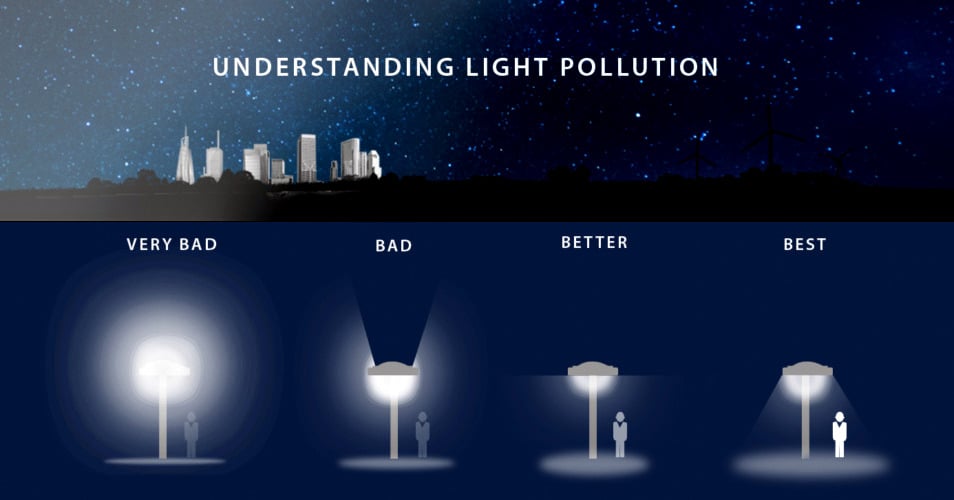
“The biggest thing people can do to help them is to turn their lights off, hood them, or dim them,” Noe said.
Researchers increasingly identify artificial lighting as one of the leading threats facing fireflies worldwide. Unlike many environmental challenges that require large-scale solutions, reducing light pollution can often be accomplished by individual property owners.
Simple actions such as using motion sensors, shielding lights, and turning off unnecessary fixtures can reduce impacts on nocturnal wildlife.
West Virginia remains relatively dark
Concerns about light pollution are mounting as dark skies become increasingly rare across much of the eastern United States. One of the fastest-growing threats is the widespread adoption of bright LED lighting associated with new residential and commercial development. Their intensity and blue-rich wavelengths can contribute significantly to skyglow and interfere with the behavior of nocturnal wildlife, including fireflies.
Studies using satellite imagery have documented rising levels of artificial illumination throughout North America. Expanding suburbs, commercial corridors, and industrial development have steadily brightened night skies that were once naturally dark.
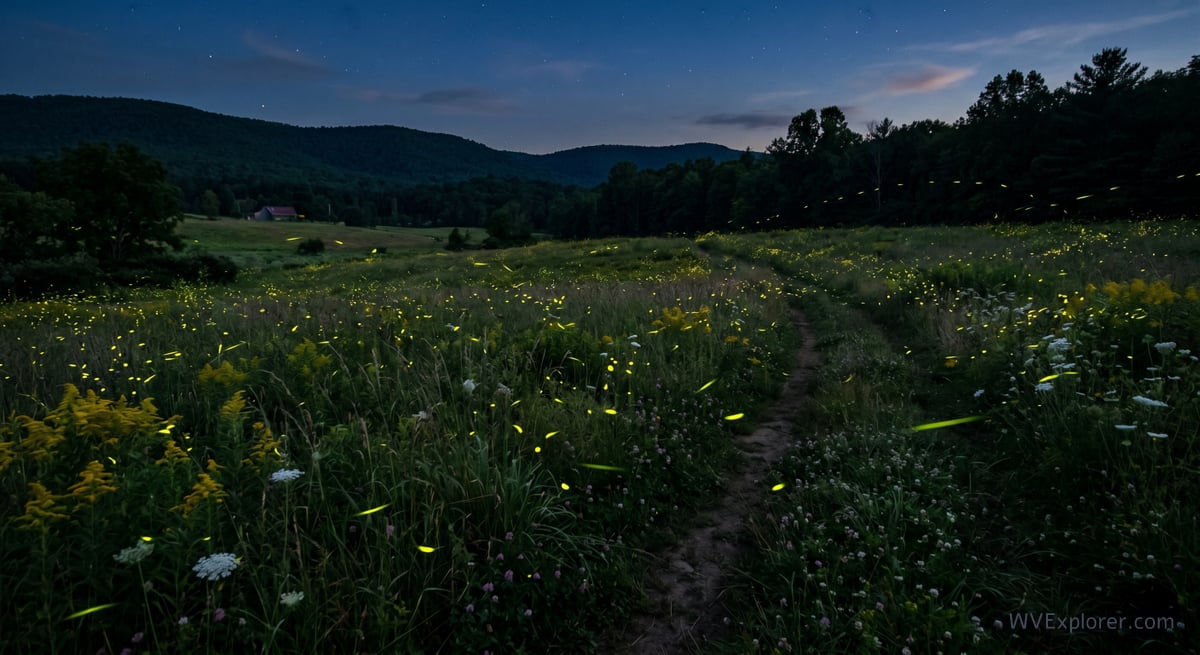
While West Virginia has not escaped these trends, the state’s mountainous terrain, extensive forests, and relatively low population density have helped preserve darker conditions than in many neighboring states.
Noe believes that difference may benefit not only fireflies but also a wide range of nocturnal species.
“We’re trying to get people to learn about it now so that we can coexist better with our nocturnal species,” she said.
Related: Nightfall’s Value: How light pollution can diminish real estate values in West Virginia.
The issue extends beyond insects, Noe said. Artificial lighting has been shown to affect migrating birds, bats, amphibians, and numerous other species that depend on natural day-night cycles.
For fireflies, however, the relationship is particularly direct. Their ability to reproduce depends on being seen.
A state rich in firefly diversity
West Virginia’s relatively dark nights coincide with another important advantage—biological diversity. The state currently has about 33 known firefly species, though researchers continue to discover additional species and document new populations.
“We’re always finding more,” Noe said. “The more we look, the more we find.”
Many residents assume the fireflies they see on summer evenings belong to a single species. In reality, multiple species may occupy the same landscape.
Some inhabit open fields and pastures, while others prefer forest interiors, wetlands, or woodland edges. Each has evolved its own behavior and flashing pattern.
This diversity reflects West Virginia’s unique position within the Appalachian region. Because the state lies at the intersection of northern and southern ecosystems, species from different regions often overlap here.
“We tend to be the southernmost distribution of some species and the northernmost distribution of other species,” Noe said.
That pattern occurs among plants, birds, salamanders, and many other forms of wildlife. Fireflies appear to follow similar trends, making the Mountain State an important location for studying biodiversity.
Fireflies also spend most of their lives underground. The flashing adults visible on summer evenings represent only a small fraction of a firefly’s life.
For most of their lives, they live beneath the soil surface as larvae. During that stage, they are predators, feeding on snails, slugs, and other small invertebrates.
“Fireflies are voracious predators in the soil ecosystem when they’re larvae,” Noe said.
Because they spend so much time underground, soil conditions are critical. In fact, moisture appears to be one of the most important requirements. “They’re very moisture dependent,” she said.
Moist soils support both the larvae and the prey species they consume. Areas that retain moisture generally provide better habitat than dry landscapes.
This relationship helps explain why fireflies are often abundant near streams, wet meadows, woodland edges, and other areas that remain damp throughout the summer.
Are fireflies declining?
Questions about firefly populations have become more common as many people report seeing fewer insects than they did when they were children.

Scientists acknowledge these observations but caution that determining long-term population trends is difficult. “We don’t have the baseline data,” Noe said.
Unlike birds and some other wildlife groups, fireflies were not systematically monitored in the decades since. Researchers, therefore, lack the historical information needed to compare modern populations with reliable historical records.
As a result, scientists often describe reported declines as anecdotal rather than documented. “We have seen their decline anecdotally,” Noe said. “It’s hard to say scientifically for sure because nobody was out there recording firefly numbers.”
Even so, researchers recognize that several factors commonly associated with insect declines have increased over the same period. Habitat destruction, pesticide use, insecticide use, and light pollution have expanded across much of North America.
Those pressures have led many scientists to view firefly conservation as a growing concern, even as additional research continues.
Although they may appear to flash at random, fireflies use remarkably precise light signals to communicate. Males fly low over fields and forest edges, emitting species-specific flash patterns in search of a mate.
Females often remain perched on grasses or leaves, answering with their own flashes after a characteristic delay. Scientists have identified dozens of firefly species in Appalachia, each with its own timing, flight pattern, and preferred habitat.
On especially warm, humid nights, thousands of individual flashes can combine into a spectacular display, transforming quiet meadows and woodland clearings into one of the Mountain State’s most memorable natural experiences.
Where to see fireflies
Late June is typically the peak of firefly season across much of West Virginia, and warm, humid evenings following a sunny day offer the best viewing. Visitors are most likely to spot impressive displays in open meadows, forest edges, quiet country roads, and riverside fields where artificial lighting is limited.
Some of the state’s best opportunities can be found in and around the Monongahela National Forest, Canaan Valley, Dolly Sods, Watoga State Park, Calvin Price State Forest, and rural valleys bordering the New River Gorge.
Fireflies usually become active about 20 to 30 minutes after sunset and continue flashing for an hour or more, especially on calm evenings with little wind. To help protect both the insects and the experience, visitors should use red-filtered flashlights when necessary and avoid shining bright lights into fields where fireflies are displaying.
Dark Sky parks highlight the issue
Interest in preserving dark skies has grown across West Virginia in recent years. Astrotourism is becoming a major industry.
Watoga State Park, Calvin Price State Forest, and Droop Mountain Battlefield State Park have each received international recognition for their dark skies, drawing visitors interested in astronomy and night-sky observation. Other public lands have pursued similar efforts.
Although these initiatives often focus on stargazing, Noe says, they can also provide significant benefits for wildlife.
Dark skies help maintain the environmental conditions in which nocturnal species evolved. For fireflies, that means preserving the darkness necessary for communication and reproduction.
Noe believes public awareness of the connection between dark skies and wildlife remains limited, but she expects interest to grow as more people learn about the issue.
What can homeowners do?
Unlike many conservation challenges, helping fireflies does not necessarily require major investments or large tracts of land. She recommends reducing unnecessary outdoor lighting whenever possible. Shielding lights, lowering their intensity, and using motion sensors can reduce impacts on wildlife while still providing safety and visibility.
Homeowners can also improve habitat by planting native vegetation, leaving portions of lawns unmowed, and preserving leaf litter and decaying logs. Native grasses are particularly valuable because their extensive root systems help retain soil moisture.
“Invasive grasses have these really short root systems, whereas native grasses have these really large root systems,” Noe said.
These wetter conditions support the snails and other organisms that firefly larvae feed on during the years they spend underground. The same practices often benefit pollinating insects, amphibians, and other wildlife.
Tips for Watching Fireflies Responsibly
A little preparation can make a summer evening more enjoyable while helping protect one of West Virginia’s most treasured natural displays. Arrive before sunset so you can safely find a parking spot, become familiar with the area, and settle in before the first flashes begin about 20 to 30 minutes after dusk.
Once darkness falls, avoid using flash photography or bright white flashlights, which can disrupt the fireflies’ mating signals and diminish the experience for everyone nearby. If you need a light, use a flashlight with a red filter, which is less likely to interfere with the insects’ behavior and preserves your night vision.
Whenever possible, remain on established trails or open paths rather than walking through meadows or tall grasses where fireflies may be active. Resist the temptation to catch or collect them. While a single firefly may seem insignificant, leaving them undisturbed helps ensure healthy local populations and allows others to enjoy the display.
Finally, remember that many of West Virginia’s best viewing locations are on private land. Always seek permission before entering fields or farms, and respect posted signs, gates, and property boundaries. A little courtesy helps preserve access to these special places for future visitors.
A resource many states are losing
For generations, West Virginians have regarded summer fireflies as a familiar part of the landscape. Scientists increasingly see them as indicators of something broader—the health of nighttime ecosystems.
As development continues across North America, darkness itself has become a diminishing natural resource. Large portions of the eastern United States now experience levels of nighttime illumination that would have been unimaginable a century ago.
West Virginia still retains significant areas where natural darkness persists. Researchers believe this may prove increasingly important for species that evolved to live and communicate at night.
For fireflies, the connection is straightforward. They require darkness to find mates, reproduce, and complete the life cycle that has made them one of summer’s most recognizable insects.

“The biggest thing people can do to help them is to turn their lights off,” Noe said.
For a species that depends on being seen in the dark, preserving darkness may be one of the most important conservation measures available.
I’m thinking the Calhoun County Park would be an excellent place to see the Fireflies.. Great place to maintain their essence
No, it’s sad. The only way it’s like this is because they wanna keep us run out of here, West Virginia. And you are more concerned about fireflies and what you are the population in West Virginia and why like it is in dark it’s because they steal our money. They hound us. They target us until we leave for some reason and it doesn’t really make any educated sense because they’re running their tax base out of here which is what they’re still in the money so it behooves me to understand why that they’re doing this to our state, but I’m not going anywhere. I’ll be the last damn one leave even though they have targeted me and tried to push me out.
Who are “They”
People moving in from areas where they made their money and wanting to run things. Total inconsiderate to those who have been there all their lives and for generations. “They” assume they are entitled to whatever measures of influence politically and environmentally. Snobs usually that are used to people being impressed but have no idea how unimpressed the new neighbors are. THATS THE THEY
Due to the enjoyable climate,beauty and resources I can Why a rich bunch of self focused,entitle minded,egotistical “top feeders” would want to monopolize and control our wonderful state for their own personal use and for those they love,HOWEVER, people like that have a way of falling into their own traps and end up finding that the money they flail around and depend on to “buy” friendships and financial connections usually just makes them miserable and paranoid trying to hold onto it while they go mad thinking everyones plotting to take what they have. The Currency Curse also spills over into their family dynamics and it becomes a mental treadmill of accelerating instability to the point that the power and wealth becomes their own destruction…. simple folk understand the simplicity of what I just said but there will akways be those that think, while playin that Russian roulette, that Theyll Be the Exception to the rule and it wont happen to them. John Rockefeller was asked by a journalist, “How much money does it take to make a man like you happy?”… His answer should make it clear” A LITTLE MORE”… The real creep of destruction is the exceptance of those moving in that are like this COUPLED with the bending over of those who are already there and Going Along To Get Along being impressed by the new “rich” neighbors. These people made their money elsewhere,move in and bring their politics with them..THEN they want to drive that political bus where theyve recently parked. Its “No” to anything that would provide stable work or make the area productive for those who didnt leave and make their fortune elsewhere. Their families are not there,their roots are not there. They are only there to “Take” and expect everyone else to give. And unfortunately, most who have been there ablige them..making themselves part of the problem. The whole world wants its cake and fireflies too…imho
It seems to me that the “top feeders” are the people whose families have been here a long time; the Justices, the Capitos, etc. They are modern day Robber Barons.
The City Of Morgantown is determined to make everything look like UFOs are landing in the middle of the night here with all the street lights. It’s so annoying. I wish they would shut them all off!
That’s cool and all, but with our government pushing for data centers, we’ll lose that too.
I have fireflies in my yard at night. They cover the entire yard and sometimes the trees. It such a joyful experience. I am next to Fort Boreman.