
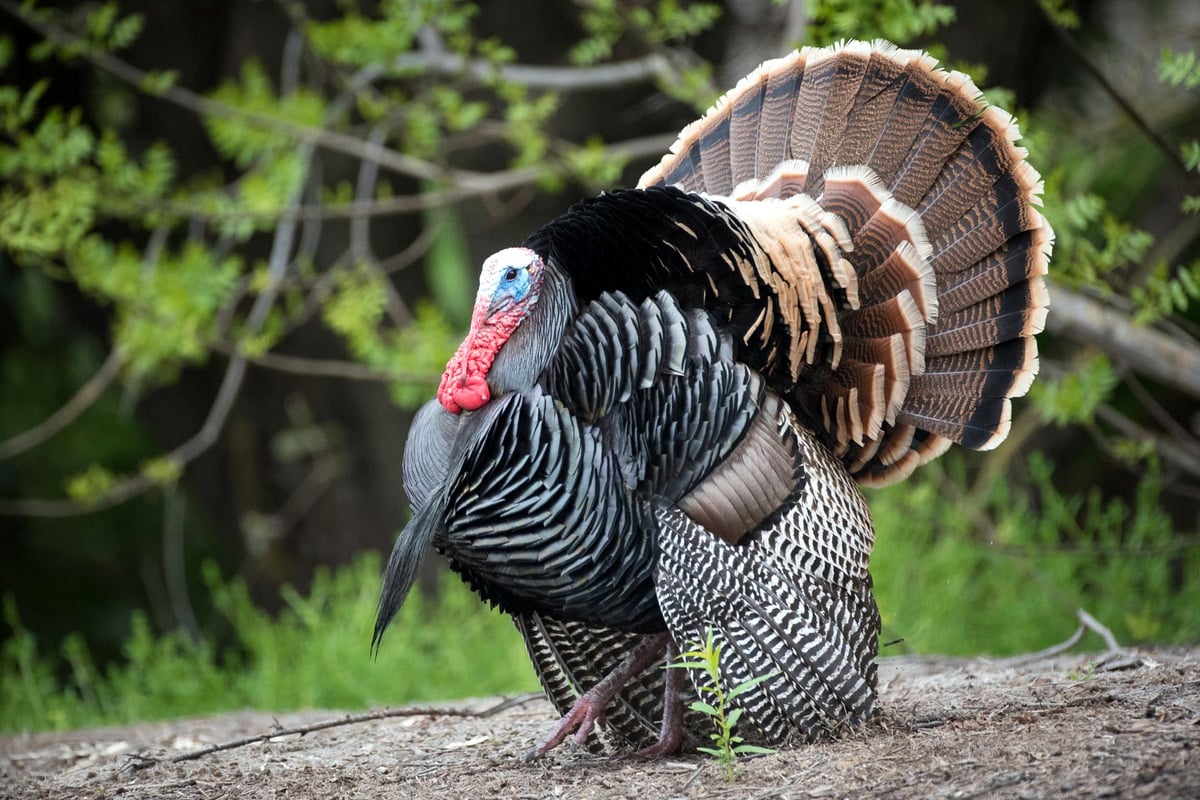
CHARLESTON, W.Va. — It wasn’t long ago that hearing the gobble of wild turkeys at daybreak was a rare experience across much of West Virginia.

By the early 1900s, unregulated hunting and widespread logging had pushed the state’s wild turkey population to dangerously low levels. In many areas, the birds had disappeared altogether.
Today, they are once again a familiar sight along mountain roads, farm fields, forest edges, and even in suburban neighborhoods.
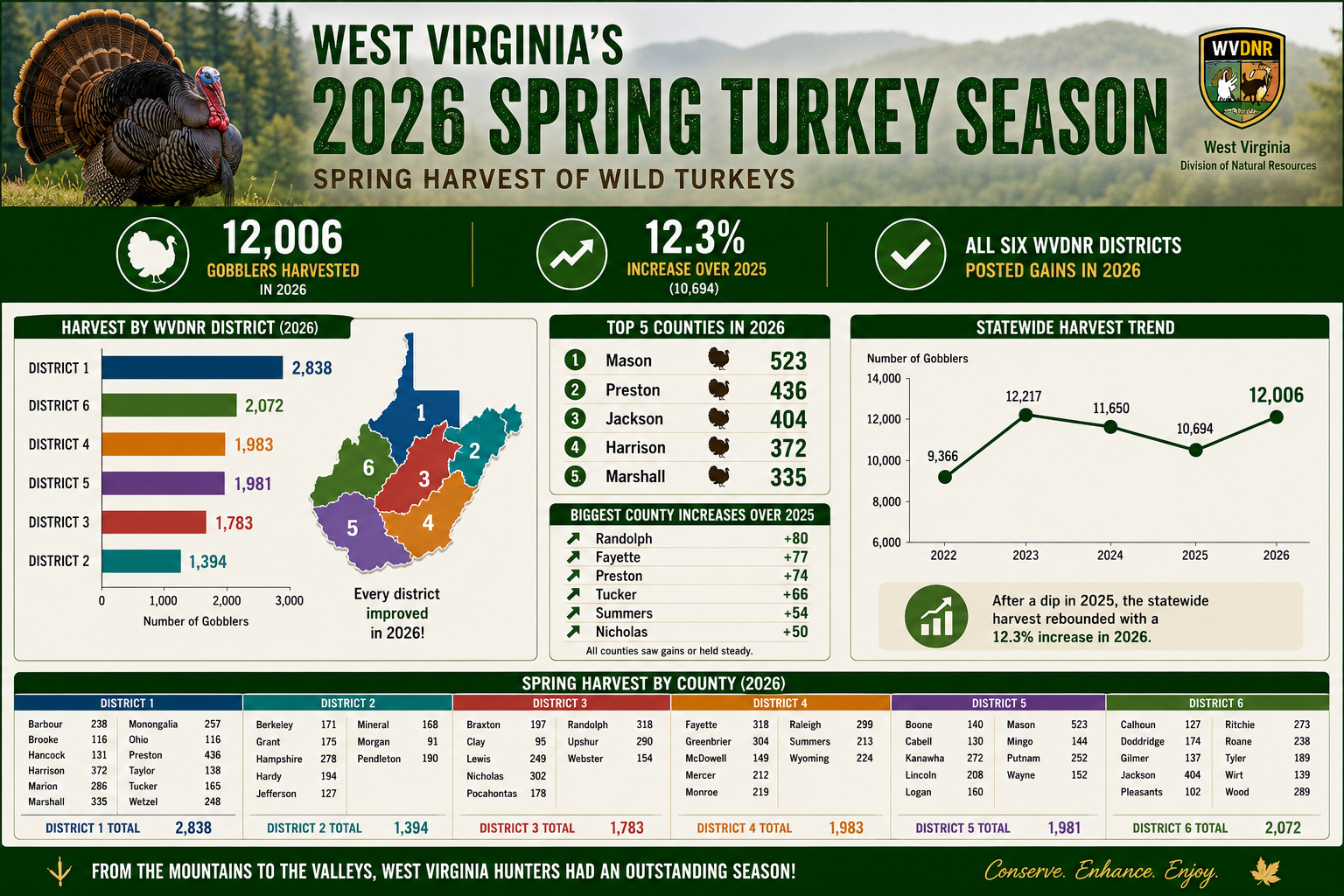
New figures released by the W.Va. Division of Natural Resources underscore how successful that recovery has been.
Hunters harvested 12,006 bearded wild turkeys during West Virginia’s 2026 spring gobbler season, according to preliminary data. The harvest increased by 12.3 percent over last year and exceeded both the five-year and 10-year averages, suggesting that wild turkey populations remain healthy across much of the Mountain State.
Brett McMillion, director of the division, lauded the success of the wild turkey management program in the Mountain State.
“This year’s spring gobbler season was a resounding success, highlighting the incredible hunting opportunities available in West Virginia,” he said.
For wildlife biologists, however, the harvest represents more than a successful hunting season.

It reflects decades of habitat management, scientific research, hunting regulations, and restoration work that transformed a species once on the brink of disappearance into one of West Virginia’s greatest conservation success stories.
Wild turkeys nearly vanished
As European settlement accelerated across Appalachia in the 1800s, extensive timber harvesting dramatically altered the forests that wild turkeys depended on.
At the same time, unrestricted market hunting supplied meat to growing towns and logging camps.
By the early twentieth century, wild turkey populations had collapsed throughout much of the eastern United States, including West Virginia.
Unlike deer, which readily adapt to agricultural landscapes, wild turkeys require extensive forests, reliable nesting habitat, and mature woodlands that produce acorns, beechnuts, and other mast crops.
Without those resources, populations declined rapidly.
Restoration changed everything
Beginning in the mid-twentieth century, wildlife agencies nationwide began restoring wild turkey populations using modern conservation techniques.

The recovery of the wild turkey is widely regarded as one of North America’s greatest wildlife restoration achievements. According to The Nature Conservancy, early efforts to rebuild turkey populations by releasing pen-raised birds largely failed because the birds lacked the instincts needed to survive in the wild.
Wildlife agencies instead began trapping healthy wild turkeys from thriving populations and relocating them to suitable habitat. Combined with habitat conservation and carefully regulated hunting, the strategy restored wild turkeys across much of their historic range, including every county in West Virginia.
Rather than releasing pen-raised birds—which generally failed to survive—biologists trapped healthy wild turkeys from robust populations and relocated them to suitable habitat.
At the same time, forests across Appalachia matured after the decline of large-scale logging, creating ideal habitat.
Regulated hunting seasons helped ensure that populations continued to grow while generating license revenue that funded additional wildlife conservation efforts.
Over time, the strategy proved remarkably successful. Today, wild turkeys occupy nearly every county in West Virginia and are commonly encountered by hunters, hikers, photographers, and motorists alike.
West Virginia helped restore turkeys across America
As West Virginia’s wild turkey population recovered, the state became a source of birds for restoration projects elsewhere in the country.
According to the Associated Press, West Virginia wildlife officials began trading surplus wild turkeys with other states in the late 1960s. In one of the best-known exchanges, the state sent 26 wild turkeys to New Hampshire in 1969 in return for 25 fishers, helping restore both species in different parts of the country.
Similar exchanges later brought river otters and bobwhite quail to West Virginia while helping establish or strengthen wild turkey populations elsewhere.
These trades reflected how successful West Virginia’s restoration program had become. Once struggling to rebuild its own turkey population, the Mountain State had become one of the nation’s leading suppliers of wild birds for conservation efforts.
Strong harvest reflects healthy populations
According to preliminary WVDNR figures, harvests increased in all six wildlife districts during the 2026 spring season.
The highest harvests occurred in Mason County, followed by Preston, Jackson, Harrison, and Marshall counties.
Youth participation also increased substantially, McMillion said. During the state’s two-day youth season, young hunters harvested 875 turkeys—an increase of more than 28 percent compared with last year.
“We are excited to see such a significant jump in youth participation,” he said. “Passing down these outdoor traditions to the next generation is vital to the future of conservation in our state, and this season shows that the future of hunting in West Virginia is bright.”
More than a hunting story
For many West Virginians, seeing a flock of wild turkeys cross a country road has become so common that it is easy to forget how remarkable their recovery truly is.
The birds are now part of daily life across much of the state, sharing forests with black bears, white-tailed deer, elk in southern West Virginia, and a growing variety of wildlife that has benefited from decades of conservation.
Whether appreciated through binoculars, a camera lens, or from a spring turkey blind before sunrise, the wild turkey stands as one of the clearest examples of how science-based wildlife management can restore native species once thought to be in decline.
Why are they patting themselves on the back ? Grouse are gone, Quail are gone and rabbits are scarce . Coyotes are detrimental to everything, raccoon populations are out of control and they still treat them as a game animal.