
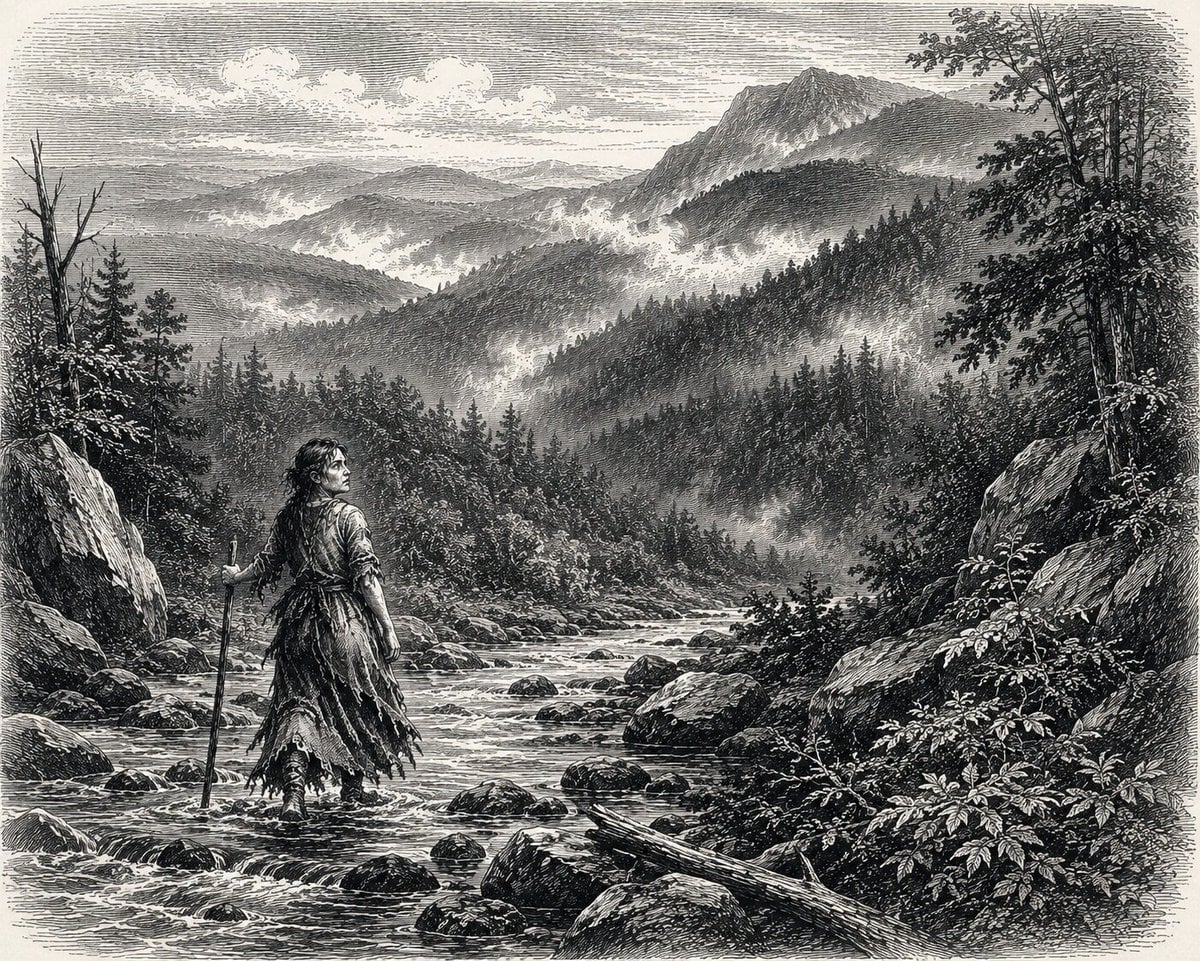
BIG SANDY VALLEY, W.Va. — Long before West Virginia became a state, before railroads climbed its mountains or highways threaded its valleys, the Appalachian wilderness began where civilization ended.

To Americans living in Philadelphia or the young nation’s capital on the Potomac, the mountains beyond the Blue Ridge marked the edge of the known world. Beyond them lay hundreds of miles of dense forest, broken by swift rivers, rocky gorges, and narrow valleys where only scattered cabins and isolated frontier forts broke the trees. Travelers might journey for days without seeing another family.
Today, millions of visitors come to these same mountains seeking solitude, waterfalls, and scenic overlooks. In the late eighteenth century, they inspired something very different—uncertainty. It was into this vast wilderness that a young pioneer mother named Jenny Wiley disappeared in the autumn of 1789. More than two centuries later, her name still echoes across Appalachia.
A mountain stream bears her name. So does one of Kentucky’s best-known state parks, an outdoor theater, and countless schools, roads, and historical landmarks. Thousands of families in eastern Kentucky and southwestern West Virginia trace their ancestry to her, while generations have passed down her remarkable story around kitchen tables and campfires.
Many frontier women endured unimaginable hardship. Few became part of the landscape itself. Huntington journalist Doris Miller studied Wiley’s life at length in the mid-1900s and worked to bring her story to life in the border country on either side of the Big Sandy.
“Her dramatic capture and escape from Indians in 1787-88 is an outstanding legend of border life in this area,” Miller once wrote. “It has been retold until its versions vary widely, yet the basic facts remain constant.”
Where the American Frontier Began
For modern travelers driving the interstate through Virginia or West Virginia, it can be difficult to imagine how formidable the Appalachian Mountains once seemed.
There were no bridges across the great rivers. No reliable roads crossed the ridges. The forests that cloaked the Tug Fork, Twelvepole Creek, and Big Sandy valleys formed one of eastern North America’s largest remaining wildernesses.
This was not merely empty land. For thousands of years, it had been home to Native peoples whose hunting grounds and villages extended across the mountains long before European settlement. By the late 1700s, however, the Revolutionary War had ended, settlers were pushing steadily westward, and the frontier had become one of America’s most violent places.
Raids and reprisals scarred both Native communities and frontier settlements. Families on every side lived with uncertainty. Jenny Wiley’s story unfolded during one of the darkest chapters of that conflict.
A cabin on the edge of the wilderness
Born Jean Sellards, Jenny grew up along Virginia’s western frontier before marrying Thomas Wiley, an Irish immigrant who established a modest farm near Walker’s Creek in what is now southwestern Virginia. The couple built a simple log cabin and began raising their young family.
Like thousands of frontier settlers, they cleared fields by hand, hunted game in surrounding forests, and relied almost entirely upon their own labor to survive. The wilderness fed them and threatened them.
Family tradition, later preserved by historian William Elsey Connelley and other early chroniclers, recounts that one autumn afternoon, Jenny’s brother arrived with disturbing news. Native warriors had reportedly been seen nearby, and he urged the family to flee immediately.
They were too late. A raiding party attacked the cabin before the family could escape. Three of Jenny’s young children were killed. Her brother also died in the assault. Jenny herself was taken captive, carrying only her infant child as she was forced away from the only home she had ever known. Within hours, she had vanished into the mountains.
Following rivers into another world
Most modern maps show highways, county lines, and towns. Jenny Wiley would have recognized none of them. Her captors traveled through forests that now lie within eastern Kentucky and southwestern West Virginia, following ancient Native trails and winding river valleys that offered the easiest passage through the mountains.
The journey crossed country that even today feels surprisingly wild. Deep hollows disappear into hardwood forests. Narrow streams tumble between sandstone cliffs. Morning fog still lingers over secluded valleys much as it did more than two centuries ago. Unlike many frontier stories that focus only on violence, Jenny Wiley’s ordeal became one of endurance.
“Wading swift streams to hide her footprints,” Miller wrote, “she hastened across the mountains, following down streams when she dared, hoping to reach a river she had seen in her dream.”
According to long-preserved family accounts, she spent months living among her captors, learning enough of their language to communicate, performing daily work, gathering food, and adapting to an unfamiliar life while quietly waiting for an opportunity to escape.
Modern historians caution that frontier captivity was often more complex than early American legends suggested. Native communities themselves had suffered devastating losses during years of warfare, and captives sometimes became part of households that had lost family members of their own. Jenny’s experience reflected that larger human tragedy while never diminishing the suffering she herself endured.
The mountains offered one last chance
Opportunity finally came after many months. Tradition holds that Jenny loosened the rawhide bindings that secured her and slipped away under the cover of darkness while much of the camp slept. She carried no map and had no compass, but trusted the landscape instead.
Knowing that rivers eventually led toward settlements, she followed mountain streams through unfamiliar forests, often wading in the water itself to hide her tracks. Hungry, exhausted, and alone, she crossed rugged country where every ridge concealed another valley and every valley another stream. One creek she crossed still bears her name.
Eventually, she reached the Levisa Fork of the Big Sandy River, where, across the water, stood a frontier blockhouse. Unable to swim the river, she called for help. An elderly frontiersman named Henry Scaggs reportedly heard her cries and, with assistance from others inside the fort, fashioned a rough raft to bring her safely across before her pursuers arrived.
Whether every detail survived exactly as it occurred can no longer be known, but what is certain is that Jenny Wiley returned alive, when few expected she ever would.
A story that outlived the frontier
Jenny Wiley reunited with her husband and eventually settled along the Big Sandy River, where the family rebuilt their lives and raised more children.
She died in 1831; however, her story refused to disappear. Children repeated it to their grandchildren. Descendants carried it westward as Kentucky and the Ohio Valley filled with new settlements. Historians collected family recollections before they faded, while artists, playwrights, and educators transformed her ordeal into one of Appalachia’s enduring frontier narratives.
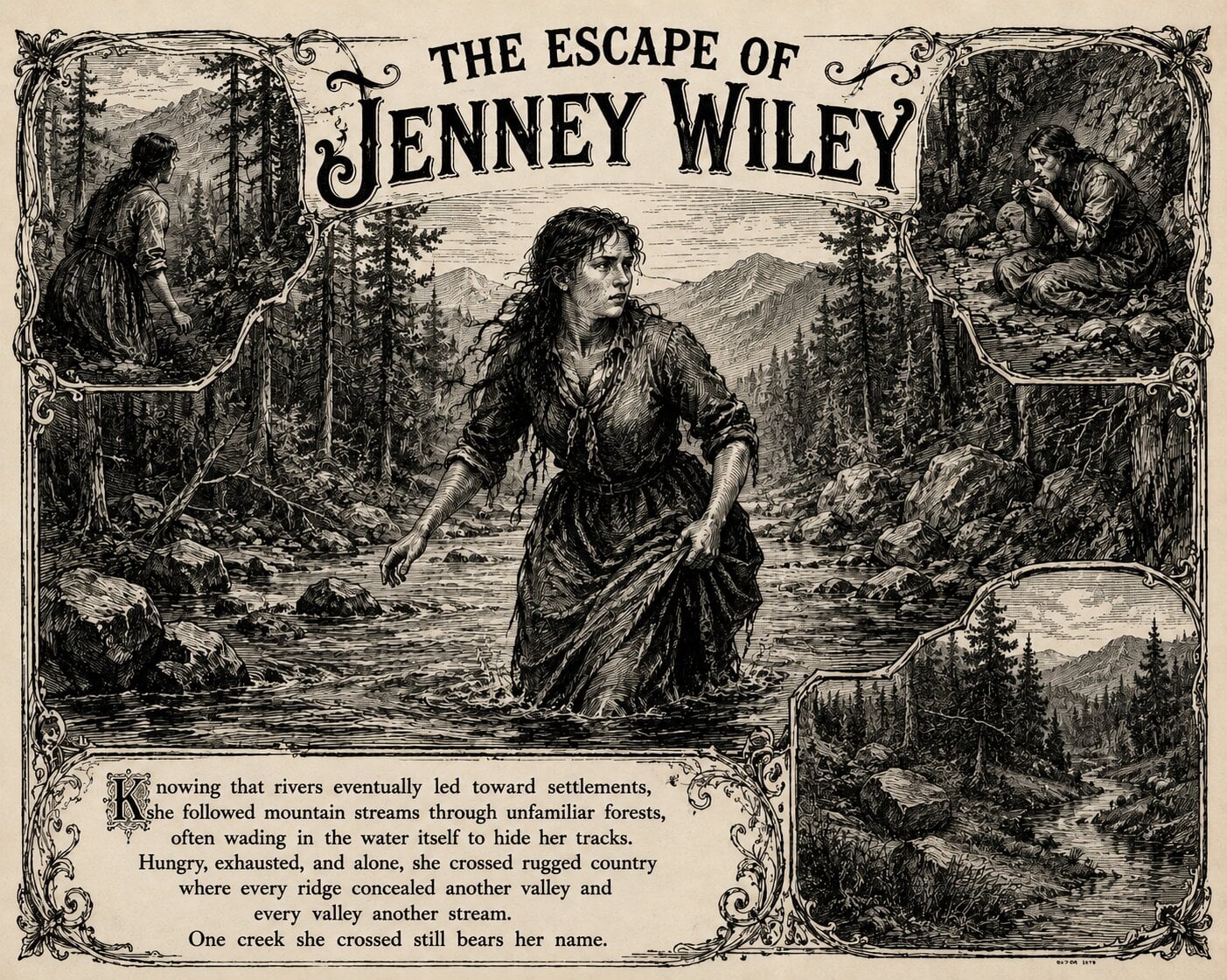
Today, visitors hiking trails at Jenny Wiley State Resort Park, paddling the Big Sandy watershed, or exploring the mountain valleys along the Kentucky-West Virginia border are traveling through the same landscape that shaped her remarkable journey.
Even today, much of Jenny Wiley’s route passes through some of the wildest country remaining in the eastern United States.
The wilderness has changed. Roads now follow rivers that were once navigated only by canoe. Scenic overlooks stand where dense forests once concealed every horizon. Yet the mountains remain. Their ridges still rise in blue layers toward the horizon. Morning fog still settles into the hollows. Black bears still wander remote forests. On quiet evenings, it takes little imagination to understand why eighteenth-century settlers viewed this country with equal measures of awe and fear.
Jenny Wiley reportedly summed up her extraordinary survival with simple gratitude: “The Lord gave me back my family.” More than two centuries later, Appalachia has never forgotten hers.
Why Appalachia still remembers
The Appalachian frontier produced countless stories of courage, and while most have been forgotten, the story of Jenny Wiley survived because it became more than the story of one remarkable woman. It became the story of a place, of a wilderness that tested every person who entered it, of communities struggling to survive on the edge of a new nation, and of mountains whose beauty has always been matched by their power.
For visitors discovering West Virginia and central Appalachia for the first time, Jenny Wiley’s journey offers something more than a tale from long ago.
It reminds us that beneath today’s scenic highways, state parks, and peaceful forests lies another landscape, one that shaped generations of pioneers and Native peoples alike. The names on maps, the creeks winding through the hills, and the old trails disappearing into the trees still carry echoes of that earlier world.
Few frontier stories have become so deeply woven into the geography of Appalachia. Fewer still continue to invite travelers to look beyond the mountains’ beauty and discover the remarkable human history hidden among them.
Jenny Wiley State Resort Park is located just outside Prestonsburg, in eastern Kentucky’s Big Sandy Valley, about 20 miles southwest of the West Virginia border.
Read Also
Great story. I stayed at her namesake park as a kid. Mom was from Ashland and I recall all the coal trucks on the drive down. She was a nervous wreck navigating twisty roads
I live in Floyd County, Kentucky and withina few miles of Jenny Wiley State Park, have driven past her grave site many times, it is in Johnson County. There is now a road down to the Levisa Fork of the Big Sandy River at the site where Jenny Wiley called for help from Harmans Station. Her story was in a book that I have read several times.
The first part is absolutely not true, someone needs to check their history.
The western Virginia area had plenty of farmers and frontier families living there in the later half 1700s and most of these families learned how to coexist and work with the natives of the western Virginia territory much like how Virginia settlers started out as in the 1600s. Much of western Virginia was surveyed by cartographers in the 1750s and 1760s alongside the rest of Virginia. There are even a number of West Virginia towns that were definitely first settled before the revolution.
Many settlers that made landfall in Pennsylvania used the “Old Wagon Trail” that went around the Allegheny Mountains and down the Kanawha river valley and New River into the back side of Virginia, and this other route around to the north was well known by the later 1700s and shown in a Virginia map dated 1756.
What is true is that the counties were not formed by the state until closer to or into the 1800s. This has nothing to do with whether people lived there or not, and much to do with how the Virginia House of Burgesses assimilated territory into counties over time (which was slow) and with the Loyal Land Company of Virginia that processed Crown sales of territory land being frozen during the Revolutionary War.
Jennaly Wileys cabin was located
In Bland County. Virginia on Walkers
Creek ,area know as Crackers Neck.
This was in my cousins property.
She rememberd where cabin was
As a child, cabin is no longer there.
I’m a 6th Great Granddaughter of Jenny Wiley and I can say that the women in my line are all tough as nails and face everything head on! I love when people keep Jenny’s memory alive!
We appreciate you and your heritage. You all are indeed the ‘flint’ of the frontier.