
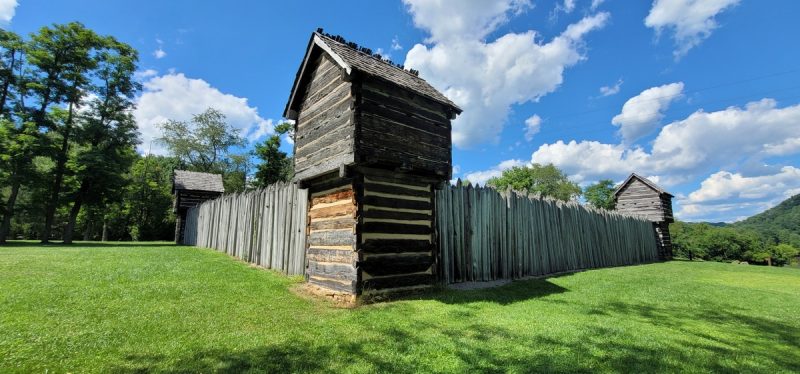
Prickett’s Fort State Park is a living history museum and state park near Fairmont in Marion County, West Virginia. Situated along the Monongahela River, the park preserves and interprets life on the eighteenth-century Virginia frontier through a reconstructed stockade fort, historical exhibits, educational programs, and archaeological research.
The site commemorates Prickett’s Fort, one of several frontier outposts established during a turbulent period of conflict between European settlers and Native American tribes on the trans-Appalachian frontier.
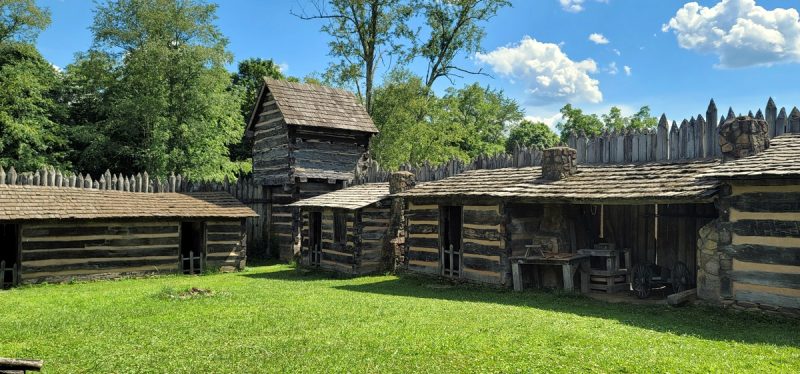
Although the original fort no longer survives, the reconstructed fort and surrounding park have become one of West Virginia’s premier historical attractions, drawing thousands of visitors each year for living history demonstrations, festivals, and educational programs.
Today, Prickett’s Fort State Park encompasses more than 180 acres and serves as both a recreational destination and an important center for the study of frontier history in the upper Monongahela Valley.
Historical Background
The Frontier Settlement Era
During the late eighteenth century, western Virginia was undergoing rapid settlement as pioneers crossed the Appalachian Mountains into lands claimed by both colonial authorities and Native American nations. The Monongahela Valley became a significant corridor for westward migration, attracting settlers seeking fertile farmland and access to river transportation.
By the 1770s, tensions between frontier settlers and Native American tribes had intensified. Raids and retaliatory attacks became increasingly common, prompting settlers to construct fortified refuges where families could gather during times of danger.
Construction of the Original Fort
Prickett’s Fort was established in approximately 1774 by Jacob Prickett, a frontier settler who arrived in the Monongahela Valley with his family. The fort was constructed during a period marked by increasing hostilities associated with Lord Dunmore’s War and later conflicts that accompanied the American Revolution.
Like many frontier forts, Prickett’s Fort was not a military installation in the modern sense. Rather, it served as a community refuge where local families could seek protection during attacks. The stockade consisted of wooden palisade walls enclosing cabins, storage facilities, and communal spaces.

The fort became an important gathering point for settlers living in the surrounding countryside. During periods of heightened danger, families often abandoned isolated homesteads and took shelter within the fort’s walls.
Frontier Conflicts
The region surrounding Prickett’s Fort experienced significant violence during the late eighteenth century. Native American resistance to expanding settlement brought frequent conflict to the upper Monongahela Valley. The fort served as a base for local militia operations and as a refuge for civilian families.
Among the most famous episodes associated with the fort is the story of the Prickett family and other settlers who endured the uncertainties of frontier warfare. Historical accounts describe attacks, captures, and rescues that illustrate the dangers faced by both settlers and Native peoples during the era.
Although Prickett’s Fort itself was never the site of a major battle, it played a crucial role in the defense network that allowed settlement to continue throughout north-central Virginia.
Decline of the Fort
As settlement expanded and regional security improved during the early nineteenth century, frontier forts became increasingly unnecessary. Families returned to permanent farms and communities, and the original Prickett’s Fort gradually disappeared from the landscape.
Like many wooden frontier structures, the fort deteriorated over time. By the nineteenth century, little visible evidence of the original stockade remained.
Creation of the Modern Park
Historical Preservation Efforts
Interest in preserving the history of Prickett’s Fort emerged during the twentieth century as historians and community leaders sought to commemorate the region’s frontier heritage.
Research into historical documents, archaeological evidence, and frontier construction methods helped guide efforts to recreate the fort. Preservation advocates recognized the importance of the site in interpreting early settlement patterns in what would later become West Virginia.
Reconstruction
The reconstructed fort was built in the 1970s using historical techniques and materials intended to reflect eighteenth-century frontier architecture. Although not located precisely atop the original structure, the reconstruction was designed to provide visitors with an accurate representation of a frontier stockade.
Construction relied upon historical records, archaeological findings, and comparisons with similar forts from the period. The completed fort includes blockhouses, cabins, defensive walls, and interior spaces furnished with period-appropriate objects.
Establishment as a State Park
Prickett’s Fort became part of the West Virginia state park system, ensuring long-term preservation and public access. The park developed into a major educational facility where visitors could experience frontier life through interactive programs and demonstrations.
State support enabled the expansion of exhibits, research initiatives, and recreational opportunities throughout the surrounding property.
Living History Programs
One of the defining features of Prickett’s Fort State Park is its extensive living history program.
Costumed interpreters portray settlers, craftsmen, traders, soldiers, and other frontier residents. Demonstrations frequently include:
- Blacksmithing
- Woodworking
- Weaving
- Candle making
- Open-hearth cooking
- Flintlock firearms demonstrations
- Frontier gardening
- Traditional music
These programs allow visitors to observe daily life as it might have appeared during the late eighteenth century.
Educational activities are designed for both school groups and the general public, helping visitors understand the challenges and skills required for survival on the frontier.
Museums and Exhibits
In addition to the reconstructed fort, the park contains a visitor center and museum featuring exhibits related to:
- Frontier settlement
- Native American history
- Archaeological discoveries
- Colonial transportation
- Military history
- Regional culture
Artifacts displayed in the museum include tools, household items, weapons, clothing, and archaeological materials recovered from historical sites throughout the Monongahela Valley.
Interpretive exhibits emphasize the complex interactions among Native Americans, settlers, traders, and military forces during the eighteenth century.
Archaeological Research
Archaeology has played an important role in understanding the history of Prickett’s Fort and the surrounding region.
Excavations have uncovered evidence of early settlement patterns, trade networks, and frontier lifestyles. Researchers have used artifacts to reconstruct aspects of daily life that are not fully documented in written records.
The park continues to support archaeological interpretation as part of its educational mission, helping visitors understand how historians and archaeologists study the past.
Recreation and Trails
Although primarily known for its historical attractions, Prickett’s Fort State Park also offers recreational opportunities.
Several walking trails traverse the property, providing access to river views, forests, and wildlife habitat. The park’s location along the Monongahela River contributes to its scenic appeal and historical significance.
Visitors frequently use the park for:
- Hiking
- Birdwatching
- Photography
- Picnicking
- Nature study
The park also connects to regional trail systems that attract cyclists and outdoor enthusiasts.
Special Events
Throughout the year, Prickett’s Fort hosts a variety of public events celebrating frontier culture and West Virginia history.
Popular events include:
Frontier Festivals
These festivals feature historical reenactments, demonstrations, traditional crafts, and period music.
Encampments
Military reenactors recreate colonial-era and Revolutionary War camps, allowing visitors to explore military life on the frontier.
Educational Programs
Workshops and special presentations focus on topics such as archaeology, genealogy, traditional crafts, and local history.
Seasonal Celebrations
Holiday-themed events often incorporate historical traditions and family-oriented activities.
These gatherings attract visitors from across West Virginia and neighboring states.
Significance to West Virginia History
Prickett’s Fort occupies an important place in the interpretation of West Virginia’s early history.
The site represents the period when the region transitioned from a contested frontier to a settled agricultural landscape. It illustrates the experiences of families who established communities west of the Appalachian Mountains and highlights the broader forces that shaped the development of the American frontier.
The fort also serves as a reminder of the complex and often violent interactions between Native American peoples and expanding colonial settlements. Modern interpretation at the park seeks to present these histories in a balanced and historically informed manner.
Legacy
Today, Prickett’s Fort State Park stands among West Virginia’s most significant historical attractions. Through preservation, education, and living history programming, the park provides visitors with a tangible connection to the state’s frontier past.
The reconstructed fort, museum collections, archaeological research, and educational initiatives collectively preserve an important chapter in Appalachian and American history. As a result, Prickett’s Fort continues to serve as both a cultural landmark and a valuable resource for understanding life on the eighteenth-century frontier.
Directions: Prickett’s Fort State Park is located near Fairmont, WV, in eastern Marion County, in the Monongahela Valley Region in northern West Virginia.
Hotels near Prickett’s Fort State Park
Attractions near Prickett’s Fort State Park
Tygart Lake State Park
Valley Falls State Park
Monongahela River Rail Trail
Mannington Round Barn
Mother’s Day Shrine
Coopers Rock State Forest
Pleasant Creek Wildlife Management Area
Watters Smith Memorial State Park
Prickett’s Fort State Park
Route 3, Fairmont, WV 26554
PFSP Website
Phone: (304) 363-3030
