
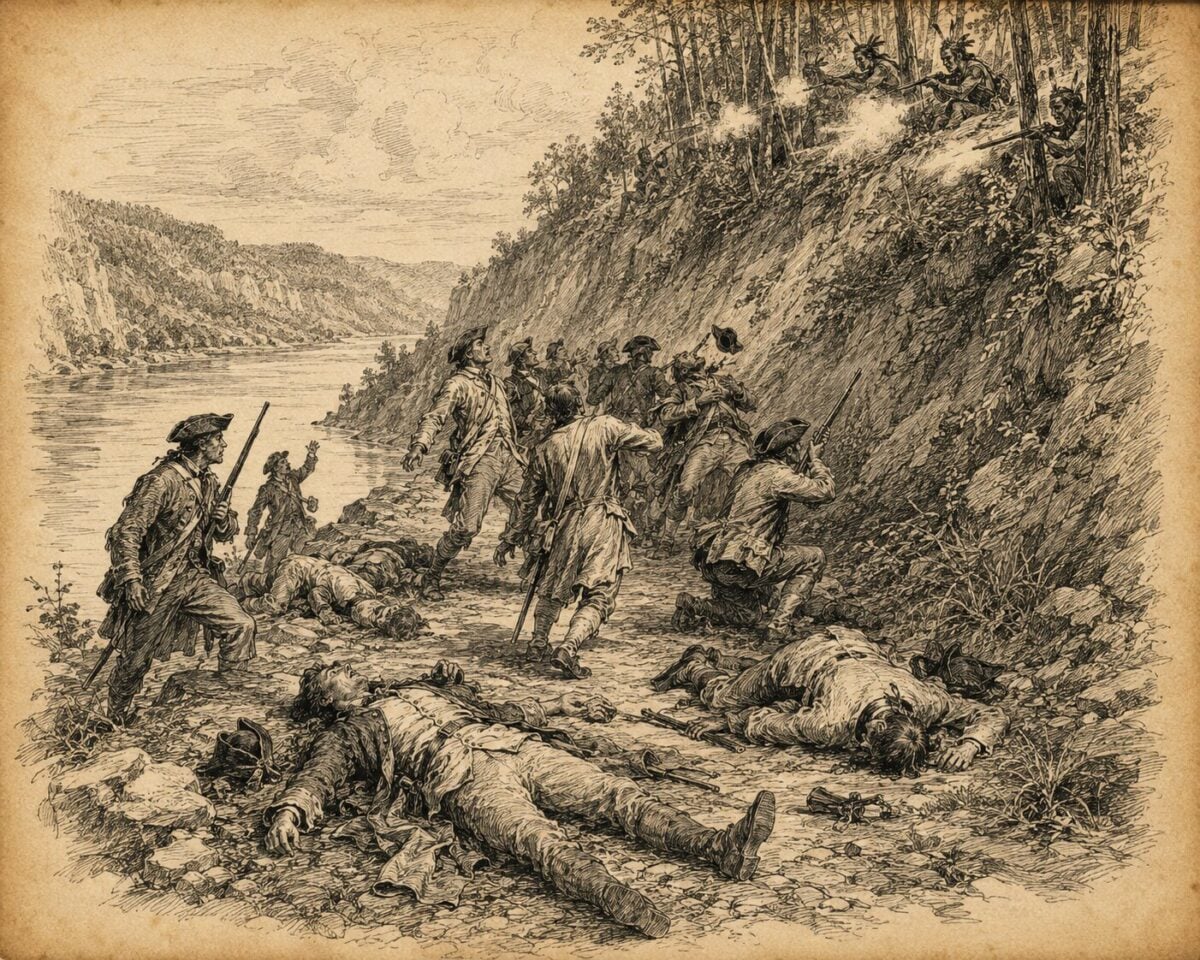
The 1777 attack known as the Foreman Massacre left 22 frontier militiamen dead and remains one of the most significant Revolutionary War-era sites in the Ohio Valley.
MCMECHEN, W.Va. — The steep hills rise abruptly from the Ohio River at McMechen Narrows, creating one of the most dramatic landscapes in West Virginia’s northern panhandle. Today, motorists pass through the narrow corridor with little thought for what happened there nearly 250 years ago.
But on a September morning in 1777, the same terrain became the setting for one of the bloodiest frontier disasters in the history of present-day West Virginia.
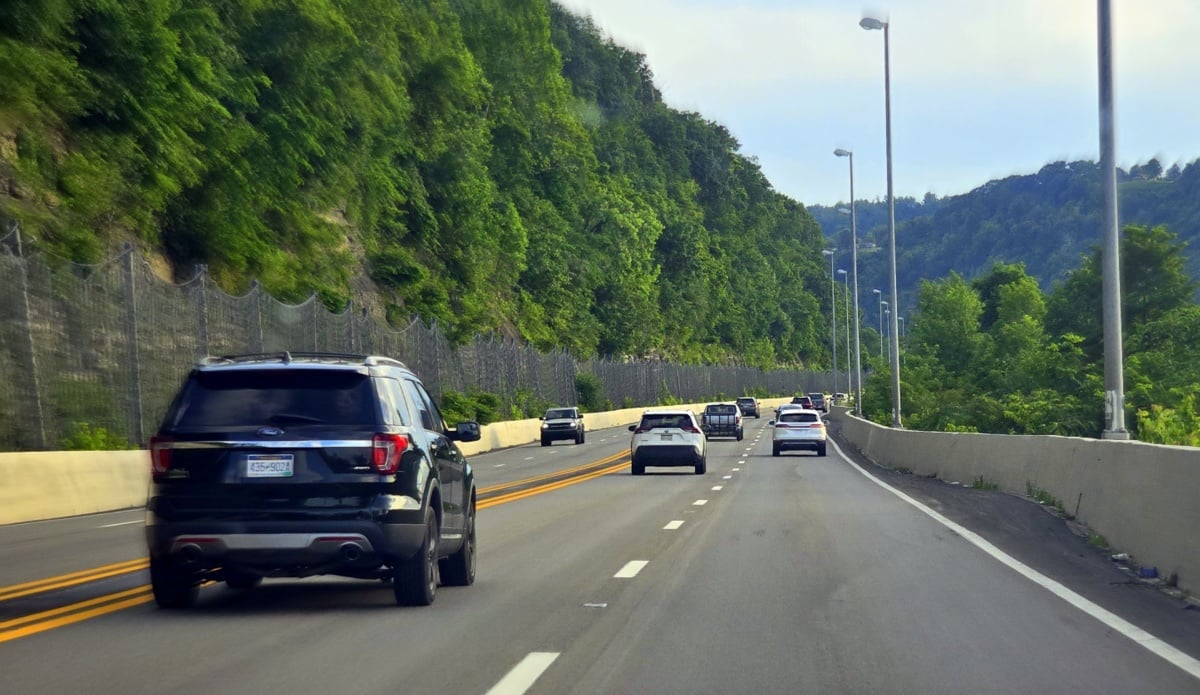
Known as the Foreman Massacre or Foreman’s Defeat, the ambush claimed the lives of Captain William Foreman and 21 of his men during the turbulent years of the American Revolution.
Though overshadowed by famous battles fought along the Atlantic seaboard, the attack reveals how the Revolutionary War was also fought on the Appalachian frontier, where settlers, Native nations, and imperial powers struggled for control of the Ohio Valley.
A Frontier at War
When Americans think of the Revolutionary War, they often imagine battles at Lexington, Saratoga, or Yorktown. Yet the conflict extended far beyond the eastern colonies.
By 1777, the Ohio Valley had become a dangerous frontier. Native warriors allied with the British launched raids against settlements west of the Appalachian Mountains, while colonial militias organized expeditions to defend isolated communities.
The settlement at Wheeling, then known as Fort Henry, stood on the edge of that contested territory. During the summer of 1777, attacks on frontier settlements intensified, and reports of violence spread rapidly through the region.

Captain William Foreman, a respected militia officer from Virginia’s South Branch Valley, answered the call to help defend the frontier. Gathering a company of volunteers, he marched westward toward Wheeling, crossing hundreds of miles of rugged wilderness.
Many of the men who followed him came from communities in what is now eastern West Virginia. Few could have imagined the fate awaiting them along the Ohio River.
A Dangerous Mission
After helping reinforce Fort Henry, Foreman joined other officers in investigating reports of attacks farther south along the river.
The militia discovered evidence of destruction near Grave Creek, now at Moundsville, where cabins and settlements had been abandoned or burned. Believing the immediate danger had passed, the force began returning north toward Wheeling.
The route followed a narrow trail squeezed between the Ohio River and the steep hillsides of the narrows. It was exactly the kind of terrain that favored an ambush.
According to frontier accounts, Captain William Lynn, serving as a scout, warned Foreman about the dangers ahead. He reportedly urged the militia to leave the riverside path and travel over higher ground where they would be less vulnerable. Foreman declined and continued along the lower route.
The decision would prove disastrous.

The Trap at McMechen Narrows
On the morning of September 27, 1777, Foreman’s men entered the narrows south of present-day McMechen.
Accounts of the incident describe Native warriors concealed on the wooded slopes overlooking the trail. Some reports state that small objects were deliberately placed along the path to attract attention and break the militia’s formation.
As the men paused and gathered, gunfire erupted from above. The first volley devastated the column.
Caught in a confined space with little cover, many militia members were killed almost immediately. Others attempted to return fire, but the attackers held the advantage of elevation, concealment, and surprise.
The fight quickly turned into a desperate struggle for survival. Captain Foreman was among those killed. Two of his sons also died in the attack. By the time the firing ended, 22 men lay dead.
The narrow valley had become a killing ground.
A Frontier Disaster
Had the attack continued much longer, even more lives might have been lost. Fortunately for the survivors, William Lynn and other scouts had taken an alternate route along higher ground. Hearing the gunfire, they rushed toward the scene.
Accounts suggest the arriving men fired their weapons and shouted loudly enough to convince the attackers that a larger force was approaching.
The warriors withdrew before they could destroy the entire company. Even so, the losses were devastating. For frontier communities already living under constant threat, the attack became one of the most memorable tragedies of the Revolutionary War era.
News of the ambush spread quickly through settlements across western Virginia. Families mourned fathers, sons, brothers, and neighbors who had volunteered to defend the frontier.
The Native Perspective
Like many frontier conflicts, the story of the Foreman Massacre reflects competing claims to the Ohio Valley. For Native nations including the Shawnee, Wyandot, Miami, and Mingo, the region represented ancestral homelands increasingly threatened by colonial expansion.
Many Native warriors sided with the British during the Revolutionary War because they viewed British authorities as more likely than American settlers to restrain westward migration.
To frontier settlers, attacks such as the one at McMechen appeared as shocking acts of violence.
For Native leaders defending their territory, it was part of a larger struggle against encroachment.
Understanding the event requires acknowledging both perspectives and recognizing that the Ohio Valley frontier was one of the most contested landscapes in North America.
Why the Terrain Mattered
Visitors standing at McMechen Narrows today can immediately understand why the location was chosen.
The hills rise steeply from the river, creating a natural bottleneck that limits movement and visibility.
In the eighteenth century, before modern roads and rail lines transformed the valley, travelers often had little choice but to follow narrow paths along the riverbank.
An attacking force positioned on the slopes above could observe movement below while remaining largely hidden among trees and rocks.
The geography itself became a weapon.
That terrain remains one of the most compelling aspects of the story because it allows modern visitors to visualize how the ambush unfolded.
Unlike many historic battlefields that have been heavily altered by development, the narrows still retain much of the landscape character that shaped the events of 1777.
Remembering the Fallen
The attack has not been forgotten. Monuments and historical markers near McMechen commemorate the men who died in the ambush and help preserve the memory of an event that might otherwise be lost to time.
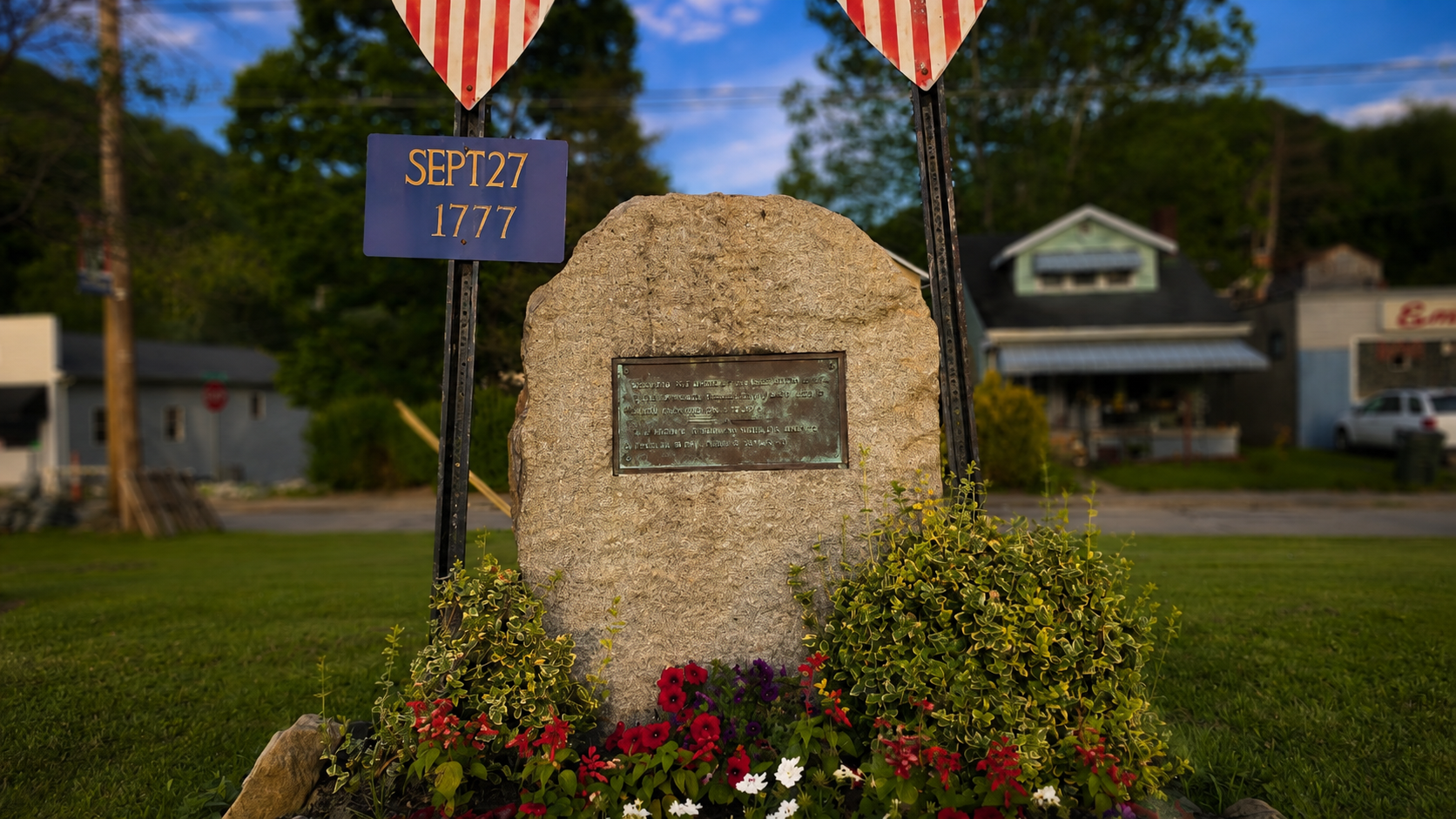
For generations, local residents have passed down stories of the attack, keeping alive one of the Ohio Valley’s most dramatic Revolutionary War-era episodes.
The site also serves as a reminder that the American Revolution was not fought solely in famous eastern cities and battlefields.
Along the frontier, ordinary settlers faced dangers every bit as real as those confronting soldiers in the Continental Army. Many never returned home.
Nearly two and a half centuries later, the story remains one of the most powerful reminders that West Virginia’s history was forged not only by industry, railroads, and rivers, but also by the struggles of people living on a dangerous and contested frontier.
Visiting McMechen Narrows Today
Travelers exploring the northern panhandle will find it difficult to reach the site of the massacre. Although it lies near a proposed recreational trail along the Ohio River, no steps have been taken to provide access. The site, whose whereabouts are unconfirmed, is brambly and steep and may have been annihilated by railroad construction.
West Virginia Explorer Magazine publisher David Sibray says he’s disheartened that local efforts to interpret the event have not been pursued.
“Many West Virginians know about Fort Henry and the Siege of Wheeling, but few realize that one of the deadliest Revolutionary War-era ambushes in the state occurred along the Ohio River at McMechen,” Sibray said.
“Here’s hoping local governments return to working together to provide access to the site.”
Did You Know?
- Many of the victims traveled from Virginia’s South Branch settlements, now part of eastern West Virginia.
- The attack occurred during the same year as the pivotal Saratoga campaign.
- The terrain at McMechen Narrows remains recognizable nearly 250 years later.
- The site is considered one of the most important Revolutionary War landmarks in West Virginia.
We lived in Moundsville for 11 years, and I do not recall hearing about this.
I have lived in Marshall County for 69 years and never heard of it before until now.
Great ready thanks for sharing.
Great read, sorry my last comment had a typo.
I am totally unaware of this battle!!!! Thank you so much for sharing.
can I subscribe?
The lead illustration purported to provide a depiction of Foreman’s Defeat is AI generated. I’m admittedly old fashioned, but I believe digitally-created images should be identified as such.
I have lived in Putnam, & mostly Mason county my entire life & I am another one that has never heard anything about this & I really appreciate that you are keeping our history alive. Thank you for a very interesting story.
I was born and raised in this area, and never heard of it until today…. thanks for sharing.
In the Book, That Dark and Bloody River, as I recall it said Lewis Wetzel was with the party and suggested they take the high ground, which he did and let the Counter Attack. It is a great book for the history of the Valley.
I don’t think that Lewis was with the party at the time, he would have been about 14yo at the time. I think his brother Martin who was about 20yo, was with the party and was listed as one of the survivors on a site that I have seen before.
Raised in Brooke County and love to hear/read/learn about local history.
Just discovered this story as I was researching one of my ancestors, Isaac Harris whom was among those killed in the defeat. It’s incredible to think of the sacrifices that were made. I’m glad that the DAR created a marker to commemorate these brave men. Thank you for sharing this story.