
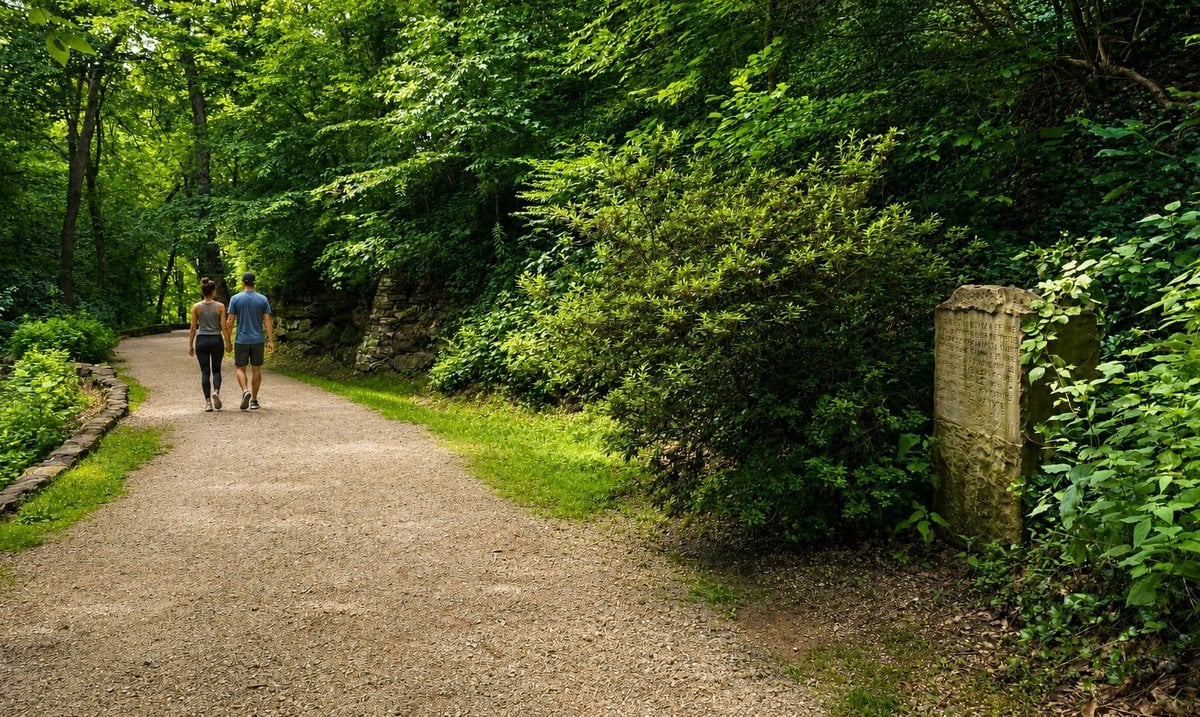
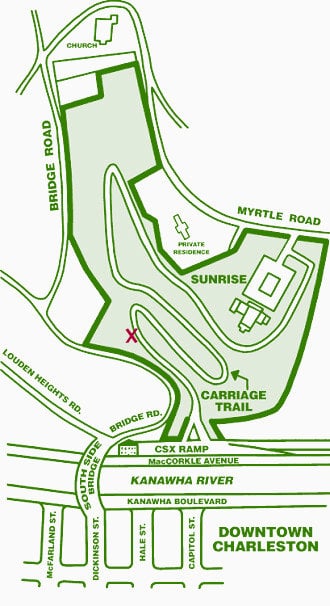
CHARLESTON, W.Va. — Few places in West Virginia’s capital city are as popular with walkers as the Carriage Trail, the shaded path climbing the hillside below Sunrise, the former estate of Gov. William A. MacCorkle. Along the trail, a weathered stone monument tells one of the city’s most enduring Civil War stories.
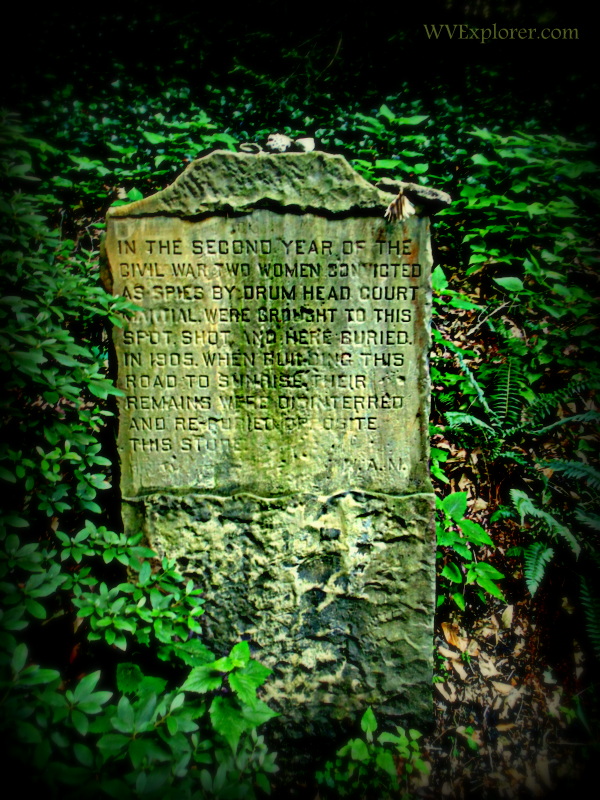
Its inscription leaves little room for doubt:
IN THE SECOND YEAR OF THE CIVIL WAR
TWO WOMEN CONVICTED AS SPIES BY
DRUMHEAD COURT MARTIALS WERE
BROUGHT TO THIS SPOT, SHOT, AND
HERE BURIED. IN 1905, WHEN BUILDING
THIS ROAD TO SUNRISE, THEIR REMAINS
WERE DISINTERRED AND REBURIED
OPPOSITE THIS STONE.
W.A.M.
The certainty of the inscription stands in striking contrast to the historical record. While former Gov. MacCorkle believed the women were Civil War victims, his own memoir recounts conflicting eyewitness accounts rather than documented proof. More than a century later, historians are still trying to separate history from tradition.
A governor’s discovery
MacCorkle recounted the discovery in his 1928 memoir, The Recollections of Fifty Years of West Virginia. While constructing the carriage road leading from downtown Charleston to Sunrise in 1905, he wrote that workers uncovered the remains of two women.
“I dug up the remains of two women—one a blonde and the other a brunette,” he recalled.
Unable to identify them, MacCorkle sought out Captain John Slack, a former Union soldier whom he described as one of the Kanawha Valley’s foremost authorities on local history.
Slack told him the women had been camp followers accompanying Confederate forces encamped along the Kanawha River. Suspected of spying for the Union, they were tried by a drumhead court-martial, marched into the secluded hollow, shot, and buried.
Later, however, MacCorkle asked another acquaintance, former Confederate soldier James Pauline, about the discovery.
Pauline dismissed Slack’s account entirely. According to Pauline, it was Union troops—not Confederates—who had executed the women after suspecting them of spying for the South.
MacCorkle then related yet another account. An unnamed former Union soldier from Lincoln County reportedly confessed on his deathbed that he had been a member of the firing squad responsible for the execution.
Rather than declaring one version true, MacCorkle used the story to illustrate the fallibility of memory. “Both were equally honest,” he wrote of Slack and Pauline. “So you see, it all depends on the point of view.”
Questions remain
Nearly a century later, retired West Virginia State Archives historian Terry Lowry believes the story deserves another look.
Lowry, author of several books on Civil War operations in the Kanawha Valley, recently reviewed MacCorkle’s account while researching the monument. Rather than finding confirmation, he discovered a series of unanswered questions.
“If you’ve got an eyewitness who’s credible, you’ve got a good case,” Lowry said. “Unfortunately, none of the three is credible.”

Lowry notes that MacCorkle identifies only two of the three alleged eyewitnesses by name. The third—the Lincoln County soldier said to have confessed on his deathbed—is never identified, making his account impossible to verify.
The two named witnesses also contradict one another completely. Slack blamed Confederate soldiers. Pauline blamed Union soldiers.
“They told the same story, but from a different angle,” Lowry said. “One story was that it was done by Confederates. The other story was that it was done by the Union side.”
Lowry also questioned whether Pauline’s own background matches the story he told. While examining available records, he found discrepancies that raise additional questions about Pauline’s recollections, though further research is needed before drawing conclusions.
For Lowry, the greatest difficulty is the absence of independent evidence supporting the execution itself.
Military records, court-martial records, and other contemporary documentation have yet to surface confirming that two women were tried and executed at the site.
What do we actually know?
Lowry does not dismiss MacCorkle’s discovery. The remains of two women may indeed have been uncovered during construction of the carriage road.
What happened before they were buried, however, is another matter. “There was something that happened,” Lowry said. “We just don’t know what happened.”
He suggests several possibilities remain open. The women could have been Civil War victims. They could have been murdered for unrelated reasons. They may have died under entirely different circumstances and been buried in the isolated hollow long before or after the war.
Without additional evidence, historians cannot say.
Read also: The West Virginia deputy who offered his life to stop a lynch mob.
Legend becomes history
The story continued to evolve after MacCorkle published his memoir. Kanawha County historian Dr. Billy Joe Peyton summarized the governor’s account in his history of Sunrise and the Carriage Trail, noting the conflicting testimony of Union and Confederate veterans and recounting a later tradition recorded by historian George Summers in 1934.
Summers wrote that “no living person knows who the women were,” but suggested local tradition held that MacCorkle and John Slack intentionally withheld their identities to spare surviving family members embarrassment or grief. If true, Summers wrote, both men took the secret to their graves.
No documentary evidence supporting that tradition has since emerged.
An enduring mystery
Today, thousands of walkers pass the monument each year, often pausing to read its inscription before continuing up the wooded hillside.
The stone presents the story as settled history, yet MacCorkle’s own memoir offers only conflicting recollections from aging Civil War veterans, while modern historians continue to search for evidence that might confirm—or challenge—the legend.
Whether the women were spies, camp followers, murder victims, or simply two forgotten souls whose identities vanished with time remains unknown.
For now, one of Charleston’s oldest Civil War mysteries endures, inviting every passerby to wonder what really happened in the quiet hollow above the Kanawha River more than 160 years ago.
About the Carriage Trail
The Carriage Trail is one of Charleston’s most popular public walking paths, climbing a wooded hillside above the Kanawha River overlooking the city’s downtown.
Originally constructed in 1905 as the private carriage road leading to Sunrise, the hilltop estate of former Gov. William A. MacCorkle, the route today offers visitors a peaceful escape within the city, with views of the river, mature hardwood forest, and several historic landmarks.
Today, the 0.65-mile Carriage Trail is open daily from dawn to dusk, offering visitors scenic views, a peaceful woodland walk, and several historic landmarks—including the stone monument marking one of Charleston’s most enduring Civil War mysteries.
The Carriage Trail is designated as a National Recreation Trail.
For more information on visiting Charleston and the Carriage Trail, visit the Charleston Convention and Visitors Bureau.
Read also: Walking the Carriage Trail in Charleston, West Virginia
This is jogging an ancient memory but I believe my father, Bob Jarrell, wrote an article about this when he had a history column with the Charleston Daily Mail. He worked there after serving in the Navy in WWII, and we moved to Florida in 1956 when I was 5 years old so this had to be the late 40’s or early 50’s. If my memory is correct, his article stated they were Confederate spies executed by Union soldiers, but I don’t remember if they were shot or hung.