
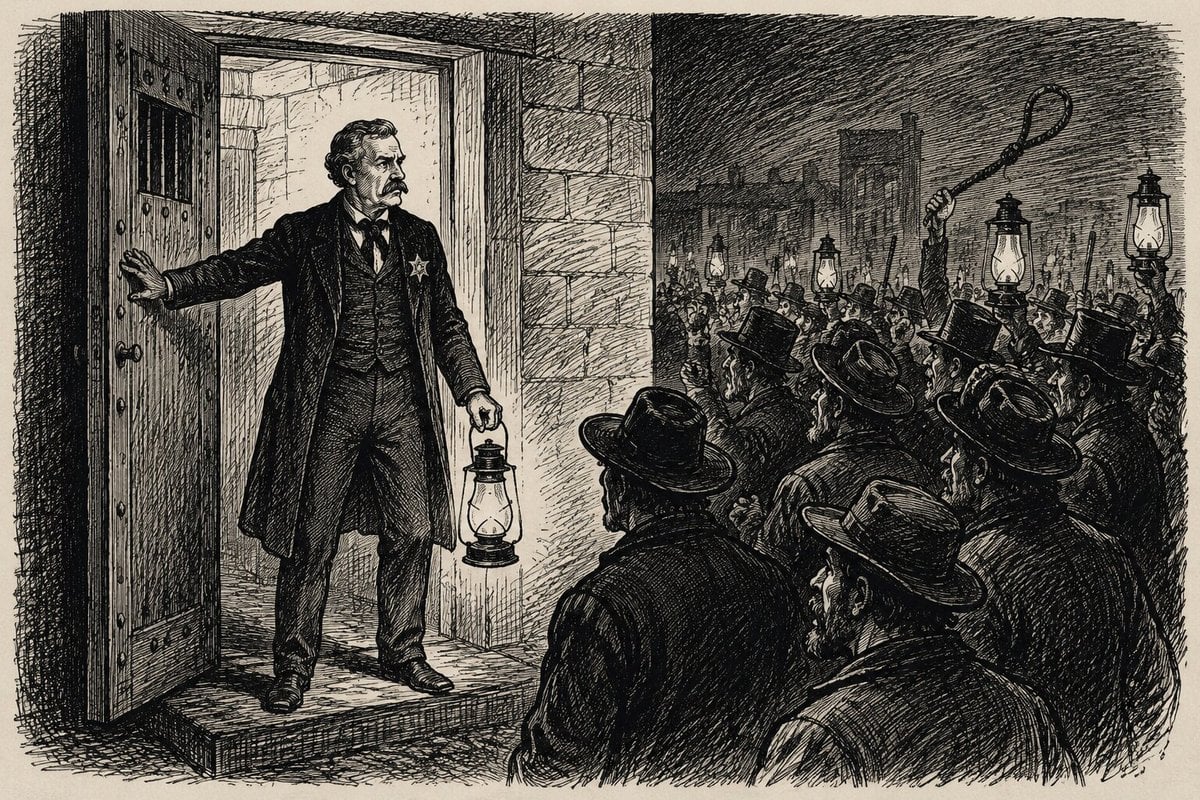
CHARLESTON, W.Va. — On a cold winter night in 1875 in West Virginia’s capital city, an angry mob surrounded the county jail demanding justice. Inside stood Deputy Sheriff T.S. Perry, determined to protect the prisoners entrusted to his care. He lost that battle.
Years later, faced with another mob intent on taking lives, Perry made an offer that would become one of the most remarkable acts of personal courage in West Virginia history.
“If you must have a victim,” he reportedly pleaded, “take me instead.”
A Christmas murder
The story began on Christmas Eve. Tom Lee, a coal miner who lived between Charleston and Campbells Creek, rode into Charleston on a white mule to buy Christmas gifts for his family. During the trip, he quarreled with Rufus Estep and John Dawson in a saloon.
The following day, Lee’s body was discovered beneath the Campbell Creek bridge. Suspicion immediately fell upon Estep and Dawson, who were arrested and lodged in the Kanawha County jail. Fearing violence, the sheriff secretly moved them under the cover of darkness, first to Huntington and later to Parkersburg, where officials hoped they would be beyond the reach of an angry public.
Around the same time, another prisoner, a man named Hines, had been jailed after being accused of murdering a Black cobbler named Dooley in Charleston.
The lynch mob comes to Charleston
When Estep and Dawson were eventually returned to Charleston for trial, tensions exploded once again. Their attorneys sought a change of venue, and the court postponed proceedings while the request was considered. That evening, however, a crowd assembled outside the jail.
Among those attempting to stop the violence was young attorney George W. Atkinson, who would later become governor of West Virginia. According to later accounts, Atkinson appealed to the crowd to disperse but was pushed aside. Mob leaders forced their way into the jail and demanded the keys from Deputy Sheriff T.S. Perry.

Perry resisted as much as he could, but he was overwhelmed. Estep and Dawson were dragged into the street. At the same time, a second mob—made up of members of Charleston’s Black community seeking revenge for Dooley’s death—entered the jail and seized Hines.
All three prisoners were lynched. The killings shocked Charleston and became one of the darkest episodes in the city’s history.
Read also: Did two women really die as Civil War spies on Charleston’s Carriage Trail?
A confession decades later
The tragedy did not end there. According to later historical accounts, some 21 years afterward, Gov. George W. Atkinson was summoned to the bedside of a dying man from the Campbells Creek area.
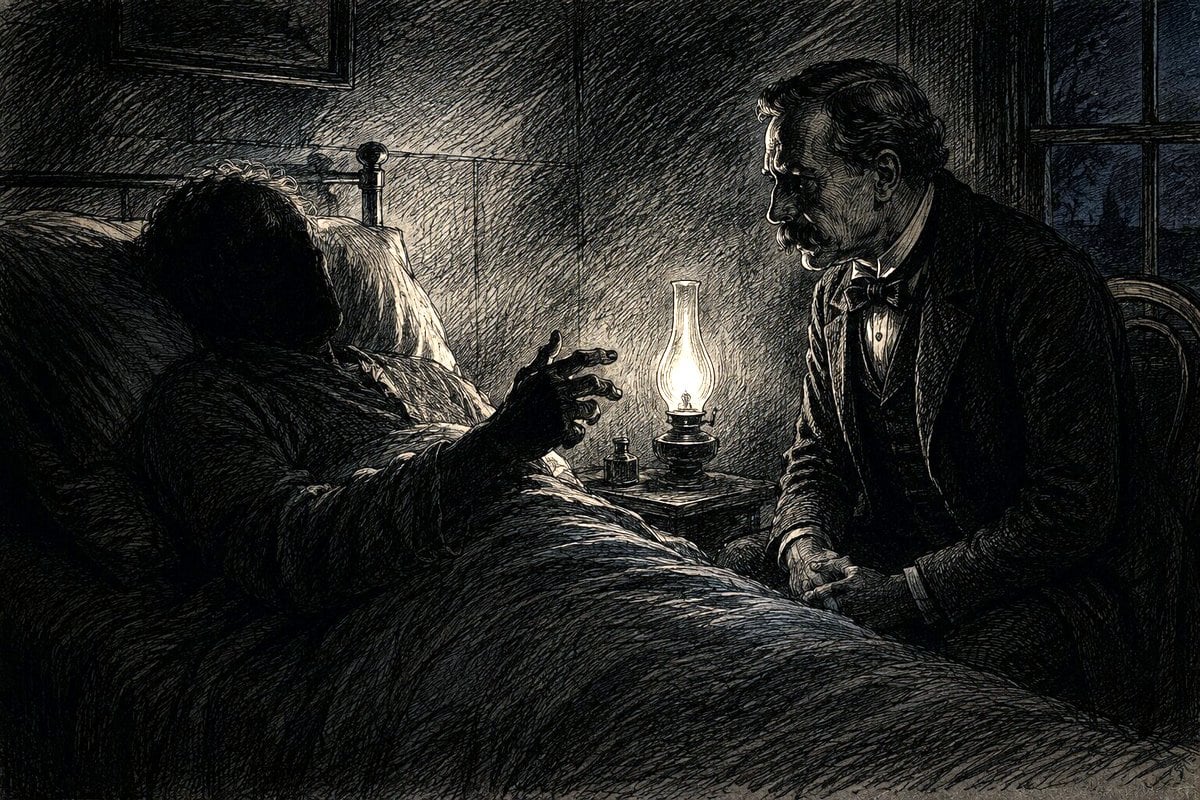
The man reportedly confessed that he—not Estep or Dawson—had murdered Tom Lee over an old grudge. Atkinson kept the confession private during his lifetime, explaining that it lacked legal proof. Only shortly before his own death did he reportedly reveal the story to a reporter for the Charleston Daily Mail.
According to Janet Estep, who reviewed some particulars of the matter in a blog post titled “When Lynch Mobs Ruled.” If true, the confession meant that Dawson had died at the hands of a mob for a crime he never committed.
Perry’s extraordinary stand
For T.S. Perry, the experience left a lasting impression. Years later, while serving as deputy sheriff during another sensational murder case, another mob gathered at the jail, intent on lynching two accused men.
According to accounts published afterward, Perry stood in the jail doorway and refused to move. When the crowd seized the jailer and threatened to hang him, Perry made an astonishing offer.
The jailer, he told the mob, had a sick wife. “My wife is well,” Perry reportedly said. “Take me if you must have a victim.”
The mob placed a rope around Perry’s neck. Then something unexpected happened. His courage—and what one account described as his “winsome eloquence”—changed the mood of the crowd. The mob abandoned the lynching and dispersed.
Although another mob later succeeded in lynching the prisoners after Perry was no longer able to protect them, his willingness to sacrifice his own life remained one of the most extraordinary examples of personal bravery by a West Virginia lawman.
Remembering a forgotten chapter
Perry later became known throughout West Virginia as “Flintlock” Perry, a colorful newspaper editor, printer, and writer whose long career included editing newspapers in Richmond, Louisville, and Charleston.
Yet one of the most remarkable chapters of his life had little to do with journalism. In an era when lynchings were often carried out with little resistance, Perry chose to stand between an angry crowd and defenseless prisoners, even offering his own life in their place.
His story also serves as a reminder of the terrible consequences of mob justice. Whether every detail of the later confession can be fully verified today, the tragedy surrounding the deaths of Estep, Dawson, and Hines underscores a lesson as relevant now as it was then: justice depends on evidence, due process, and the courage of individuals willing to defend both—even when standing alone.
I am 85 yrs old and I love, love WVA. It breaks my heart to think that so many people had to leave this state to find work to support their families. But what else could they do!!!
My family dates back before the Civil War and they have always been proud people. Yes I got teased a lot and called “hillbilly,” but I would always remind them that NO I was not a hillbilly, I was a “mountain-ere.
I have tried to go back to WVA at least once a year but at my age that is coming to an end. But when I die, I will take some of the most wonderful memories with me. And when I wake up in Heaven, yes I will be back in West Virginia.
“But when I die, I will take some of the most wonderful memories with me. And when I wake up in Heaven, yes I will be back in West Virginia.” – quote your sent
Ma’am, you just made me cry and filled my heart. 🥲 I want you to know how deeply your sentiment resonated with me. My own family has a rich history woven into the very fabric of this state, stretching from the Potomac & Shenandoah Rivers confluence to the Ohio River and Tug Fork. We have traced our lineage here to before the Revolutionary War, working through the coal mines and serving in our state government. Like you, West Virginia is my first love. You spoke for so many of us who carry these mountains in our souls. Thank you for your fierce pride, for sharing your memories, for reminding us all what it truly means to be a Mountaineer, and why our people are so special. I hope you feel the love of the hills wrapping around you today.
Rufus Estep was my great great uncle. Tom Lee was not murdered on Christmas Eve. It was Christmas night. Check the death record, the sheriff’s report or the newspapers that reported it at the time. Flintlock Perry earned his name when the mob tried to take take Estep and Dawson from the jail not years later. I have documentation other than the Daily Mail article that pretty much proves that Estep and Dawson did not murder Tom Lee. It would be great if you could do a follow-up to include this information.