
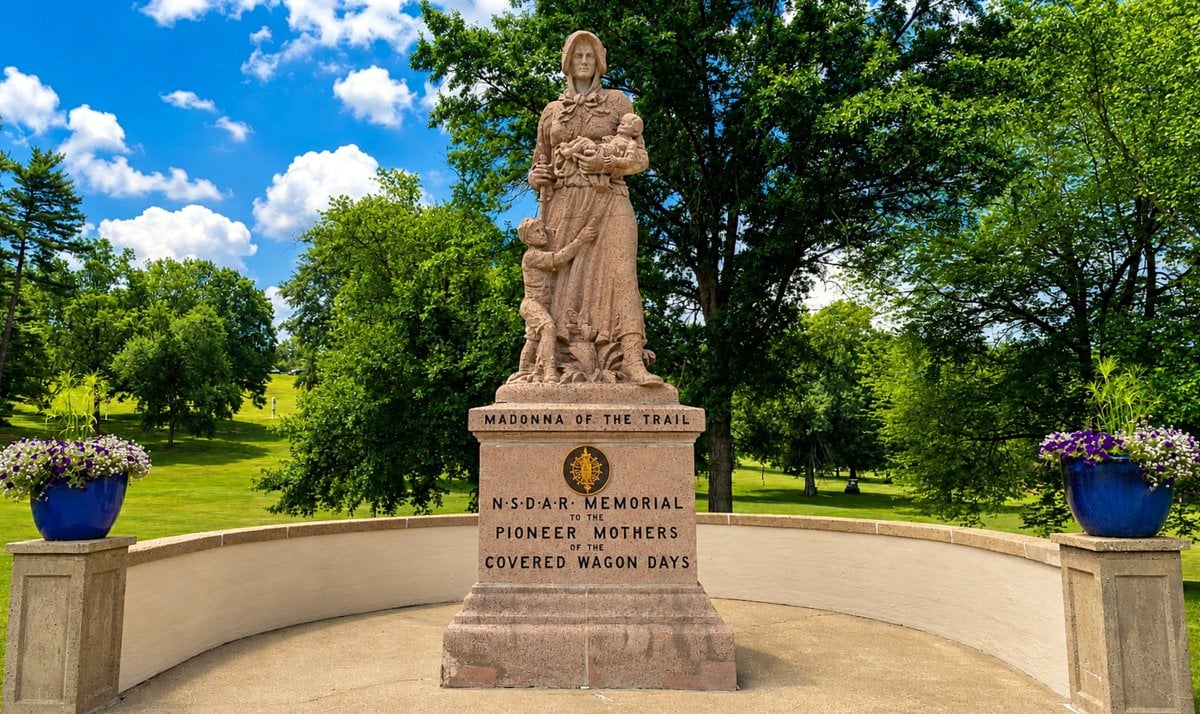
WHEELING, W.Va. — Thousands of motorists pass it every day along the historic National Road. Many may glance up, see a stone woman carrying a child, and keep driving without realizing they’re looking at one of the nation’s most significant memorials to America’s frontier.
Standing at the entrance to Wheeling Park along U.S. Route 40, the Madonna of the Trail honors the courage, sacrifice, and endurance of the women who helped settle the American frontier. It is one of only 12 identical monuments erected across the United States, each marking a state through which the historic National Old Trails Road once passed.
For West Virginia, the monument holds added significance. Before wagon trains reached the plains and deserts of the West, many pioneers crossed the Appalachian Mountains through Wheeling. In the early 1800s, the city became the western terminus of the National Road—the nation’s first federally funded highway—and one of the busiest gateways to the frontier. Every family traveling west passed through here.
A Tribute To Pioneer Mothers
Commissioned by the National Society of the Daughters of the American Revolution in the late 1920s, the monument commemorates the women who endured the hardships of westward expansion.
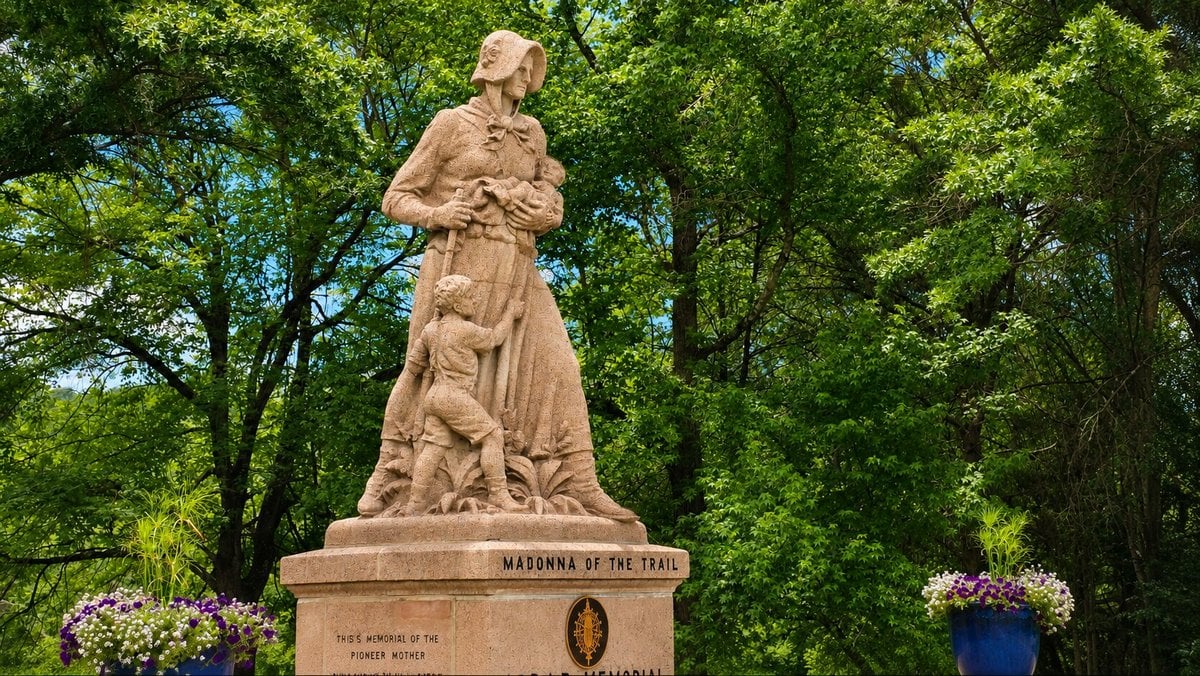
Rather than portraying a romanticized frontier heroine, sculptor August Leimbach created a determined figure whose expression reflects exhaustion as much as hope. She cradles an infant in one arm. She carries a rifle in the other. A young boy clings to her skirts.
The message is unmistakable: frontier women were expected to nurture their children while defending their families and helping build new communities.
That enduring message is one reason the monument continues to resonate nearly a century after its dedication.
“The monument is very important,” said Jeanne Finstein, president of Friends of Wheeling and a member of the Wheeling Chapter of the Daughters of the American Revolution. “It tells the tale of an aspect of westward expansion that might otherwise be forgotten.”

Unlike military monuments honoring famous generals or politicians, the Madonna recognizes ordinary women whose names rarely appeared in history books but whose labor made settlement possible.
Dedicated before thousands
Wheeling’s statue was unveiled on July 7, 1928, during one of the city’s largest civic celebrations of the era.
An estimated 5,000 people attended the dedication ceremony at Wheeling Park, where DAR officials described the monument as a memorial to the pioneer mothers whose perseverance helped shape the nation.
The ceremony underscored Wheeling’s importance in American transportation history. As the western end of the National Road, the city had served for decades as a gateway where eastern travelers prepared to continue their journey into the Ohio Valley and beyond.
One of only twelve
Many visitors assume Wheeling’s monument is unique, though it is part of a series stretching from Maryland to California, following the route of the National Old Trails Road—a transcontinental highway created before the Interstate system and largely following the National Road and later portions of U.S. Route 40. Each state received an identical statue.
West Virginia’s Madonna overlooks the 16-mile section of the historic National Road that crosses the state’s Northern Panhandle, one of the shortest—but historically most important—segments of the famous highway.
Where are the other Madonna of the Trail monuments?
Wheeling’s monument is one of just 12 identical Madonna of the Trail statues commissioned by the National Society Daughters of the American Revolution between 1928 and 1929. Together they trace the route of the historic National Old Trails Road, commemorating the women who helped lead their families westward across the United States.
In addition to Wheeling, the monuments stand in:
- Bethesda, Maryland
- Beallsville, Pennsylvania
- Springfield, Ohio
- Richmond, Indiana
- Vandalia, Illinois
- Lexington, Missouri
- Council Grove, Kansas
- Lamar, Colorado
- Albuquerque, New Mexico
- Springerville, Arizona
- Upland, California
Collectively, the monuments form one of the nation’s longest chains of historic memorials, stretching from the East Coast to Southern California and following much of the route that thousands of pioneers traveled during America’s westward expansion.
More than a work of art
Although called the “Madonna,” the figure is not meant as a religious symbol. In this case, the title “Madonna of the Trail” evokes motherhood and sacrifice. The woman wears practical boots rather than elegant shoes. Her clothing is plain, homespun. Her posture is forward, suggesting constant movement rather than rest.
The sculpture is intended to remind viewers that westward expansion depended not only on explorers and soldiers but also on mothers who raised families under extraordinarily difficult conditions.
That enduring symbolism continues to resonate, according to Scott Schenerlein, executive director of Wheeling Heritage.
“The Madonna of the Trail monuments are a symbol of the great role women played in our settlement,” he said. “It is a reminder of the courage and faith still needed today to press on even when the road is rough.”
Modern historians also note that monuments such as the Madonna reflect the values of the 1920s, when Americans often celebrated pioneer settlement while paying far less attention to the experiences of Native peoples displaced as settlers moved west. Today, the statues serve as memorials to frontier women and as reminders of the complex history of American expansion.

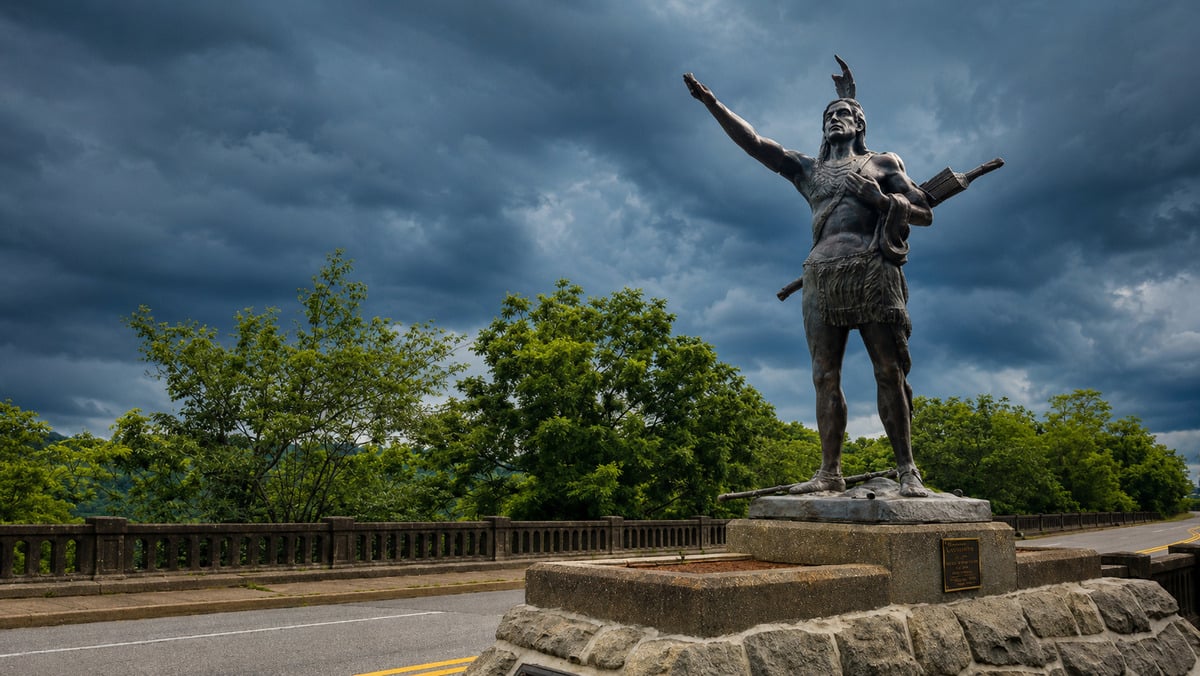
Read more: Before settlers traveled west along the National Road, the Upper Ohio Valley was home to Native nations whose history is still reflected in Wheeling today. Learn the story behind Wheeling’s Mingo statue and the people it was created to honor.
A landmark worth stopping for
Today, the Madonna of the Trail remains one of Wheeling’s best-known landmarks and a contributing feature of the National Road Corridor Historic District. Yet many travelers still pass by without recognizing its national significance.
For those exploring the historic National Road, the monument offers more than a photo opportunity. It tells the story of the families who crossed the mountains through Wheeling, carrying everything they owned—and of the women whose determination was often as essential to America’s westward growth as the road beneath their feet.
A community effort to preserve history
Nearly 100 years after its dedication, the Madonna of the Trail remains one of Wheeling’s best-maintained historic monuments.
Finstein said members of the Daughters of the American Revolution help care for the monument by maintaining seasonal flower plantings, while the grounds crew at Wheeling Park keeps the surrounding landscape trimmed and the flowers watered.
Their efforts ensure that one of the city’s most recognizable landmarks continues to welcome visitors traveling the historic National Road.
Visitors to the Madonna of the Trail can easily make it part of a day exploring Wheeling’s rich history. Just minutes away are the historic Wheeling Suspension Bridge, Wheeling Centre Market, and Oglebay Park, along with museums, shops, restaurants, and attractions that celebrate the city’s role in the settlement of the Ohio Valley.
For trip ideas, lodging, events, and additional historic sites, visit the Visit Wheeling tourism website.