
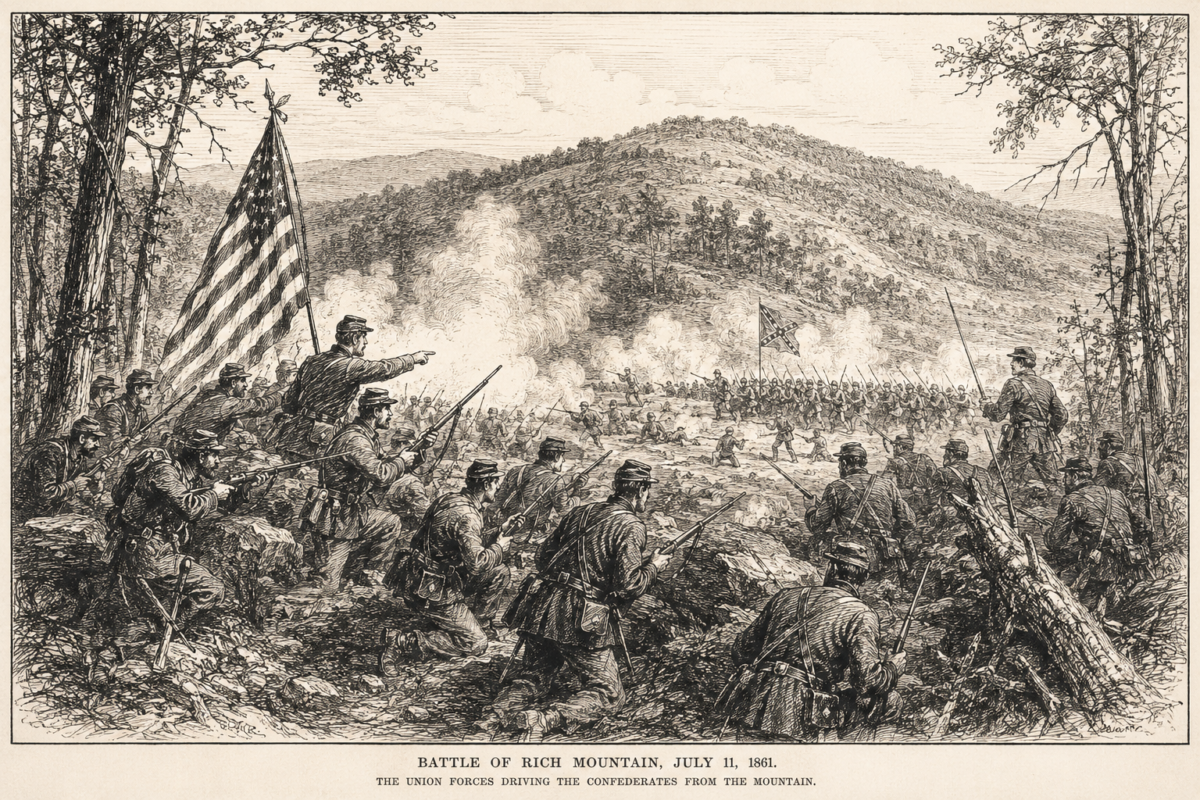
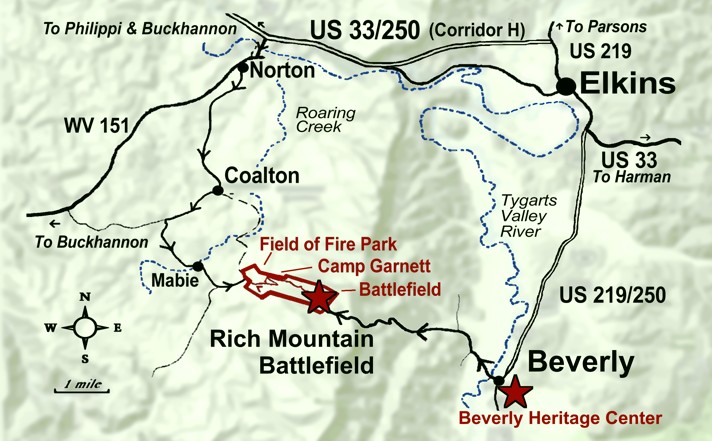
The Rich Mountain Battlefield preserves the site of one of the Civil War’s earliest and most consequential engagements, where Union forces secured a victory that helped determine the future of western Virginia and ultimately contributed to the creation of West Virginia. Located along U.S. 250 west of Beverly, the 215-acre historic site protects portions of the mountain crest where the fighting occurred, as well as the location of the Confederate encampment at the western foot of Rich Mountain.
One of the Civil War’s first major battles
The Battle of Rich Mountain was fought on July 11, 1861, less than three months after the Civil War began. At the time, Confederate troops occupied Camp Garnett at the western base of Rich Mountain and controlled the strategically important Staunton–Parkersburg Turnpike, one of the principal highways linking Virginia’s Shenandoah Valley with the Ohio River.
Control of the turnpike was essential to both armies. The route carried troops, supplies, and communications across the Allegheny Mountains, making Rich Mountain one of the most strategically significant positions in western Virginia during the war’s opening months.
Union forces under Maj. Gen. George B. McClellan outnumbered the Confederates by more than three to one and possessed superior artillery. Even so, McClellan believed Confederate defenses atop Rich Mountain were stronger than they actually were and considered abandoning the attack.
The battle instead unfolded after David Hart, a 22-year-old local guide, led Union troops under Brig. Gen. William S. Rosecrans took an unguarded mountain route that bypassed the Confederate defenses. Their surprise attack struck the Confederate flank, breaking the defensive line and forcing Southern troops to abandon the mountain.
The Union victory at Rich Mountain, together with the nearby Union success at the Battle of Corrick’s Ford two days later, effectively ended organized Confederate control of much of western Virginia. Those victories helped pave the way for the formation of the Restored Government of Virginia and, ultimately, the admission of West Virginia to the Union in 1863.
Exploring the battlefield
Today, visitors can explore wooded trails that cross portions of the battlefield while interpretive exhibits explain the military campaign, troop movements, and the strategic importance of Rich Mountain. Much of the forest remains remarkably similar to the rugged mountain terrain soldiers encountered in the summer of 1861, allowing visitors to appreciate how steep slopes, dense woodlands, and narrow ridges shaped the battle.
The preserved battlefield extends along the crest of Rich Mountain, where the principal fighting occurred, and includes the site of Camp Garnett at the mountain’s western base. Together, these landscapes provide one of the most complete surviving examples of an early Civil War mountain battlefield in Appalachia.

The battlefield is managed for both historic preservation and public recreation, offering opportunities to learn about one of West Virginia’s defining Civil War engagements while experiencing the scenic Allegheny Highlands that made the battle so difficult to fight.
Directions from Beverly
From downtown Beverly, travel west on U.S. 250 (the historic Staunton–Parkersburg Turnpike) for approximately 7 miles. The entrance to Rich Mountain Battlefield is located on the right near the crest of Rich Mountain. A parking area provides access to interpretive exhibits and hiking trails that explore the battlefield. The drive typically takes about 10 to 15 minutes and follows much of the same mountain route that Union and Confederate forces contested during the Battle of Rich Mountain on July 11, 1861.
Read More
- Tale of Rich Mountain ghosts recalls early Civil War battle in West Virginia
- West Virginia’s hidden mountaintop Civil War sites reveal forgotten campaigns
- The wounded captain who crawled off Rich Mountain
External Links