
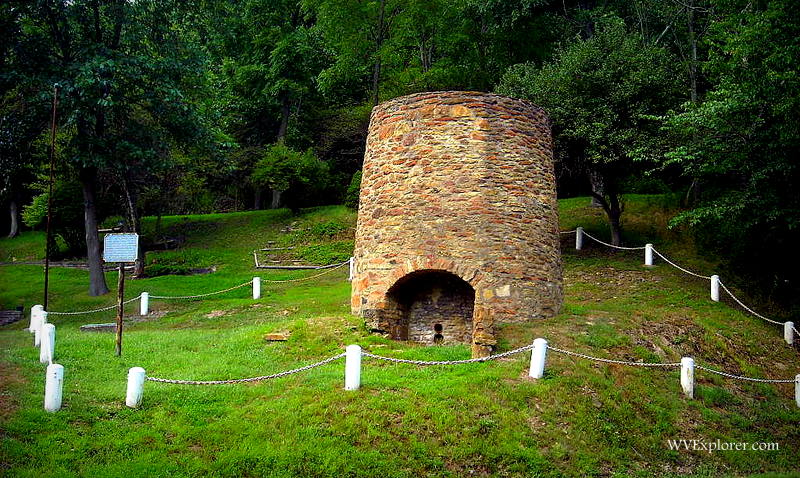
The Peter Tarr Furnace is a reconstructed charcoal blast furnace in Hancock County, West Virginia, believed to be the first successful iron furnace built west of the Allegheny Mountains. Situated along Kings Creek, north of Weirton, the furnace played a significant role in the early industrial development of the upper Ohio Valley, producing iron goods for frontier settlements in the late eighteenth and early nineteenth centuries. Today, it is listed on the National Register of Historic Places and remains one of West Virginia’s oldest surviving industrial landmarks.
History
Ironmaking was among the earliest industries to develop in what is now West Virginia. The region’s abundant hardwood forests, iron ore, limestone, and flowing streams provided nearly everything needed to run charcoal-fired blast furnaces. Before the arrival of railroads and large-scale coal mining, ironworks supplied settlers with essential tools, cookware, hardware, and agricultural implements.
The Peter Tarr Furnace was established in the 1790s along Kings Creek, a tributary of the Ohio River. According to its National Register nomination, the original furnace may have been built by a man identified only as Grant between 1790 and 1794. The property was deeded in 1801 to Peter Tarr and James Rankin, who expanded the operation and transformed it into one of the frontier’s most productive ironworks.
The furnace is widely recognized as the first successful blast furnace west of the Allegheny Mountains, although earlier bloomeries and blast furnaces had operated farther east in present-day West Virginia. Its location near the Ohio River enabled finished products to reach growing settlements throughout the Ohio Valley.
Production
Operating as a charcoal blast furnace, the Peter Tarr Furnace produced about two tons of iron per day. Workers smelted locally mined iron ore with charcoal made from nearby hardwood forests, while limestone served as a flux to remove impurities from the molten metal.
Most of the furnace’s output consisted of everyday household and agricultural items, including:
- Skillets
- Kettles
- Cooking pots
- Fireplace grates
- Farm implements
- General hardware
These products reduced the frontier’s dependence on costly iron goods transported across the Appalachian Mountains.
According to long-standing tradition, the furnace also produced small-diameter cannonballs during the War of 1812. Some accounts claim that these were supplied to Commodore Oliver Hazard Perry’s fleet before the Battle of Lake Erie in 1813. Although the story appears in the National Register nomination and has been repeated in numerous West Virginia histories, historians continue to debate the extent of the surviving documentary evidence supporting the claim.

Design
The Peter Tarr Furnace differed from many early American blast furnaces in its design. The National Register nomination notes that its stack was circular rather than square or rectangular, a relatively uncommon feature for furnaces of its era. Excavations conducted before reconstruction also revealed an oval salamander—the chamber at the base of the furnace where molten iron accumulated before being tapped.
Workers carried alternating layers of charcoal, iron ore, and limestone to the top of the furnace, where the materials were charged into the stack. Air forced into the furnace by water-powered bellows raised temperatures high enough to separate molten iron from the ore. The iron was then cast into molds or poured into pig iron for shipment to downstream ironworks.
Decline
The furnace operated for roughly three decades before ceasing production sometime after 1815. As transportation improved and larger furnaces developed elsewhere, small charcoal operations such as Peter Tarr became less competitive. The stone structure gradually collapsed, burying much of its original foundation under rubble and soil.
Ironmaking, however, continued to expand elsewhere in present-day West Virginia during the nineteenth century. By 1860, charcoal blast furnaces operated in eleven counties, eventually giving way to larger coke-fired furnaces and the steel industry that later made Wheeling and Weirton nationally prominent manufacturing centers.
Reconstruction and preservation
Interest in preserving the Peter Tarr Furnace grew throughout the twentieth century. In 1968, archaeologists investigated the site before reconstructing the furnace. They found that the original circular foundation and the underground salamander remained largely intact beneath the collapsed stonework, allowing the reconstruction to proceed without disturbing the principal archaeological remains. Much of the original stone was incorporated into the rebuilt structure.
Recognizing its importance to the nation’s industrial history, the furnace was listed on the National Register of Historic Places in 1976. The listing cites its significance in commerce, industry, engineering, and military history, noting its contribution to the settlement of the Ohio Valley and its association with the early American iron industry.
Visiting
The Peter Tarr Furnace sits along Kings Creek Road in northern Hancock County, about 1½ miles east of West Virginia Route 2 and a short drive north of Weirton. The reconstructed furnace stands in a small roadside park maintained by Hancock County and is open to the public.
Interpretive markers describe the site’s history and its role in the development of the early American frontier. Although modest in scale, the furnace remains one of the best-preserved reminders of West Virginia’s earliest industrial heritage and offers visitors a chance to explore the beginnings of the state’s iron and steel tradition.
For more information on visiting the furnace and nearby historical attractions, contact the Top of West Virginia Convention and Visitors Bureau.
Legacy
The Peter Tarr Furnace marks the start of large-scale iron production west of the Allegheny Mountains and the rise of manufacturing in the upper Ohio Valley. Its success proved the region had the natural resources to sustain heavy industry—a legacy that culminated in the ironworks of Wheeling, the steel mills of Weirton, and West Virginia’s rise as one of America’s foremost steel-producing states.
More than two centuries after molten iron last flowed from its hearth, the Peter Tarr Furnace remains a tangible reminder that West Virginia’s industrial story began not with coal but with iron.
Read Also: Why the Peter Tarr Furnace is one of West Virginia’s most important historic landmarks